

If you need another way to say let me know your thoughts, try I’d appreciate your feedback, I welcome your input, please share your perspective, I’d value your opinion, or what do you think? The best alternative depends on whether you want to sound professional, formal, friendly, or casual.
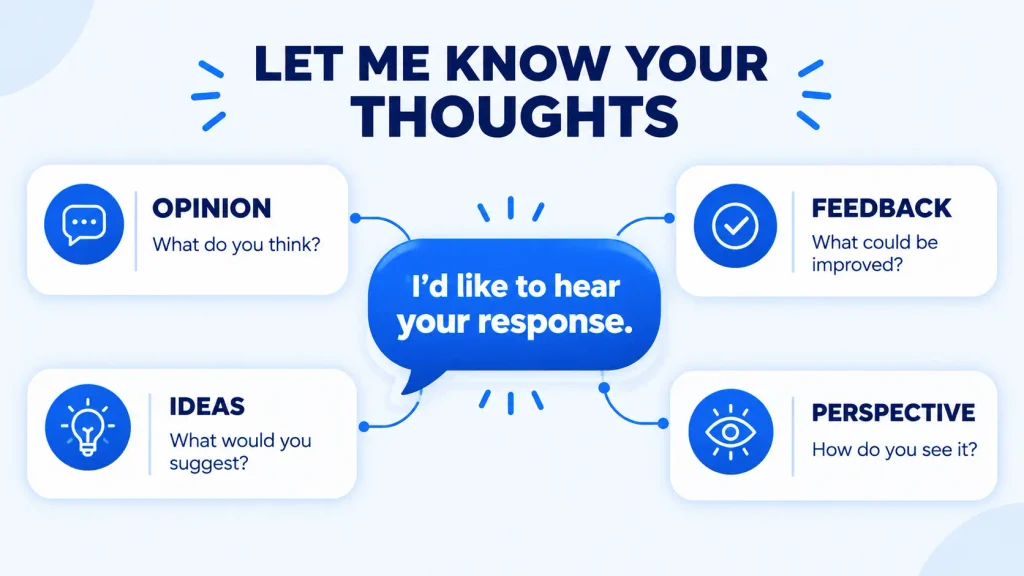
“Let me know your thoughts” is a polite way to ask someone for their opinion, feedback, ideas, or reaction to something. It is commonly used after sharing a proposal, document, idea, plan, or personal question.
For example, you might write, “I’ve attached the revised proposal. Let me know your thoughts.” The sentence tells the reader that you want their response without making the request sound demanding.
The phrase works in emails, workplace conversations, messages, meetings, and everyday communication. However, the best wording can change depending on your relationship with the reader and the type of response you want. Current usage guides similarly describe the phrase as a common way to invite feedback in both professional and casual settings.
“Let me know your thoughts” is perfectly natural, but using alternatives can make your communication more specific and less repetitive. The right phrase can also tell the reader exactly what kind of response you want.
Using alternatives can help you:
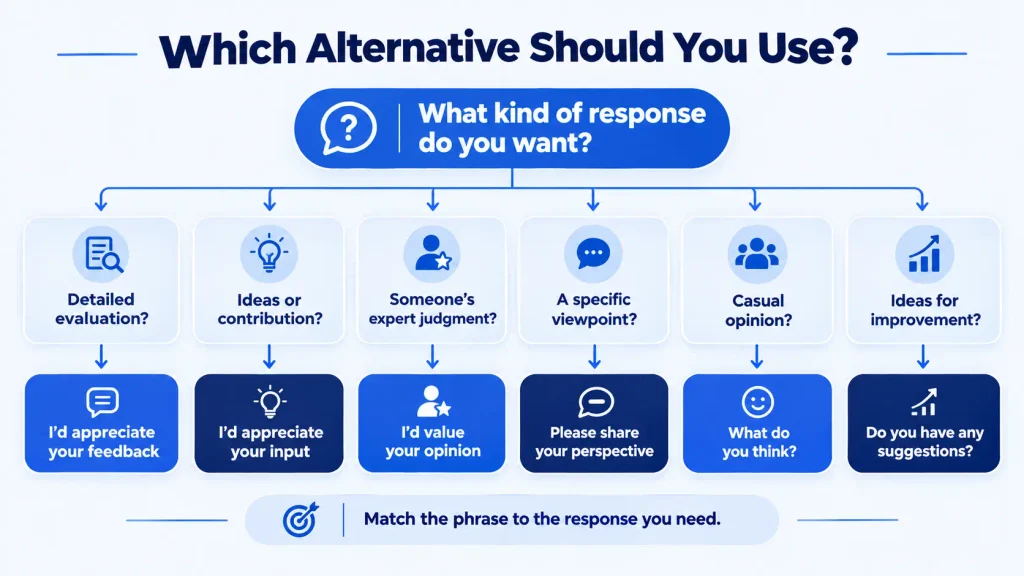
For example, “I’d appreciate your feedback” clearly asks for evaluation, while “I’d value your opinion” places more emphasis on the person’s judgment.
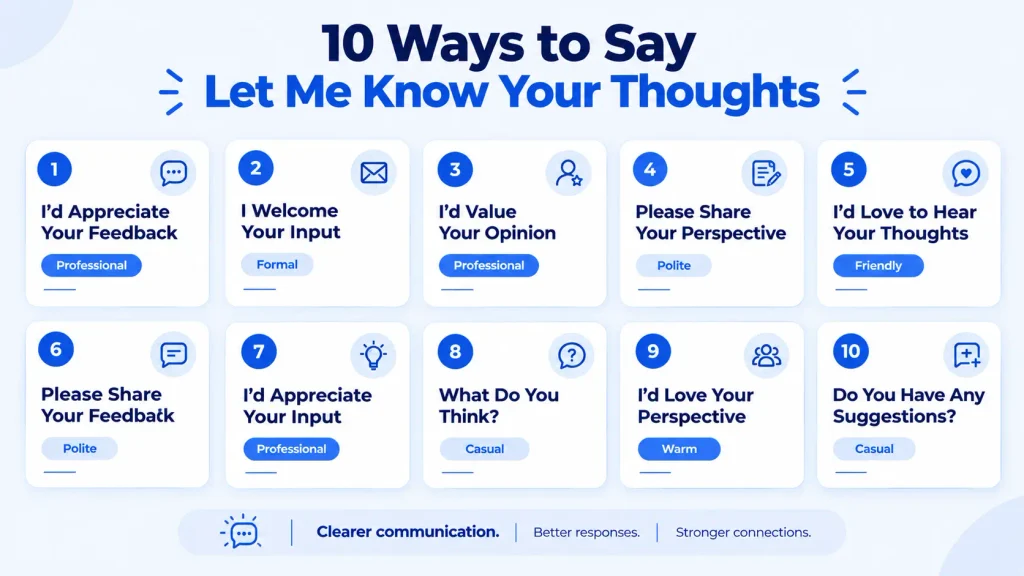
“I’d appreciate your feedback” is a polite and professional way to ask someone to review something and share their response. It works especially well when you want useful comments, suggestions, or an evaluation.
I’d appreciate your feedback on the revised marketing proposal before Friday.
I’d appreciate your feedback on the presentation so I can make the final changes.
Use this when you want specific feedback, rather than simply asking whether someone likes an idea.
“I welcome your input” shows that you are open to another person’s ideas, suggestions, or expertise. It creates a collaborative tone without making the request sound demanding.
I welcome your input as we finalize the team’s project priorities.
I welcome your input on the proposed changes to our customer service process.
This phrase works particularly well when you want to make the other person feel that their contribution can influence the outcome.
“I’d value your opinion” communicates that the other person’s judgment matters to you. It is a thoughtful alternative when you are asking someone with relevant experience or knowledge.
I’d value your opinion on whether this approach makes sense for our clients.
I’d value your opinion before we decide which proposal to present.
Use this when the person’s experience, judgment, or perspective is especially relevant.
“Please share your perspective” asks someone to explain how they see or understand an issue. It sounds professional while encouraging a more thoughtful response than a simple yes-or-no answer.
Please share your perspective on the challenges facing the new team.
Please share your perspective on how we can improve the onboarding process.
Choose this when you want to hear someone’s point of view, especially on a complex topic.
“I’d love to hear your thoughts” is warm and inviting without being overly formal. It keeps the original meaning but makes the request feel more conversational and personal.
I’d love to hear your thoughts on the new design when you have a chance.
I’d love to hear your thoughts about the changes we discussed yesterday.
This is a good choice for colleagues and professional contacts when you want to sound approachable rather than overly formal.
“Please share your feedback” is direct, clear, and professional. Unlike the broader phrase “your thoughts,” it specifically tells the reader that you want comments or an evaluation.
Please share your feedback on the draft before we send it to the client.
Please share your feedback after you have reviewed the training materials.
Use this when the recipient has been asked to review something specific.
“I’d appreciate your input” politely asks someone to contribute ideas, advice, or information. It has a collaborative tone and is especially natural in workplace communication.
I’d appreciate your input on the proposed timeline for the project.
I’d appreciate your input before we finalize the hiring plan.
Use input when you want the person’s contribution to help shape a decision or plan.
“What do you think?” is one of the simplest ways to ask for an opinion. It sounds natural and conversational, making it a good choice for friends, coworkers, and informal discussions.
I’m thinking about moving the meeting to Thursday. What do you think?
I changed the opening paragraph to make it shorter. What do you think?
Use this in relaxed situations, but choose a more polished option for formal client or executive communication.
“I’d love your perspective” invites someone to share their particular viewpoint or experience. It can sound warm while still being appropriate in many professional situations.
I’d love your perspective on how we can make the training more engaging.
I’d love your perspective on the challenges we should address before launch.
This phrase is especially useful when you are asking someone because of their experience or specialized knowledge.
“Do you have any suggestions?” asks the reader to recommend changes, solutions, or improvements. It is more specific than “let me know your thoughts” when you are actively looking for ideas.
We want to make the checkout process easier. Do you have any suggestions?
I’m revising the presentation this weekend. Do you have any suggestions for improving it?
Use this when you want actionable ideas, rather than a general opinion.
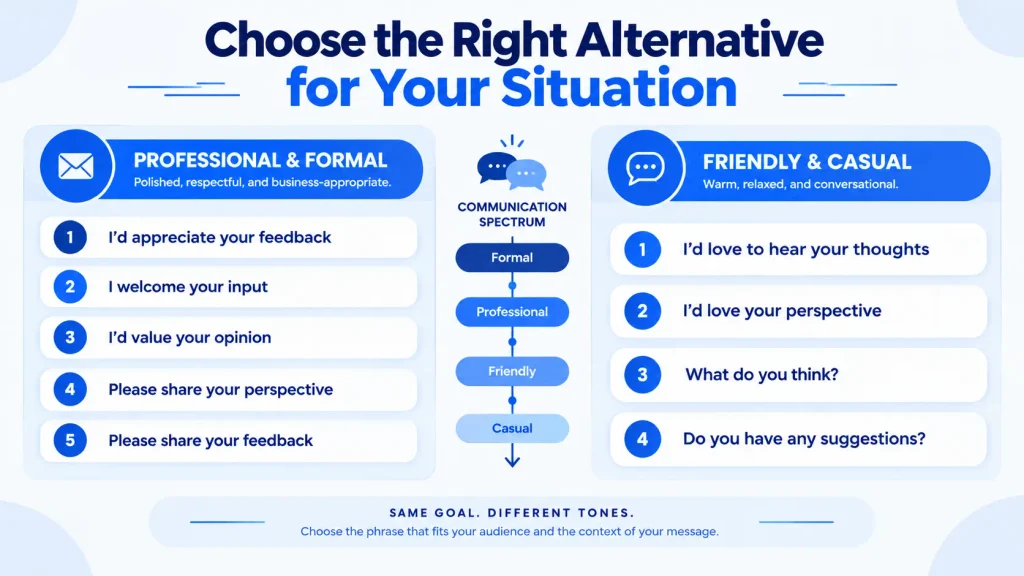
| Alternative | Best Used In | Tone |
| I’d appreciate your feedback | Professional emails, reviews | Professional/Formal |
| I welcome your input | Team decisions, collaboration | Professional |
| I’d value your opinion | Advice and important decisions | Formal/Warm |
| Please share your perspective | Discussions and workplace topics | Formal/Professional |
| I’d love to hear your thoughts | Emails and friendly work conversations | Warm/Friendly |
| Please share your feedback | Reviews and document feedback | Professional/Polite |
| I’d appreciate your input | Projects and planning | Professional |
| What do you think? | Casual conversations | Casual/Friendly |
| I’d love your perspective | Advice and experience | Warm/Professional |
| Do you have any suggestions? | Problem-solving and improvements | Polite/Casual |
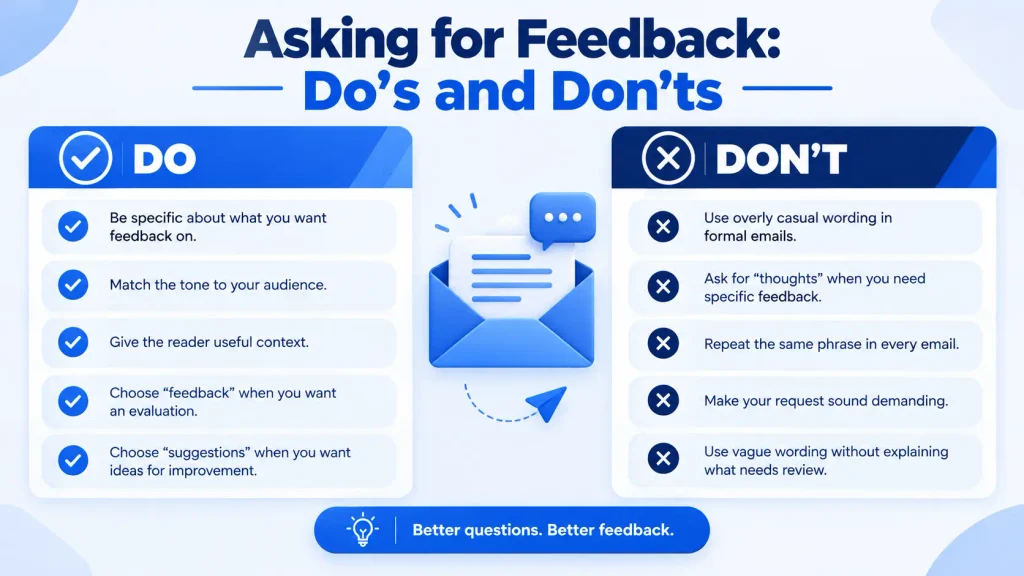
“What do you think?” is natural, but it may feel too casual when addressing a senior executive, client, or external stakeholder. In those situations, “I’d appreciate your feedback” may fit better.
“Thoughts” can mean almost anything from a quick reaction to detailed criticism. If you need an evaluation of a document, “Please share your feedback” makes your request clearer.
A sentence such as “I’d love your thoughts” does not tell the reader what they should consider. Mention the specific document, decision, idea, or section you want them to address.
Using “let me know your thoughts” at the end of every email can make your writing feel repetitive. Rotate between natural alternatives based on the response you actually need.
Avoid phrases that pressure the reader unnecessarily, especially when you have not provided a deadline. A polite request such as “I’d appreciate your feedback when you have a chance” gives the recipient reasonable flexibility.
Yes. “Let me know your thoughts” is generally polite and professional, especially in workplace emails and discussions. However, it can be somewhat broad. If you need a specific type of response, phrases such as “I’d appreciate your feedback” or “Do you have any suggestions?” can make your request clearer.
“I’d appreciate your feedback” is a strong professional option. Other choices include “I welcome your input,” “I’d value your opinion,” and “Please share your perspective.” The best phrase depends on whether you want feedback, ideas, advice, or a person’s broader viewpoint.
You can say “I’d value your opinion,” “I’d appreciate your input,” or “I’d love to hear your thoughts.” Each phrase invites an opinion without sounding demanding. For a formal situation, “I’d value your opinion” can sound especially respectful while remaining natural.
Be specific about what you want reviewed and use a polite request. For example, instead of simply writing “Let me know your thoughts,” say, “I’d appreciate your feedback on the attached proposal before we finalize it.” This tells the reader exactly what you need and why.
You can use “I’d appreciate your feedback,” “What are your thoughts?” “I welcome your input,” “I’d value your opinion,” or “Please share your perspective.” For casual conversations, “What do you think?” is simple and natural. The right choice depends on your audience and purpose.
Yes. “I’d love to hear your thoughts” can work well in professional communication, particularly with colleagues, team members, and familiar business contacts. It sounds warmer and more conversational than “I’d appreciate your feedback,” so a more formal option may be preferable for highly formal correspondence.
“Thoughts” is broad and can refer to opinions, reactions, or ideas. “Feedback” usually suggests an evaluation or comments intended to help improve something. If you are asking someone to review a draft, presentation, or project, feedback often communicates your purpose more clearly.
Choose an ending that matches the type of response you want. For general input, try “I’d love to hear your thoughts.” For professional feedback, use “I’d appreciate your feedback.” If you want recommendations, “Do you have any suggestions?” is more specific and actionable.
Knowing another way to say let me know your thoughts gives you more flexibility when writing emails, messages, and workplace communication. The original phrase is polite and useful, but different situations may call for more precise wording.
Use “I’d appreciate your feedback” when you want an evaluation, “I welcome your input” when you want someone to contribute to a decision, and “I’d value your opinion” when their judgment matters. For a warmer tone, “I’d love to hear your thoughts” works naturally, while “What do you think?” is better suited to casual conversations.
The key is to match the phrase to your purpose. Instead of asking for “thoughts” when you need specific suggestions or feedback, choose words that clearly communicate what you want from the reader.

Our editorial team brings together decades of expertise in applied linguistics, lexicography, and educational publishing. Dedicated to clarity, precision, and tone, our experts ensure that every resource meets the highest standards of professional and academic excellence.