

Looking for another way to say checking in? Try following up, touching base, circling back, reaching out, checking on, or seeing how things are going. For professional emails, “following up” is clear and direct, while “touching base” and “circling back” sound friendly and conversational. Choose the phrase that matches your purpose and tone.
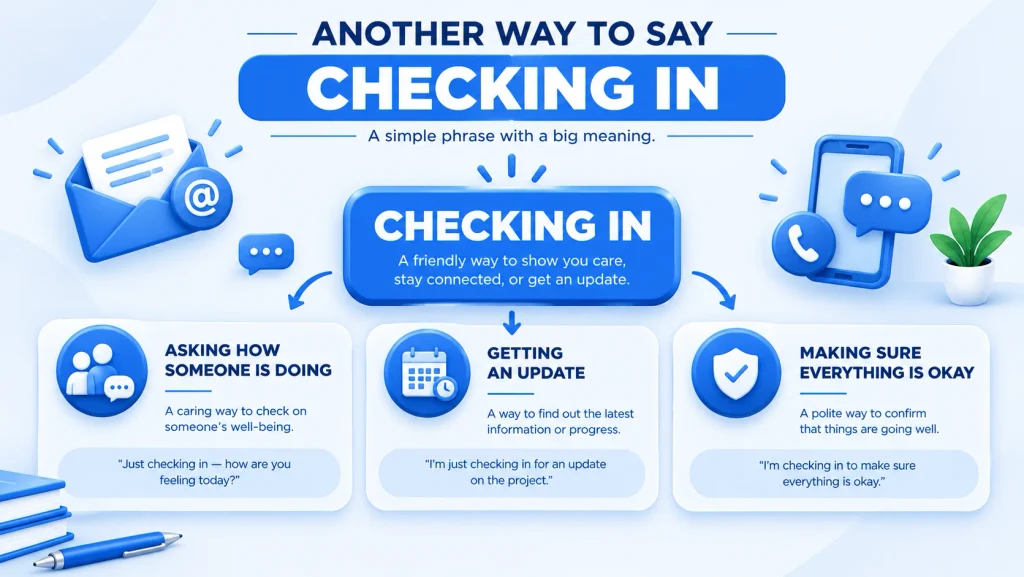
“Checking in” can mean contacting someone to see how they are doing, make sure everything is okay, or ask about the status of something. Cambridge defines the contact sense of “check in” as contacting someone by phone, visit, or another method to make sure there are no problems or to tell them there are no problems.
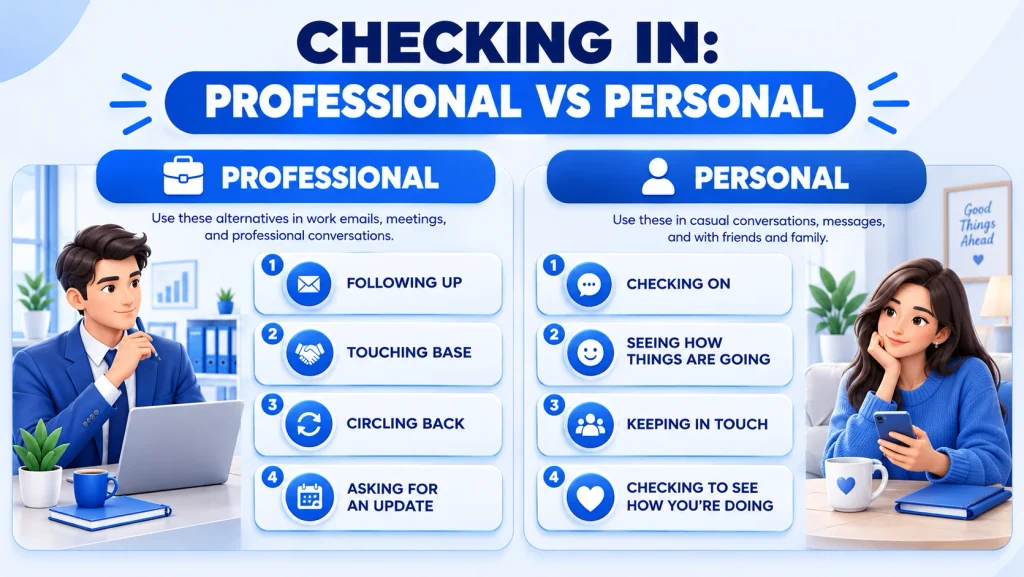
In everyday conversation, you might check in with a friend after a difficult week. In professional communication, “checking in” often refers to following up on an email, project, request, meeting, or pending decision.
The phrase is useful because it sounds relatively friendly and low-pressure. However, in work emails, a vague “just checking in” can sometimes hide the actual purpose of your message, so a more specific alternative may make your communication clearer.

Using different expressions can make your communication more specific and natural. Instead of repeating “checking in,” choose words that explain exactly why you are contacting someone.
For professional follow-ups, current business-writing guidance commonly recommends stating the purpose of the message instead of relying on a generic “just checking in.”
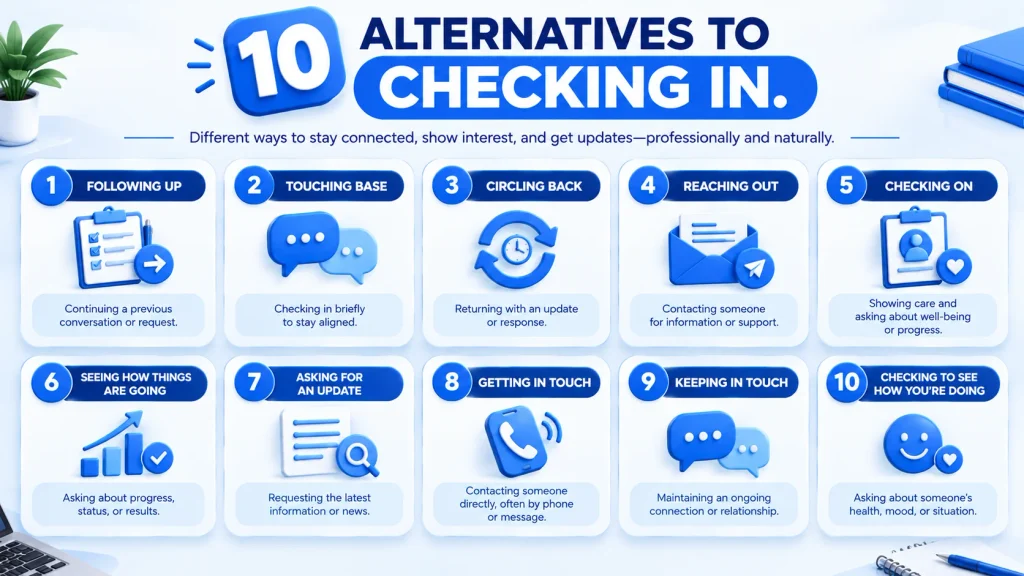
“Following up” means contacting someone again about a previous conversation, request, email, or action. It is one of the clearest alternatives when you need a response or update.
“I’m following up on the proposal I sent last Tuesday.”
“I wanted to follow up regarding the documents you requested.”
Use “following up” when the recipient already has context and you need to continue an earlier conversation.
“Touching base” means briefly contacting someone to exchange information, discuss progress, or stay connected. It has a friendly workplace tone and is common in professional conversations.
“I wanted to touch base before our meeting tomorrow.”
“Let’s touch base next week and review the project timeline.”
Use this when you want your message to sound collaborative rather than demanding.
“Circling back” means returning to a previous topic, conversation, or request. It is especially common in workplace emails when some time has passed since the original discussion.
“I’m circling back on our conversation about the hiring timeline.”
“I wanted to circle back and see whether you had any questions about the proposal.”
This works best when you are reopening an existing discussion rather than starting a completely new topic.
“Reaching out” means contacting someone for a particular reason. It is broad enough for networking, workplace communication, customer service, and personal conversations.
“I’m reaching out to see if you need any additional information.”
“I wanted to reach out after our meeting and thank you for your time.”
Add the reason for contacting the person immediately after “reaching out” to make your message more specific.
“Checking on” focuses on making sure a person, situation, task, or issue is okay. It can sound more caring than a simple business follow-up.
“I just wanted to check on you after hearing about the storm.”
“I’m checking on the order to make sure everything is still on schedule.”
Use “checking on” when your main goal is to make sure something or someone is doing well.
“Seeing how things are going” is a warm and conversational alternative to “checking in.” It is useful when you want a general update without making the conversation feel like a formal request.
“I wanted to see how things are going with your new job.”
“Just wanted to see how things are going with the renovation.”
This phrase is especially natural when you care about someone’s experience rather than needing one specific piece of information.
“Asking for an update” directly states that you want current information about a project, request, task, or situation. It removes the vagueness that can come with “just checking in.”
“I’m writing to ask for an update on the application.”
“Could you provide an update on the revised schedule?”
Choose this when getting current information is the main purpose of your message.
“Getting in touch” means contacting or communicating with someone. It can work in both professional and personal situations, especially when you want a natural alternative to “checking in.”
“I wanted to get in touch about the upcoming conference.”
“It was great getting in touch again after all these years.”
Pair it with a clear purpose when writing professionally so the recipient knows why you contacted them.
“Keeping in touch” focuses on maintaining communication over time. Unlike “following up,” it does not necessarily suggest that you need an update or response about a specific matter.
“It was wonderful seeing you again, and I hope we can keep in touch.”
“We’ve moved to different cities, but we still keep in touch regularly.”
Use this when maintaining a relationship is more important than discussing a particular task or request.
“Checking to see how you’re doing” is a warm, direct way to ask about someone’s well-being. It is more personal than professional follow-up phrases and works naturally when you genuinely care about someone.
“I wanted to check to see how you’re doing after your move.”
“I’m checking to see how you’re doing and whether you need anything.”
Use this when the focus is the person’s well-being rather than a work task or pending request.
| Alternative | Best Used In | Tone |
| Following Up | Emails, requests, projects | Professional, direct |
| Touching Base | Workplace conversations | Friendly, professional |
| Circling Back | Previous discussions | Professional, polite |
| Reaching Out | Emails, networking, communication | Professional, friendly |
| Checking On | People, tasks, situations | Warm, caring |
| Seeing How Things Are Going | Personal conversations, informal updates | Friendly, warm |
| Asking for an Update | Projects, applications, requests | Professional, direct |
| Getting in Touch | Personal and professional contact | Friendly, neutral |
| Keeping in Touch | Relationships and ongoing communication | Warm, friendly |
| Checking to See How You’re Doing | Personal well-being | Warm, caring |
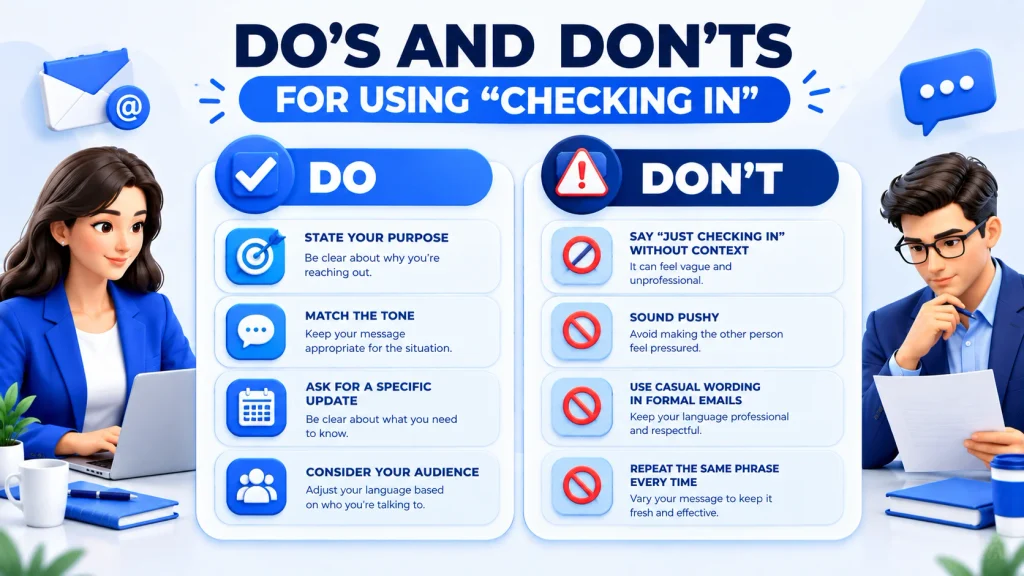
A message that only says “just checking in” may leave the recipient wondering what you need. In professional communication, explain the purpose early, such as asking for an update or following up on a specific request.
Expressions such as “seeing how things are going” can sound natural with a colleague but may be too informal for certain business situations. When writing to a client or making a formal request, “following up” or “asking for an update” may be clearer.
“Following up” usually suggests a previous request or conversation. If you are simply asking a friend how they are doing, “checking on you” or “seeing how things are going” sounds more personal.
Using “just checking in” repeatedly can make your emails feel generic. Vary your wording based on your actual purpose: follow up on a request, ask for an update, share new information, or reconnect with someone.
A check-in should not make the recipient feel pressured unnecessarily. Keep the tone respectful and explain what you need rather than sending repeated vague reminders.
Common alternatives include “following up,” “touching base,” “circling back,” “reaching out,” “checking on,” and “getting in touch.” The best choice depends on your purpose. For a professional email about a pending request, “following up” is usually clear. For a personal message, “checking on you” may sound warmer.
“Following up” is one of the most straightforward professional alternatives. You can also say “I’m reaching out regarding,” “I wanted to ask for an update,” or “I’m following up on.” These phrases make the purpose of your email clearer than a vague “just checking in.”
Yes. “Checking in” is commonly used in professional communication, especially for follow-ups and status updates. However, a more specific opening can make the email clearer. Instead of “Just checking in,” explain what you need, such as an update, decision, confirmation, or response.
Try “I’m following up on,” “I wanted to ask for an update on,” “I’m reaching out regarding,” or “I wanted to circle back on.” These alternatives communicate the reason for the email more directly and can help the recipient understand what response you need.
They are similar, but not always identical. “Touching base” usually suggests a brief conversation or exchange of information, often in a workplace. “Checking in” can also mean asking about someone’s well-being or making sure everything is okay, so its meaning can be more personal.
For a friend, you can say “I wanted to see how you’re doing,” “I just wanted to check on you,” or “I wanted to see how things are going.” These phrases sound warmer and more personal than workplace expressions such as “following up” or “circling back.”
For work emails, useful alternatives include “following up,” “touching base,” “circling back,” and “asking for an update.” If you need a response to a specific task, state that task directly. Current business-writing guidance generally favors clear context and a specific purpose over a generic follow-up opener.
Yes. “Circling back” is widely used in workplace communication when you want to return to a previous discussion or request. It has a somewhat conversational business tone, so it works well with coworkers and professional contacts. For highly formal writing, a simpler phrase such as “following up on” may be more direct.
Finding another way to say “checking in” helps you make your communication more specific and natural. The phrase itself is useful because it can describe both a personal check-in and a professional follow-up, but the best replacement depends on your purpose.
For workplace emails, “following up,” “asking for an update,” and “circling back” clearly signal that you are continuing an earlier matter. “Touching base” and “reaching out” offer a friendlier professional tone. When talking to friends or checking on someone’s well-being, “checking on,” “seeing how things are going,” and “checking to see how you’re doing” sound warmer.
Before sending your message, ask yourself what you actually need from the conversation. Then choose the phrase that communicates that purpose clearly and naturally.

English Language & Communication Specialist
Dr. Emily Carter is an English language and communication specialist focused on vocabulary, word choice, professional writing, and practical English usage. She helps readers understand the differences between similar words and choose expressions that sound natural, clear, and appropriate for different contexts.