
If you need another way to say “ups and downs,” you can use highs and lows, good and bad times, peaks and valleys, ebb and flow, fluctuations, or challenges and successes. The best choice depends on whether you are talking about life, relationships, work, emotions, or changing circumstances.
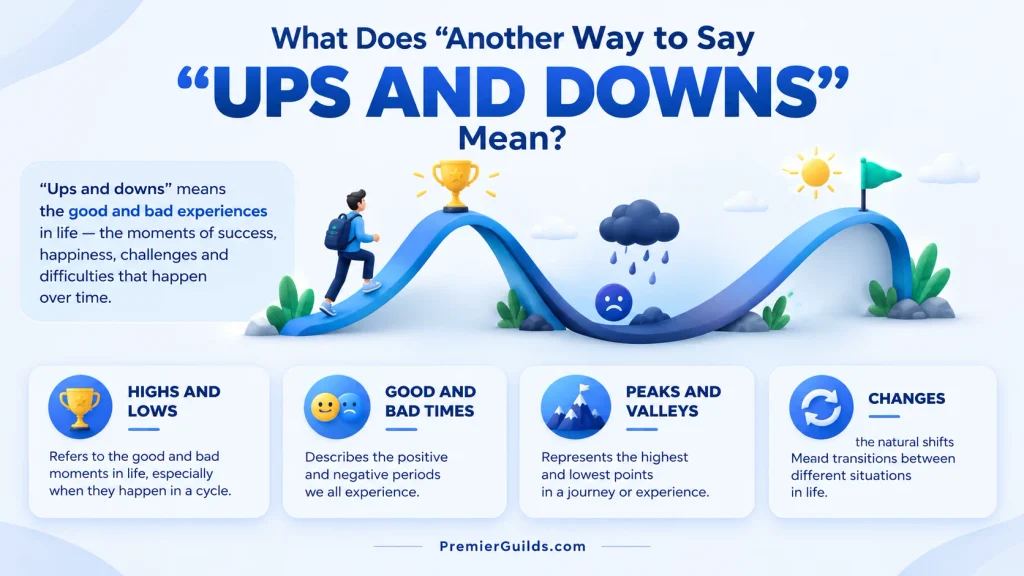
The phrase “ups and downs” describes the good and bad experiences that happen over a period of time. People use it when something is not always positive or negative but changes between better and more difficult periods.
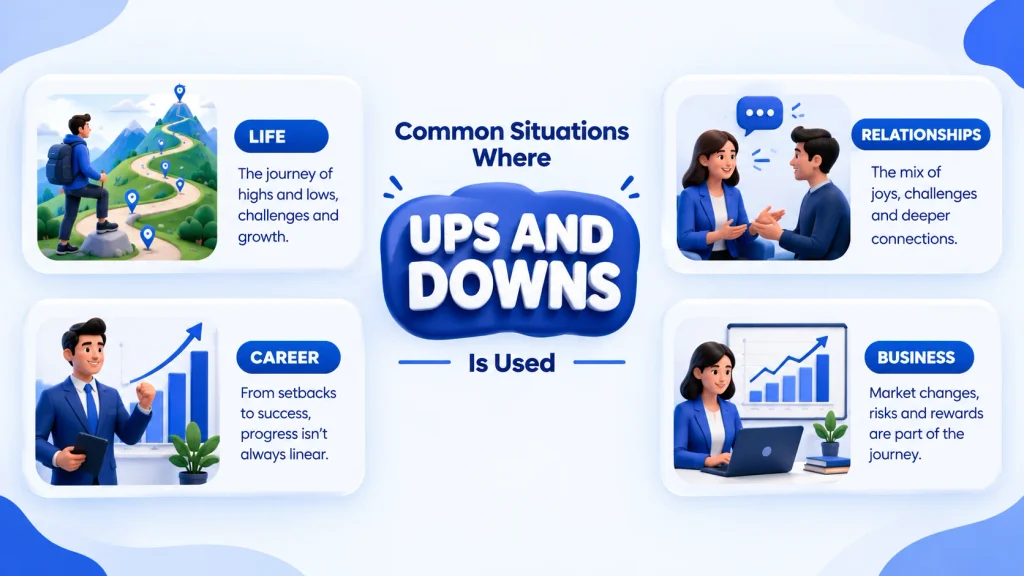
For example, someone might talk about the ups and downs of a relationship, career, business, or personal journey. The phrase can describe emotional experiences, successes and failures, or changing circumstances.
Sometimes, you may want a more specific or polished expression. In those situations, alternatives such as highs and lows, good and bad times, peaks and valleys, or fluctuations can make your meaning clearer.
The right choice depends on what you are describing. A phrase that sounds natural when discussing a relationship may not be the best option for a business report.
Using alternatives can make your writing and conversations more precise and natural.
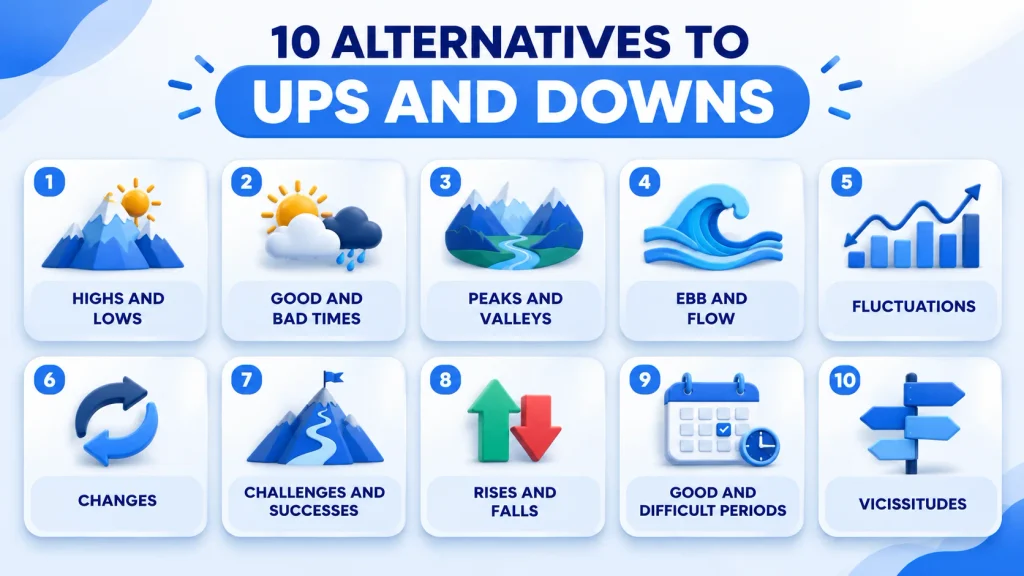
Highs and lows refers to the best and worst moments of an experience. It is one of the closest alternatives to “ups and downs” and keeps the same general meaning.
Every career has its highs and lows, but I have learned something from each experience.
She shared the highs and lows of starting her own business.
Use “highs and lows” when discussing personal experiences, emotions, careers, relationships, or major life events.
Good and bad times is a simple and direct way to describe positive and difficult periods. It is especially useful when you want your sentence to be easy for everyone to understand.
We stayed close through the good and bad times.
The company has experienced good and bad times since it opened.
Choose this phrase when clarity matters more than sophistication.
Peaks and valleys creates a visual image of high and low points. It often suggests that experiences naturally move between periods of success and difficulty.
The entrepreneur’s journey was filled with peaks and valleys.
Our team experienced several peaks and valleys during the season.
This expression works particularly well in reflective writing, speeches, and discussions about long-term journeys.
Ebb and flow describes the way something changes or moves between different levels or states over time. It can suggest a natural pattern of change rather than simply focusing on good and bad experiences.
Customer demand follows a natural ebb and flow throughout the year.
Their friendship continued through the normal ebb and flow of life.
Use “ebb and flow” when you want to emphasize ongoing movement or changing circumstances.
Fluctuations refers to repeated changes, especially increases and decreases. It is more precise and formal than “ups and downs.”
The company adjusted its strategy in response to fluctuations in demand.
Investors closely monitored the fluctuations in the market.
Use “fluctuations” for business, finances, prices, data, performance, or measurable changes.
Changes is a broad and neutral alternative to “ups and downs.” It does not automatically suggest that some periods are good and others are bad, so context may be needed.
The project went through several changes before reaching its final stage.
Life brings many changes, and we learn to adapt along the way.
Choose “changes” when you want neutral wording without emphasizing positive or negative results.
Challenges and successes clearly identifies the two sides of an experience. It is more specific than “ups and downs” because it directly names difficulties and achievements.
Her career has included many challenges and successes.
The team reflected on its challenges and successes after completing the project.
This phrase is excellent for resumes, interviews, professional profiles, speeches, and career discussions.
Rises and falls describes movement between higher and lower levels. It works especially well when discussing performance, numbers, trends, or fortune.
The report examines the rises and falls in consumer demand.
The industry has experienced several rises and falls over the past decade.
Use this phrase when the subject involves measurable or noticeable changes.
Good and difficult periods provides a clear, neutral way to describe contrasting experiences. It sounds more polished than “good and bad times” while remaining easy to understand.
The organization remained focused through good and difficult periods.
They supported each other during both good and difficult periods.
This option works well in professional or sensitive writing where you want to avoid overly casual language.
Vicissitudes is a formal word for changes or variations in circumstances, especially changes that involve both favorable and unfavorable experiences. It is much less common in everyday conversation.
The memoir describes the vicissitudes of a long and unusual career.
The organization survived the vicissitudes of a changing economy.
Use “vicissitudes” sparingly because it sounds literary and formal compared with everyday alternatives such as “highs and lows.”

| Alternative | Best Used In | Tone |
| Highs and Lows | Life, relationships, career | Casual / Warm |
| Good and Bad Times | Everyday conversations | Casual / Friendly |
| Peaks and Valleys | Life journeys, careers, experiences | Warm / Reflective |
| Ebb and Flow | Relationships, trends, changing situations | Formal / Warm |
| Fluctuations | Business, finance, data, markets | Professional / Formal |
| Changes | General situations | Neutral |
| Challenges and Successes | Careers, projects, achievements | Professional / Positive |
| Rises and Falls | Trends, performance, numbers | Formal / Professional |
| Good and Difficult Periods | Professional and personal writing | Polite / Formal |
| Vicissitudes | Literary and highly formal writing | Formal |
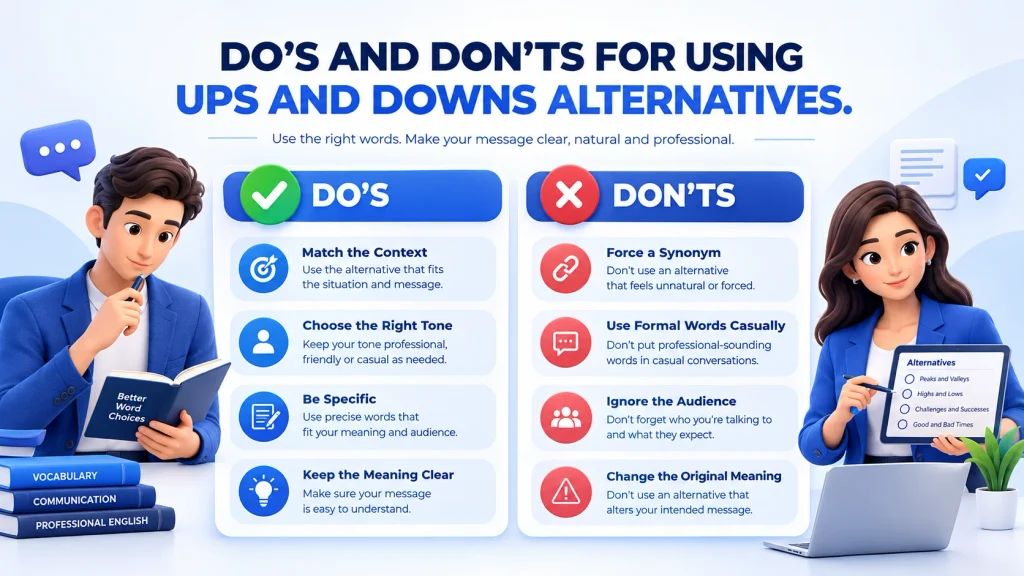
Words such as vicissitudes can sound unnatural in everyday speech. “Highs and lows” or “good and bad times” usually feels more conversational.
Not every synonym carries exactly the same meaning. For example, “changes” can be positive, negative, or neutral, while “challenges and successes” specifically highlights difficulties and achievements.
“Fluctuations” is usually better for measurable or changing conditions such as prices, demand, performance, or data. It may sound too technical when describing a friendship or family experience.
A reflective sentence may benefit from “peaks and valleys,” while a business report may need “fluctuations.” Always consider who will read or hear the sentence.
Repeating the same phrase can make an article or conversation feel predictable. However, do not replace it with a complicated synonym just for variety. Choose the expression that best fits your meaning.
Common alternatives include highs and lows, good and bad times, peaks and valleys, ebb and flow, fluctuations, and challenges and successes. “Highs and lows” is one of the closest choices for everyday English because it preserves the idea of experiencing both positive and negative periods.
Highs and lows is a very natural synonym in everyday American English. It works when discussing relationships, careers, personal experiences, emotions, and life in general. If you need a simpler option, “good and bad times” also communicates the meaning clearly.
For professional writing, consider fluctuations, changes, rises and falls, or challenges and successes, depending on your subject. “Fluctuations” works well for numbers and business conditions, while “challenges and successes” is more appropriate when discussing a person’s career or a team’s performance.
You can say highs and lows of life, peaks and valleys of life, good and difficult periods, or the challenges and successes of life. “Highs and lows” sounds natural and conversational, while “peaks and valleys” gives the sentence a more reflective tone.
For relationships, natural choices include highs and lows, good and bad times, and the ebb and flow of a relationship. “Highs and lows” is especially useful when you want to acknowledge that a relationship has included both happy and difficult moments.
Sometimes. “Fluctuations” is a strong replacement when you are talking about things that rise and fall, such as prices, demand, performance, or market conditions. It is less natural when discussing personal relationships or emotional experiences, where “highs and lows” usually sounds better.
They are very similar, but “peaks and valleys” often creates a stronger image of high and low points over time. It can sound more reflective or expressive than “ups and downs.” The phrase works especially well when discussing a long career, personal journey, or challenging experience.
Vicissitudes is a formal word that can describe changing circumstances, including favorable and unfavorable experiences. However, it is uncommon in everyday American English. In most professional situations, clearer choices such as “fluctuations,” “changes,” or “rises and falls” are easier for readers to understand.
“Ups and downs” is a useful everyday phrase for describing the positive and negative parts of an experience. However, choosing a more specific alternative can make your writing clearer and better suited to the situation.
For everyday conversations, highs and lows and good and bad times are natural choices. For reflective writing, peaks and valleys works well, while ebb and flow emphasizes continuous change. In professional contexts, fluctuations, rises and falls, or challenges and successes may communicate your meaning more precisely.
The key is to consider your subject and audience before choosing a synonym. When in doubt, choose the simplest phrase that accurately expresses what you mean.

Senior English Editor & Stylistics Director
Michael Bennett is a veteran editor, lexicographer, and publishing consultant with more than two decades of experience in academic and educational publishing. Formerly a senior editorial director at major university presses, he specializes in structural editing, register refinement, and vocabulary development. Michael oversees tone, precision, and stylistic consistency across all publication channels, ensuring content meets rigorous editorial and pedagogical standards.