
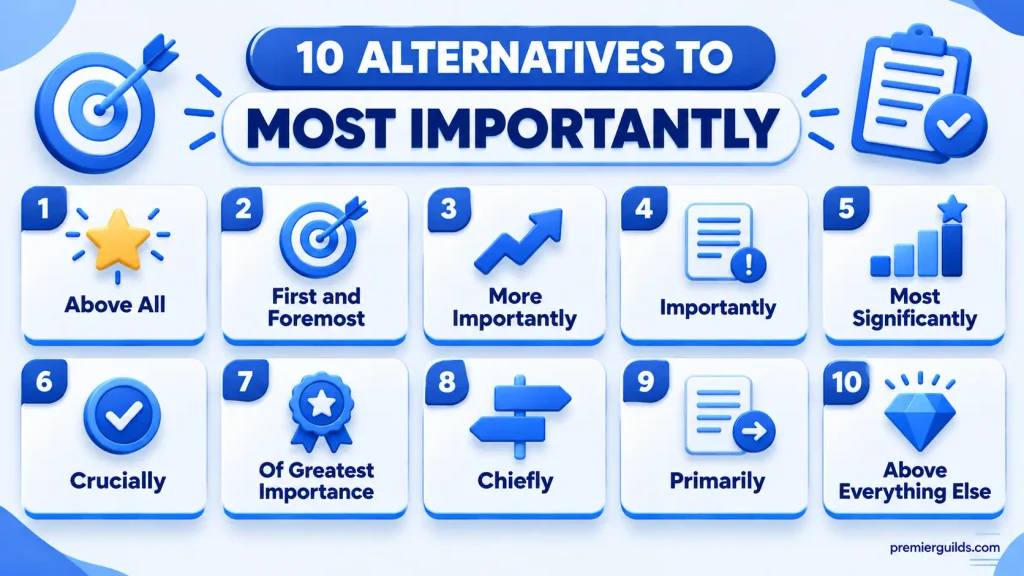
If you need another way to say most importantly, useful alternatives include above all, first and foremost, more importantly, importantly, crucially, and most significantly. The best choice depends on your tone and purpose, especially whether you are writing an academic paper, professional email, presentation, or casual message.
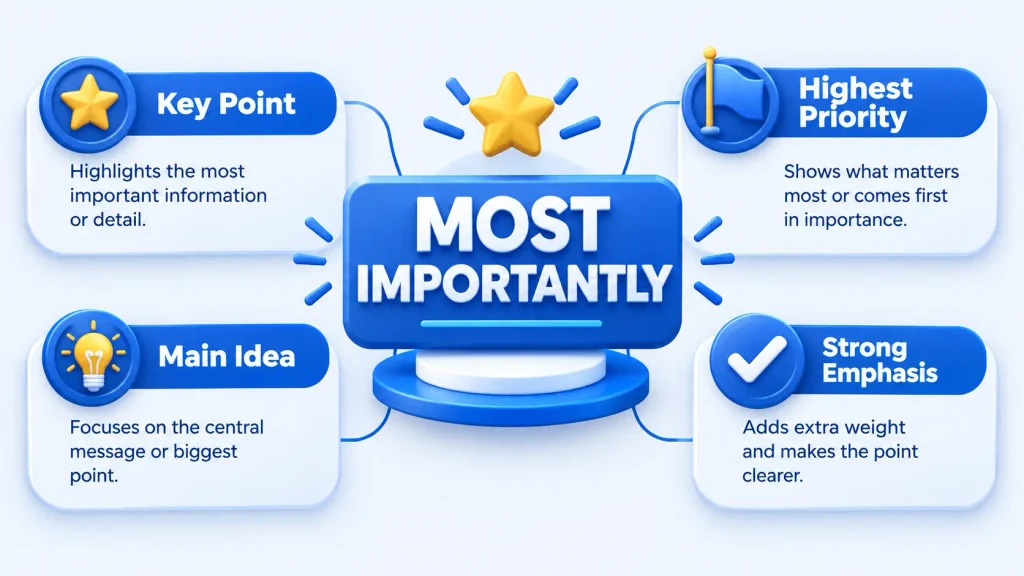
“Most importantly” is used to introduce the most significant point in a discussion, explanation, argument, or list of ideas. It tells the reader or listener that the information that follows deserves special attention.
For example, you might say, “Most importantly, we need to protect customer information.” Here, the phrase signals that protecting customer information is more important than the other points being discussed.
You will often see this expression in essays, reports, presentations, business writing, speeches, and everyday conversations. It helps organize ideas and makes the writer’s main priority clear.

Repeating the same transition phrase can make your writing feel predictable. Using suitable alternatives can make your sentences more natural while helping you express different levels of emphasis.
Other expressions can help you:
The key is to choose a phrase that actually fits the relationship between your ideas. Some alternatives emphasize priority, while others introduce an especially important fact or conclusion.
“Above all” means that something is more important than everything else being discussed. It is a concise way to highlight a top priority.
Above all, the safety of our employees must remain our highest priority.
She valued honesty above all when building long-term relationships.
Use “above all” when you want to clearly establish one idea as the highest priority.
“First and foremost” introduces the most important point before other supporting ideas. It often suggests that something should be considered before everything else.
First and foremost, students should understand the purpose of the research.
First and foremost, our team needs to address the customer’s main concern.
This phrase works especially well at the beginning of a sentence when introducing a primary consideration.
“More importantly” introduces an idea that the writer considers more significant than the point mentioned immediately before it. It is useful when moving from a supporting point to a stronger one.
The software saves time. More importantly, it reduces the number of errors.
The proposal is affordable, but more importantly, it meets the client’s long-term needs.
Use this phrase when you are deliberately increasing the importance of the next idea.
“Importantly” signals that the following information deserves attention because it has particular significance. It is shorter and more direct than “most importantly.”
Importantly, the revised policy gives employees more flexibility.
The findings are reliable and, importantly, supported by several independent sources.
Choose “importantly” when you want a clean, concise transition without strongly ranking the point above everything else.
“Most significantly” emphasizes the point with the greatest significance or impact. It has a formal tone and works well when discussing results, findings, or major effects.
Most significantly, the new approach improved customer satisfaction across all locations.
The study identified several trends, most significantly a sharp increase in online participation.
This is a strong choice for research papers, analytical reports, and discussions of measurable results.
“Crucially” means that the information that follows is extremely important to understanding a situation or reaching a conclusion.
Crucially, the agreement gives both parties enough time to review the terms.
Crucially, the experiment was repeated under the same conditions.
Use “crucially” when leaving out the next point could significantly change the meaning or outcome.
“Of greatest importance” identifies something as having the highest level of importance among several factors. It has a more formal and deliberate tone.
Of greatest importance is the need to protect sensitive customer data.
Of greatest importance to the research team is the accuracy of the collected information.
This phrase is useful in formal reports, academic writing, and carefully structured statements.
“Chiefly” means mainly or primarily. It identifies the principal reason, purpose, or factor rather than necessarily saying it is the single most important point.
The program was created chiefly to improve access to educational resources.
The decline was chiefly caused by changes in consumer demand.
Do not use “chiefly” when you specifically mean “the most important point.” It is closer to “mainly.”
“Primarily” means mainly or for the most part. It focuses on the principal purpose, reason, or factor behind something.
The workshop is primarily designed to help new managers develop communication skills.
The campaign primarily focuses on improving awareness among young adults.
“Primarily” works best when you are explaining the main purpose or cause, rather than simply emphasizing a point.
“Above everything else” emphasizes that one person, value, goal, or consideration takes priority over all others. It can sound more personal and expressive than “most importantly.”
Above everything else, we want our customers to feel respected and heard.
Above everything else, she wanted her children to feel supported during the transition.
Use this phrase when the emphasis involves values, priorities, relationships, or something deeply important to the speaker.
| Alternative | Best Used In | Tone |
| Above all | Essays, speeches, professional writing | Strong, formal |
| First and foremost | Academic and professional writing | Formal, direct |
| More importantly | Comparisons and arguments | Clear, emphatic |
| Importantly | General formal writing | Concise, professional |
| Most significantly | Research and analytical writing | Formal, precise |
| Crucially | Reports, arguments, explanations | Strong, serious |
| Of greatest importance | Formal reports and academic writing | Very formal |
| Chiefly | Academic and analytical writing | Formal, factual |
| Primarily | Academic, business, and professional writing | Neutral, formal |
| Above everything else | Personal, professional, and value-based statements | Strong, expressive |
“Primarily” means “mainly,” not necessarily “most importantly.” If you want to identify the highest-priority point, “above all” or “first and foremost” may be clearer.
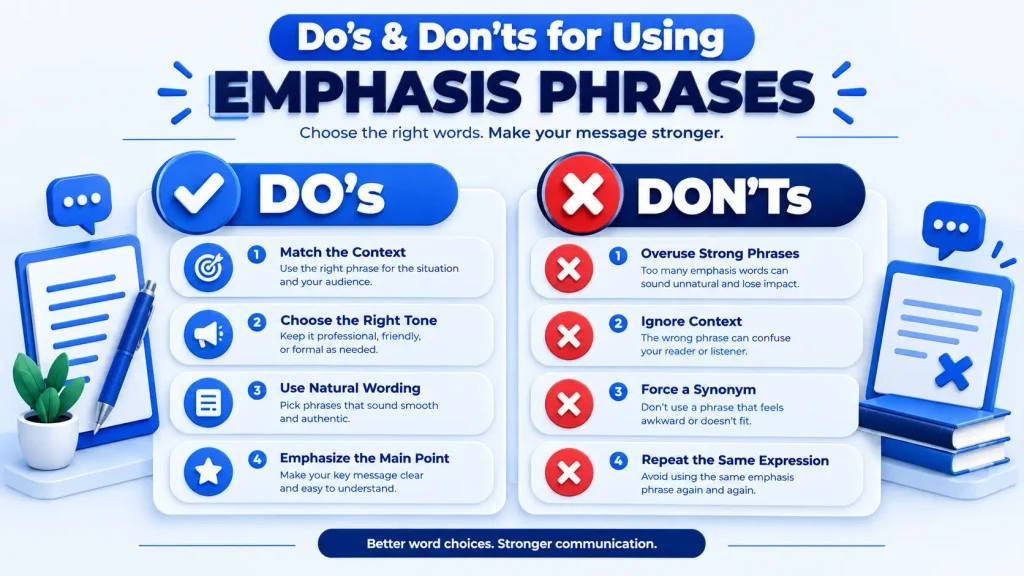
Words such as “crucially” and “above all” carry noticeable emphasis. Using them in every paragraph can make your writing sound exaggerated.
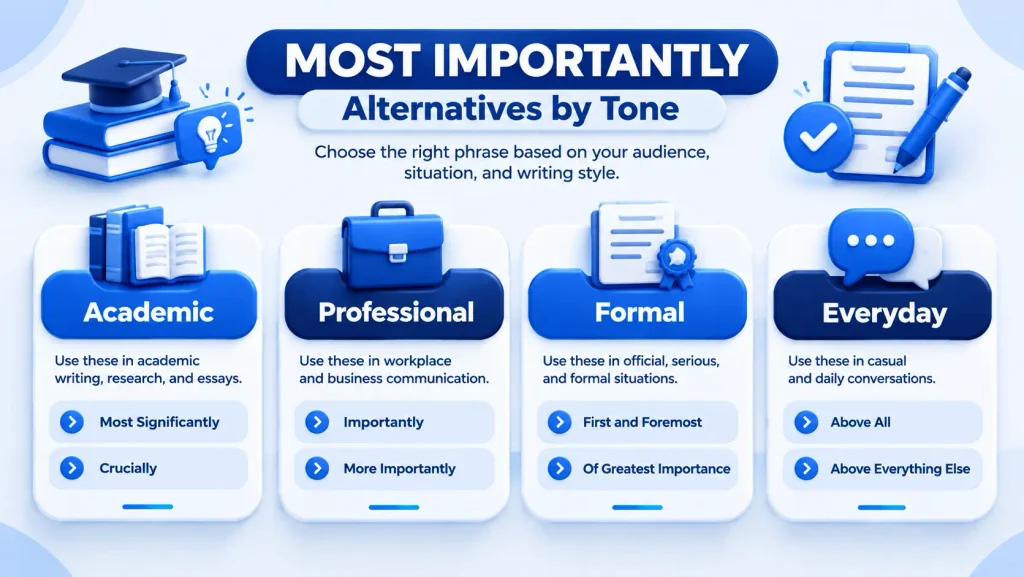
An academic paper may benefit from “most significantly” or “crucially,” while a friendly conversation may sound more natural with “above all.”
A longer expression is not automatically better. “Importantly” may communicate your idea more effectively than a highly formal phrase in a simple sentence.
Replacing “most importantly” with “above all” and then using “above all” repeatedly does not solve the repetition problem. Vary your transitions according to the meaning of each sentence.
There is no single alternative that fits every situation. “Above all” is useful when identifying the highest priority, while “first and foremost” works well in formal writing. For academic or analytical contexts, “most significantly” and “crucially” can provide stronger emphasis without sounding conversational.
Professional options include “above all,” “first and foremost,” “more importantly,” “importantly,” and “crucially.” The best choice depends on your sentence. For example, “Importantly, the report includes updated figures” sounds concise and professional, while “First and foremost” places stronger emphasis on priority.
Academic alternatives include “most significantly,” “crucially,” “first and foremost,” “of greatest importance,” and “importantly.” “Most significantly” works particularly well when discussing research findings or major effects. “Crucially” is useful when a particular factor is essential to understanding an argument or conclusion.
They are very similar, but their emphasis can differ slightly. “Above all” usually identifies the highest priority among several considerations. “Most importantly” also highlights a key point but can sound more neutral and flexible in explanations, essays, presentations, and conversations.
Yes, but they are not always interchangeable. “More importantly” usually compares the next idea with a previous idea and suggests that the new point matters more. “Most importantly” presents the following idea as the most important point overall.
Formal choices include “most significantly,” “crucially,” “of greatest importance,” and “first and foremost.” The appropriate option depends on your purpose. For example, “most significantly” suits analytical writing, while “of greatest importance” creates a more formal and deliberate tone.
“Importantly” is one of the simplest alternatives. It keeps the meaning clear while removing the extra word “most.” “Above all” is another concise option when you want to show that the following idea has the highest priority.
For a professional email, “importantly,” “above all,” “more importantly,” and “first and foremost” can work well. Choose based on the message. If you are adding a key point, “more importantly” may fit. If you are identifying the main priority, “above all” is usually more direct.
Choosing another way to say most importantly can make your writing more precise, natural, and engaging. The right alternative depends on what you want to emphasize and who will read your message.
Use above all or first and foremost when identifying a top priority. Choose more importantly when moving from one point to a stronger one. For academic and professional writing, most significantly, crucially, and of greatest importance can provide a more formal tone. Meanwhile, primarily and chiefly are better when you mean “mainly” rather than “most importantly.”
The best approach is not to replace every use with the same synonym. Instead, consider the meaning of each sentence and choose the phrase that expresses your intended level of importance naturally.

Senior English Editor & Stylistics Director
Michael Bennett is a veteran editor, lexicographer, and publishing consultant with more than two decades of experience in academic and educational publishing. Formerly a senior editorial director at major university presses, he specializes in structural editing, register refinement, and vocabulary development. Michael oversees tone, precision, and stylistic consistency across all publication channels, ensuring content meets rigorous editorial and pedagogical standards.