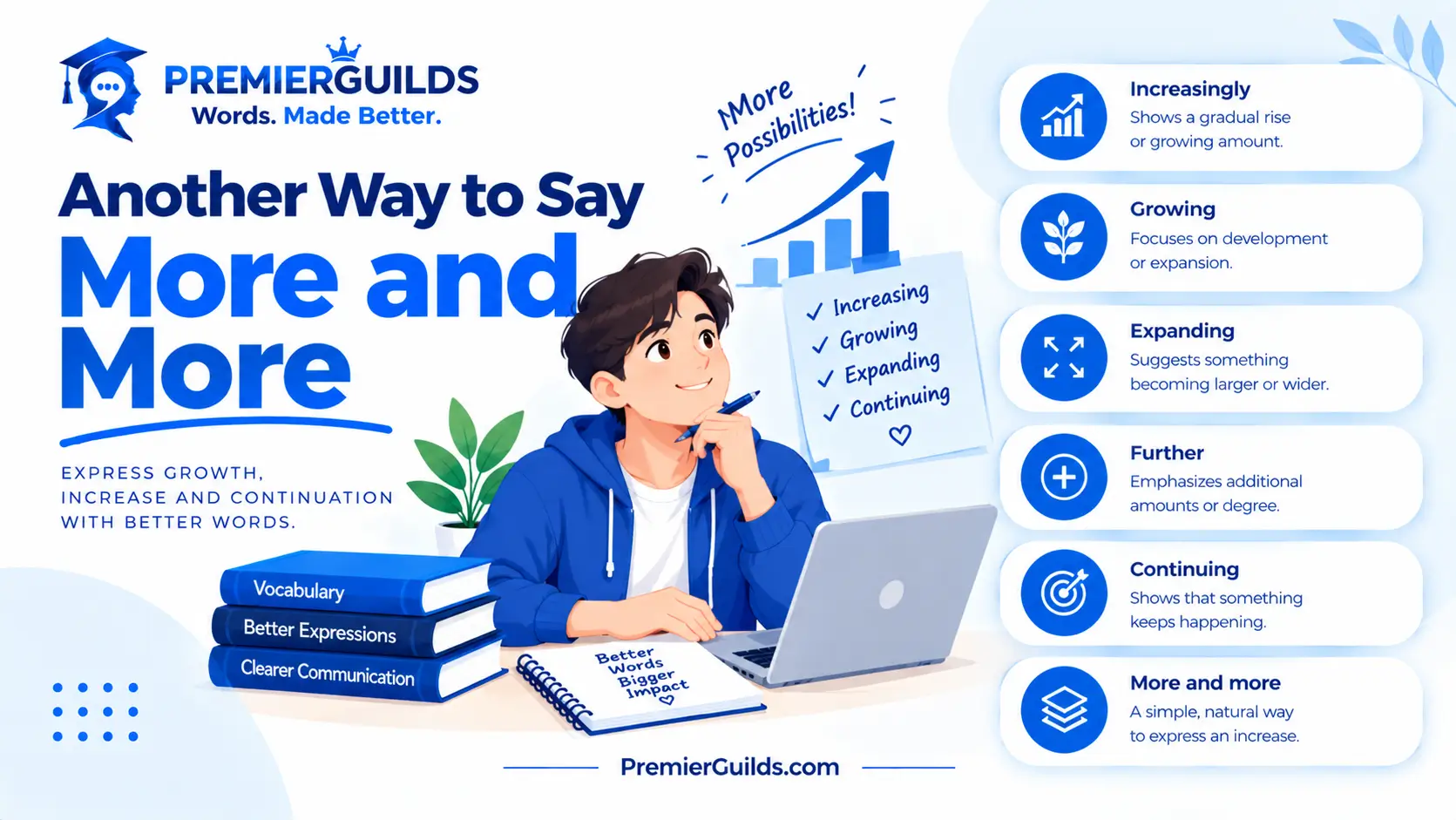
Another way to say more and more includes increasingly, progressively, to a greater extent, at an increasing rate, ever more, and with growing frequency. The best alternative depends on your sentence and meaning. For formal writing, “increasingly” is often the most natural choice, while everyday speech may favor “more frequently” or “to a greater extent.”
The phrase “more and more” is common in English when something is increasing gradually or becoming greater over time. It can describe quantity, frequency, intensity, interest, importance, or degree.
For example, you might say, “I am becoming more and more interested in photography.” While this sounds natural in conversation, another expression may work better in formal, academic, or professional writing.
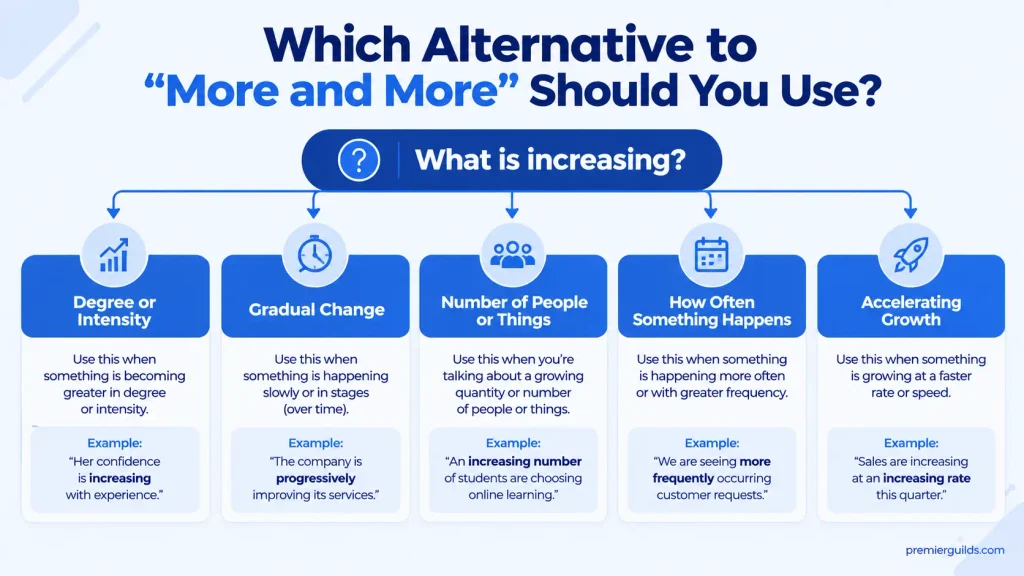
The best alternative depends on what is increasing. “Increasingly” often works as a concise replacement, while phrases such as “with growing frequency” are more specific when you are talking about how often something happens.
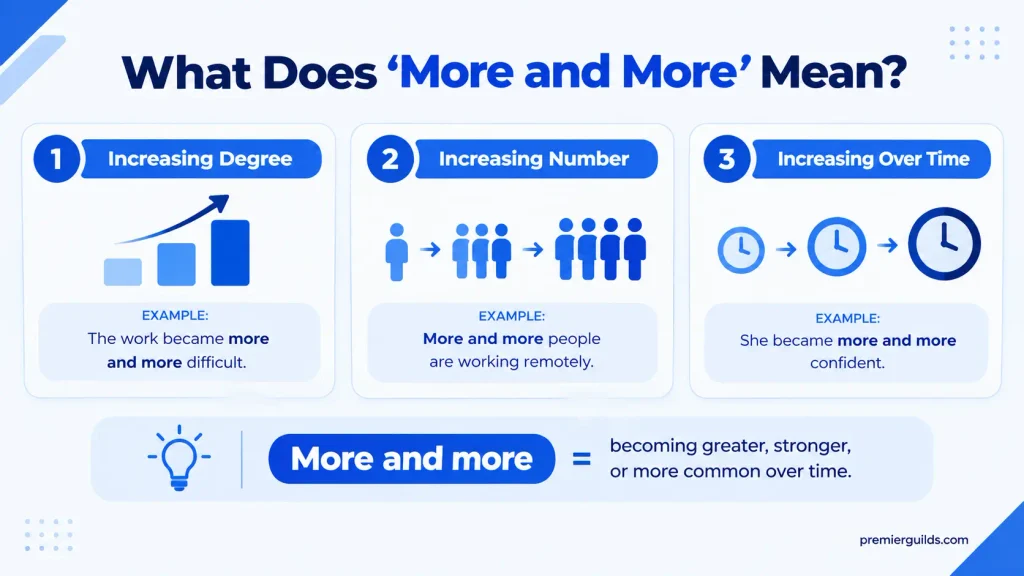
More and more means that something is increasing continuously or gradually. It can describe a growing amount, stronger feeling, greater frequency, or increasing level of something.
For example:
More and more people are choosing remote work.
Here, the phrase means that the number of people choosing remote work is continuing to increase.
You can also use it with adjectives or verbs:
She became more and more confident during the presentation.
The phrase is widely used in everyday conversations, emails, articles, essays, and general writing. However, repeating it too often can make your writing sound less varied.
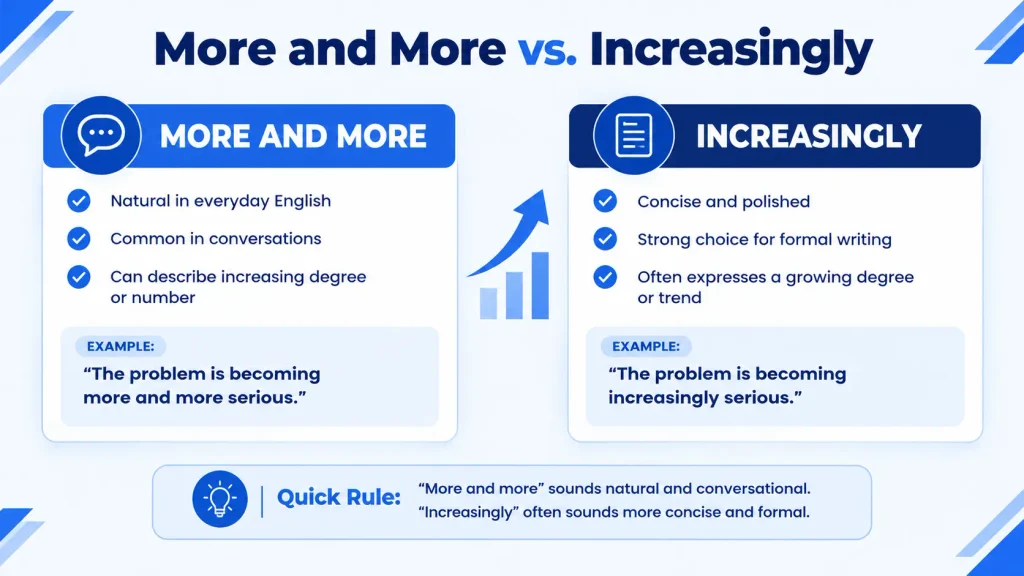
Using different expressions can make your writing more precise and natural. Instead of relying on the same phrase repeatedly, you can choose an alternative that shows exactly how or why something is increasing.
Using alternatives can help you:
The key is not simply to replace “more and more” with a longer phrase. Choose an expression that preserves the meaning of your original sentence.
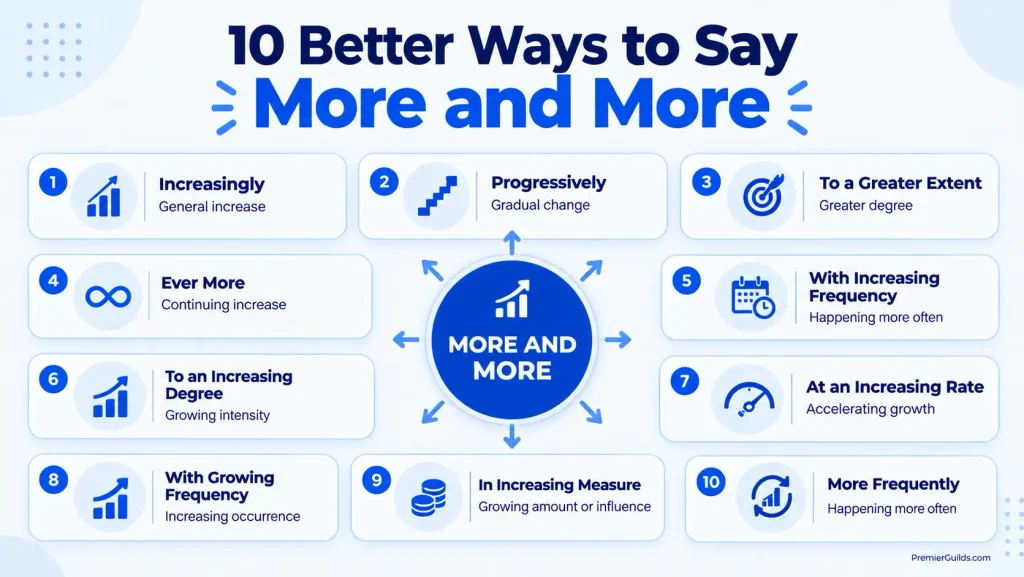
Increasingly means becoming greater, stronger, more common, or more noticeable over time. It is one of the most versatile alternatives to “more and more” and works especially well in formal writing.
Employees are increasingly interested in flexible work arrangements.
The company is increasingly focused on improving customer satisfaction.
Use increasingly when you want a concise, polished replacement that fits naturally into professional, academic, and general writing.
Progressively describes something that changes gradually from one stage to another. It emphasizes a continuing development rather than a sudden increase.
The training program became progressively more challenging each week.
Her writing improved progressively as she gained more experience.
Choose progressively when the increase happens in stages or develops gradually over a period of time.
To a greater extent means to a larger degree than before or than something else. It is particularly useful when discussing the degree to which something happens.
The new policy affects small businesses to a greater extent than expected.
Students rely on digital resources to a greater extent than they did a decade ago.
Use this phrase when you are comparing degrees or levels, rather than simply describing an increasing number.
Ever more means increasingly or to a continually greater degree. It often gives writing a slightly more polished or literary tone.
The team became ever more determined to reach its annual goal.
Consumers are becoming ever more aware of sustainable products.
Use ever more when you want to emphasize continuing growth while keeping the sentence concise.
With increasing frequency means something is happening more often as time passes. Unlike “more and more,” this phrase specifically focuses on frequency.
Customers are contacting the support team with increasing frequency.
The manager began receiving requests for flexible scheduling with increasing frequency.
Use this alternative when the main idea is how often something happens, not how much of something exists.
To an increasing degree means that something is becoming stronger, greater, or more noticeable over time. It is useful when describing a gradual change in level or intensity.
Technology influences workplace communication to an increasing degree.
The results are being shaped by customer feedback to an increasing degree.
This phrase is most useful when discussing the extent or influence of something rather than a simple numerical increase.
At an increasing rate means that something is growing or changing at a speed that itself is becoming greater. It suggests accelerating growth rather than a simple steady increase.
Online orders are increasing at an increasing rate during the holiday season.
The demand for specialized services is growing at an increasing rate.
Use this expression carefully because it suggests accelerating growth. Do not use it when something is simply becoming greater over time.
With growing frequency means that something occurs more often as time passes. It is a natural alternative when describing repeated events, actions, or interactions.
The company is holding team meetings with growing frequency.
She began receiving invitations to speak at industry events with growing frequency.
Choose this phrase when you want to highlight an increase in how often an event occurs.
In increasing measure means to an increasingly large degree or amount. It has a formal tone and can work when discussing influence, importance, responsibility, or contribution.
Technology is being used in increasing measure to improve workplace efficiency.
The organization depends on community feedback in increasing measure.
This phrase is more formal than everyday alternatives, so use it when the writing calls for a polished or academic style.
More frequently means happening more often than before or more often than another event. It is one of the clearest alternatives when “more and more” refers specifically to frequency.
The team now communicates with clients more frequently through video calls.
I have been exercising more frequently since joining the local fitness center.
Use more frequently instead of “more and more” when the sentence is specifically about how often an action occurs.
| Alternative | Best Used In | Tone |
| Increasingly | Professional, academic, and general writing | Formal/Professional |
| Progressively | Gradual development or change | Formal |
| To a greater extent | Comparing levels or degrees | Formal |
| Ever more | Continuing growth or stronger change | Formal |
| With increasing frequency | Events happening more often | Formal |
| To an increasing degree | Increasing influence or intensity | Formal |
| At an increasing rate | Accelerating growth | Professional |
| With growing frequency | Repeated events becoming more common | Formal |
| In increasing measure | Increasing amount or influence | Formal |
| More frequently | Actions occurring more often | Neutral/Professional |
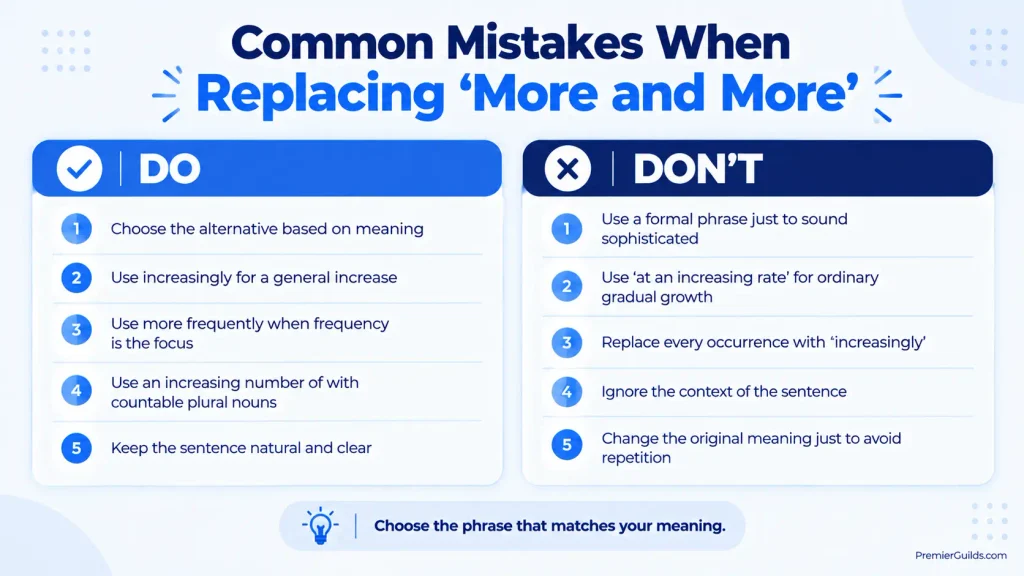
“Increasingly” is broad, while more frequently specifically describes how often something happens. Choose the more precise expression when frequency matters.
At an increasing rate suggests that the pace of growth is speeding up. If something is simply growing steadily, “increasingly” or “progressively” may be more accurate.
Phrases such as “in increasing measure” may sound unnatural in a casual conversation. In everyday English, simple wording is often clearer.
Not every alternative can replace “more and more” in every situation. Before substituting a phrase, determine whether you are describing quantity, frequency, intensity, degree, or gradual development.
Replacing “more and more” with “increasingly” in every sentence does not solve repetition. Vary your wording only when the alternative accurately matches the meaning and context.
Increasingly is usually the best formal alternative to “more and more.” It is concise, natural, and suitable for professional and academic writing. For example, “Consumers are increasingly interested in sustainable products” sounds more polished than repeatedly using “more and more,” while keeping the original meaning clear.
Increasingly is the most common one-word alternative. Depending on the context, you can also use progressively, ever more, or more frequently. The right choice depends on what is increasing. “More frequently” refers to frequency, while “progressively” emphasizes gradual development or change.
In many sentences, increasingly can replace “more and more” without changing the basic meaning. However, the two expressions are not identical in every context. “Increasingly” usually describes something becoming greater or more common, while “more and more” can also describe an increasing quantity or repeated action.
You can often replace “more and more people” with “an increasing number of people.” For example, instead of saying, “More and more people work remotely,” you could write, “An increasing number of people work remotely.” This alternative clearly focuses on a growing number of people.
Increasingly is generally the strongest professional choice because it is brief and natural. Depending on the sentence, alternatives such as progressively, to a greater extent, or with increasing frequency may be more precise. The best option should reflect exactly what is becoming greater.
Academic writing often benefits from precise alternatives such as increasingly, progressively, to a greater extent, and to an increasing degree. The best choice depends on the relationship you are describing. Avoid selecting a formal phrase simply because it sounds academic; clarity should remain the priority.
Yes. Ever more can replace “more and more” when you want to emphasize continuing or increasing change. For example, “The issue became ever more important” communicates a growing level of importance. It has a somewhat more formal or literary feel, so it may not be the best choice for casual conversation.
First, identify what is increasing. Use increasingly for a general increase, progressively for gradual development, more frequently for frequency, to a greater extent for degree, and at an increasing rate when the pace of growth is accelerating. Choosing based on meaning will make your writing more precise.
Knowing another way to say more and more can make your English more varied, precise, and appropriate for different situations. Increasingly is usually the easiest professional and formal alternative, while progressively works well for gradual changes. If you are describing frequency, phrases such as more frequently or with increasing frequency are more specific.
The important thing is to choose an alternative based on your intended meaning. If you are describing a growing number, focus on quantity; if something happens more often, choose a frequency-based phrase. For increasing intensity or influence, a degree-based expression may be better.
You do not need to avoid “more and more” completely. It is natural and correct in many contexts, especially in everyday English. The best word choice is the one that communicates your meaning clearly and naturally.

Senior English Editor & Stylistics Director
Michael Bennett is a veteran editor, lexicographer, and publishing consultant with more than two decades of experience in academic and educational publishing. Formerly a senior editorial director at major university presses, he specializes in structural editing, register refinement, and vocabulary development. Michael oversees tone, precision, and stylistic consistency across all publication channels, ensuring content meets rigorous editorial and pedagogical standards.