
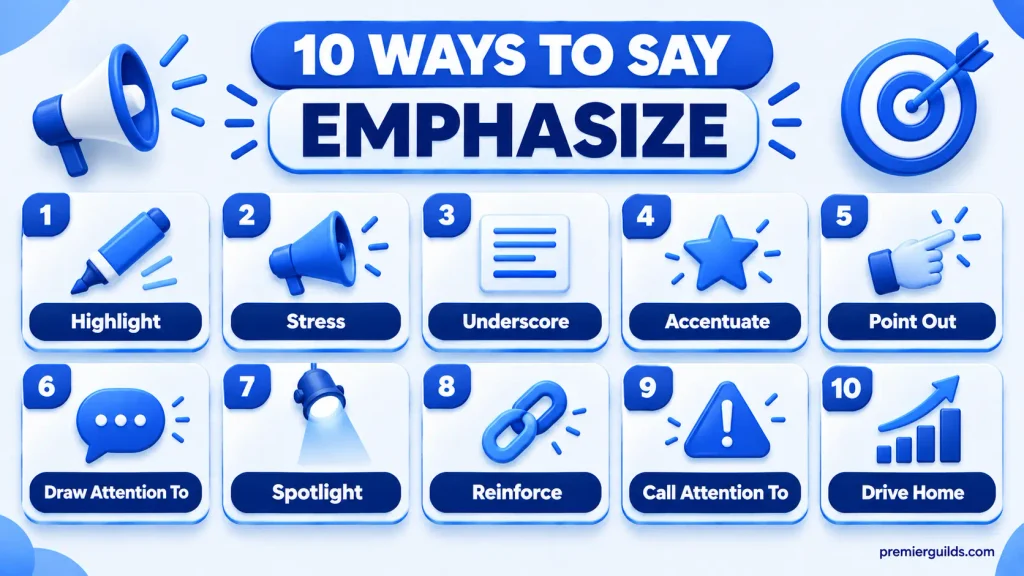
If you are looking for another way to say emphasize, you have several natural options, including highlight, stress, underscore, accentuate, point out, and draw attention to. The best choice depends on your context and tone. Some alternatives work well in academic writing, while others sound more natural in everyday or professional communication.
The word emphasize means to show that something is especially important or deserves special attention. If you want another way to say emphasize, you can use words and phrases such as highlight, stress, underscore, accentuate, spotlight, point out, or draw attention to.
These alternatives can help you avoid repetition and make your writing more precise. For example, “The report emphasizes the need for better communication” can become “The report highlights the need for better communication.”
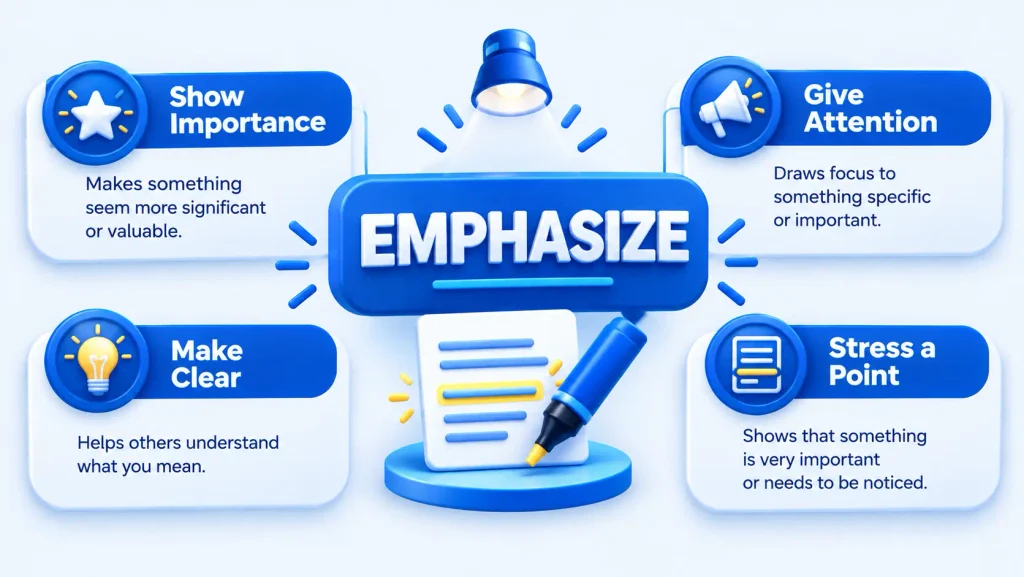
“Another way to say emphasize” refers to finding a different word or phrase that communicates the same basic idea as emphasize. In most situations, it means showing that something is important, noticeable, or worthy of attention.
You might use these alternatives in essays, business reports, emails, presentations, conversations, or professional documents. The right choice depends on whether you want your sentence to sound casual, professional, formal, or strongly focused.
For example, highlight is common and flexible, while underscore often sounds more polished in formal or professional writing.

Using different expressions can make your writing clearer and more natural. Repeating “emphasize” several times in the same article, essay, or report can also make your writing feel repetitive.
Consider an alternative when you want to:
Highlight means to give special attention to something or make an important point stand out. It is one of the most flexible alternatives to emphasize and works well in both everyday and professional communication.
The report highlights the importance of clear communication between team members.
During the presentation, Maria highlighted three major benefits of the new program.
Use highlight when you want to make an important idea noticeable without sounding overly forceful.
Stress means to give extra importance to a particular idea, fact, or point. It is especially useful when you want readers or listeners to understand that something deserves serious attention.
The professor stressed the importance of checking sources before submitting the paper.
Our manager stressed that every customer complaint should be handled promptly.
Use stress when the importance of the point needs to be especially clear.
Underscore means to emphasize or reinforce the importance of something. It often sounds polished and professional, making it a strong choice for reports, presentations, essays, and business writing.
The latest results underscore the need for better employee training.
Her comments underscored how important preparation is before an interview.
Choose underscore when you want a sophisticated alternative for formal or professional writing.
Accentuate means to make a particular feature, quality, or point more noticeable or prominent. It is useful when the goal is to draw attention to a specific characteristic.
The new layout accentuates the most important information on the page.
The speaker used examples to accentuate the differences between the two approaches.
Use accentuate when you are focusing on making a particular feature stand out.
Point out means to direct someone’s attention to a particular fact, detail, or issue. It sounds natural and conversational, so it is often easier to use in everyday communication than more formal alternatives.
I want to point out one important detail before we finalize the agreement.
Jason pointed out that the meeting time had changed.
Use point out when you want a simple, natural phrase that directly directs attention to something.
Draw attention to means to make someone notice or focus on a particular person, idea, problem, or detail. It is a clear alternative that works across many situations.
The campaign draws attention to the importance of protecting local parks.
Please draw attention to any errors you find in the final document.
This phrase is especially useful when you want to focus someone’s attention without sounding too forceful.
Spotlight means to give special attention or visibility to something. It is often used when discussing important achievements, issues, people, features, or topics.
The article spotlights several small businesses that are growing rapidly.
The event will spotlight young artists from across the community.
Use spotlight when you want to suggest that something is receiving noticeable attention.
Reinforce means to strengthen an idea, message, belief, or point. It is slightly different from emphasize because it focuses on making an existing message stronger rather than simply calling attention to it.
The statistics reinforce the importance of investing in employee development.
The instructor used a practical exercise to reinforce the main lesson.
Choose reinforce when evidence, examples, or actions make an existing idea stronger.
Call attention to means to deliberately make someone notice something important. It is clear and direct and can be used in both professional and general communication.
The memo calls attention to several changes in the company policy.
The researcher called attention to a limitation that had not been discussed previously.
Use this phrase when you want to clearly signal that readers or listeners should notice a particular detail.
Drive home means to make a point extremely clear or memorable. It is more idiomatic than most alternatives and works best when you want to show that a message has been strongly communicated.
The speaker used a personal story to drive home the importance of preparation.
The final example really drove home why accurate data matters.
Use drive home when you want to express strong, memorable emphasis, especially in speeches or conversational writing.
| Alternative | Best Used In | Tone |
| Highlight | Professional, academic, everyday writing | Neutral |
| Stress | Formal, academic, professional writing | Strong |
| Underscore | Reports, essays, business writing | Formal |
| Accentuate | Formal and descriptive writing | Formal |
| Point Out | Conversations, emails, general writing | Natural |
| Draw Attention To | Professional and formal communication | Neutral |
| Spotlight | Articles, presentations, media, business | Engaging |
| Reinforce | Academic and professional writing | Professional |
| Call Attention To | Reports, notices, formal communication | Direct |
| Drive Home | Speeches, presentations, conversational writing | Strong |
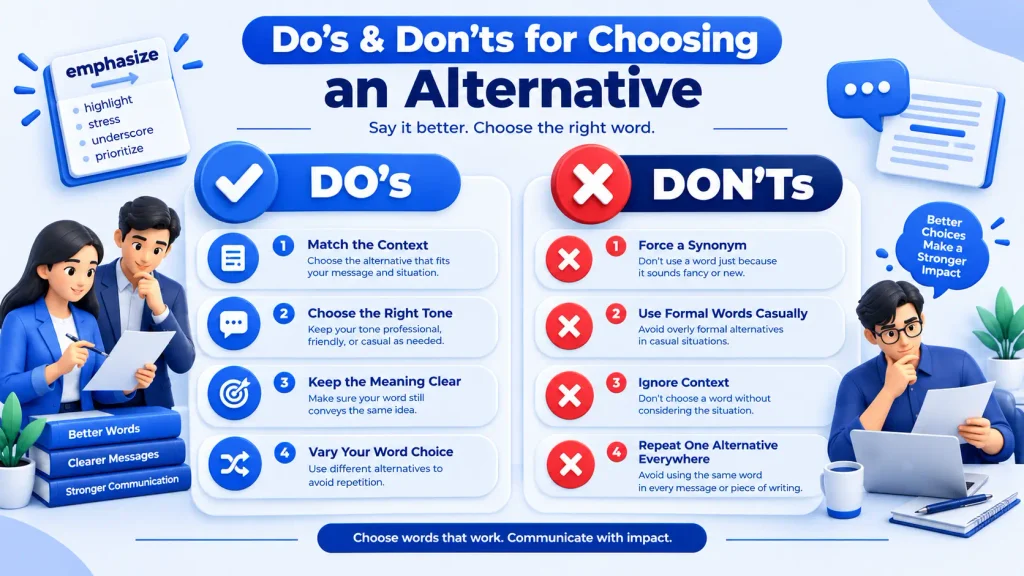
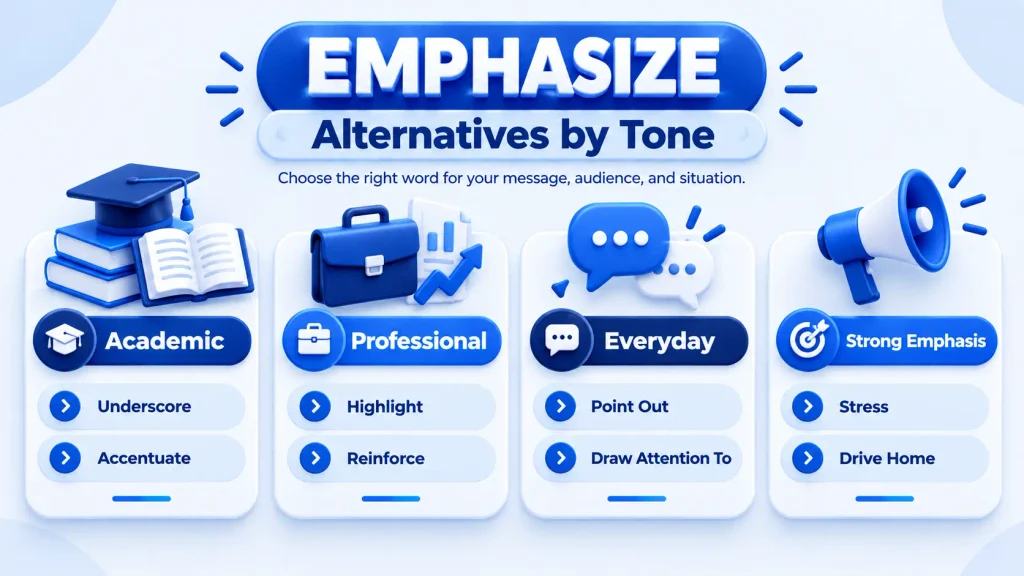
Words such as underscore and accentuate can sound unnecessarily formal in casual conversations. If you are talking with a friend, “point out” may sound more natural.
Not every alternative has the same meaning or strength. Reinforce, for example, suggests strengthening an existing idea, while highlight mainly means bringing attention to it.
The audience matters. “The report underscores the issue” fits professional writing, while “She pointed out the problem” sounds more natural in everyday conversation.
Replacing “emphasize” with “highlight” does not solve repetition if you use “highlight” in every paragraph. Vary your wording naturally while keeping the meaning precise.
Phrases such as drive home can create stronger emphasis than necessary. If your sentence simply needs to identify an important point, highlight or point out may be a better fit.
Highlight is one of the most versatile synonyms for emphasize. It works in academic writing, professional documents, presentations, and everyday communication. Other useful choices include stress, underscore, accentuate, point out, and draw attention to. The best option depends on the sentence and the level of formality you want.
In professional writing, you can use highlight, underscore, stress, reinforce, or draw attention to. For example, instead of saying “The manager emphasized the need for accuracy,” you could write, “The manager underscored the need for accuracy.” These choices can make business communication sound polished without becoming unnecessarily complicated.
For an essay, strong alternatives include highlight, underscore, stress, accentuate, and draw attention to. “Highlight” is usually the most flexible choice. “Underscore” can sound more formal, while “stress” is useful when you want to clearly signal that a particular idea deserves special attention.
Common academic alternatives include highlight, underscore, stress, reinforce, and accentuate. Your choice should depend on the intended meaning. Use “highlight” to identify an important point, “underscore” for formal emphasis, and “reinforce” when evidence or examples strengthen an existing argument.
“Highlight” and “emphasize” are very close in meaning, but they can have slightly different uses. Both can show that something deserves attention. However, “highlight” often suggests making something noticeable, while “emphasize” can also suggest deliberately stressing its importance in speech or writing.
Yes. Stress can replace emphasize in many sentences, especially when you want to show that something is particularly important. For example, “The teacher emphasized the importance of practice” can become “The teacher stressed the importance of practice.” The second version has a slightly stronger feel.
For casual communication, point out is a natural choice. Depending on the sentence, you can also use bring up, call attention to, or make clear. For example, “I want to point out one thing” sounds more conversational than “I want to underscore one thing.”
If you want strong emphasis, you can use stress, drive home, underscore, or reinforce, depending on the context. “Drive home” is particularly strong and conversational. In formal writing, “underscore” or “stress” can communicate importance without sounding overly dramatic.
Finding another way to say emphasize can make your writing more varied, precise, and appropriate for your audience. Highlight is a flexible choice for most situations, while stress and underscore work well when you want stronger or more formal emphasis.
For everyday communication, point out and draw attention to are easy and natural options. Reinforce is useful when evidence strengthens an existing idea, while spotlight works well when something deserves special visibility.
The key is to choose the alternative that matches your meaning, audience, and tone. Instead of replacing “emphasize” automatically, consider what you actually want the reader or listener to notice. That small distinction can make your writing clearer and more effective.

English Language & Communication Specialist
Dr. Emily Carter is an English language and communication specialist focused on vocabulary, word choice, professional writing, and practical English usage. She helps readers understand the differences between similar words and choose expressions that sound natural, clear, and appropriate for different contexts.