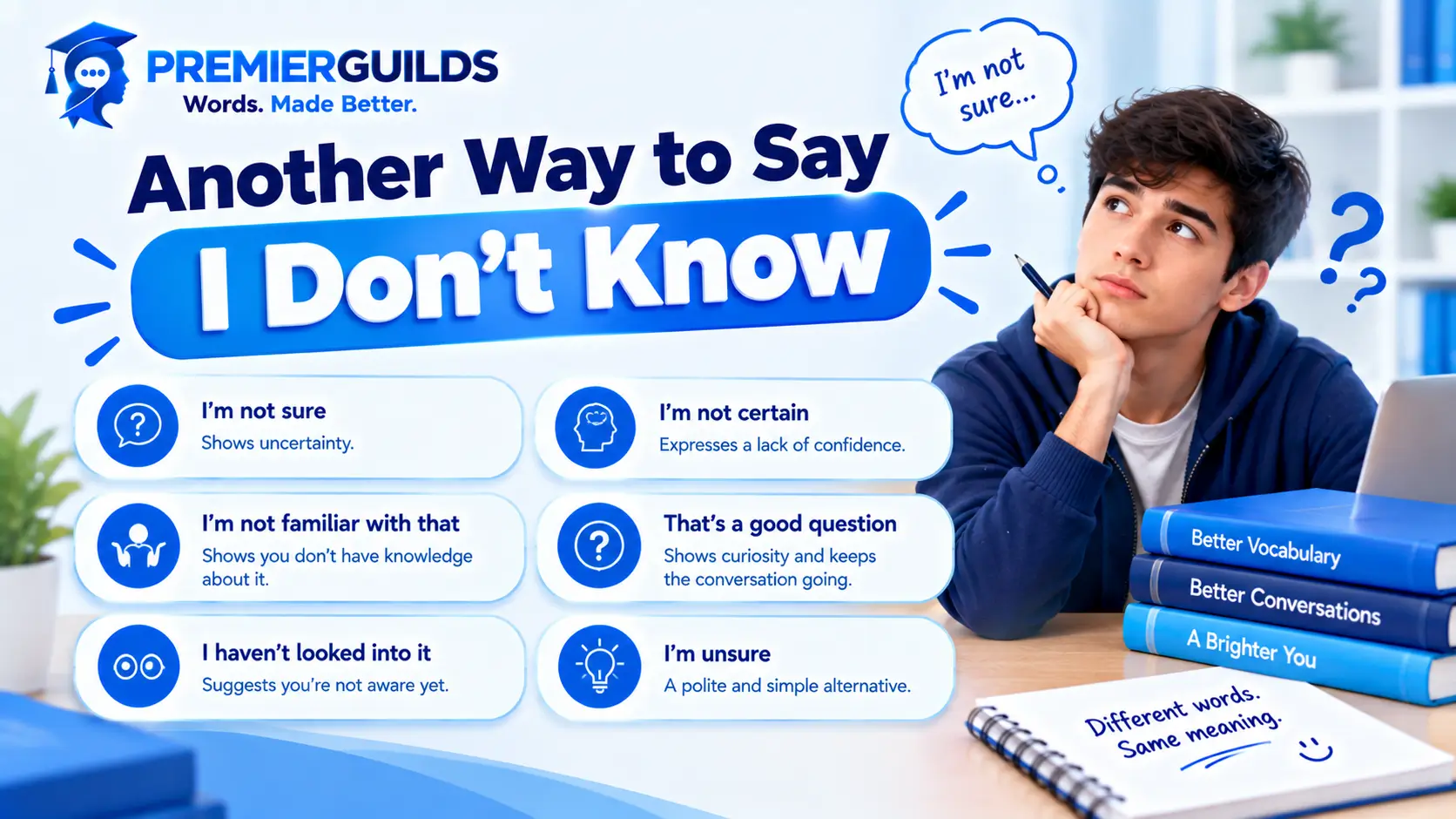
If you’re looking for another way to say I don’t know, you can use phrases such as I’m not sure, I don’t have the answer, I’m uncertain, I’m not aware, I couldn’t say, or I’m not certain. The best choice depends on the situation, your level of confidence, and how formal you want to sound.
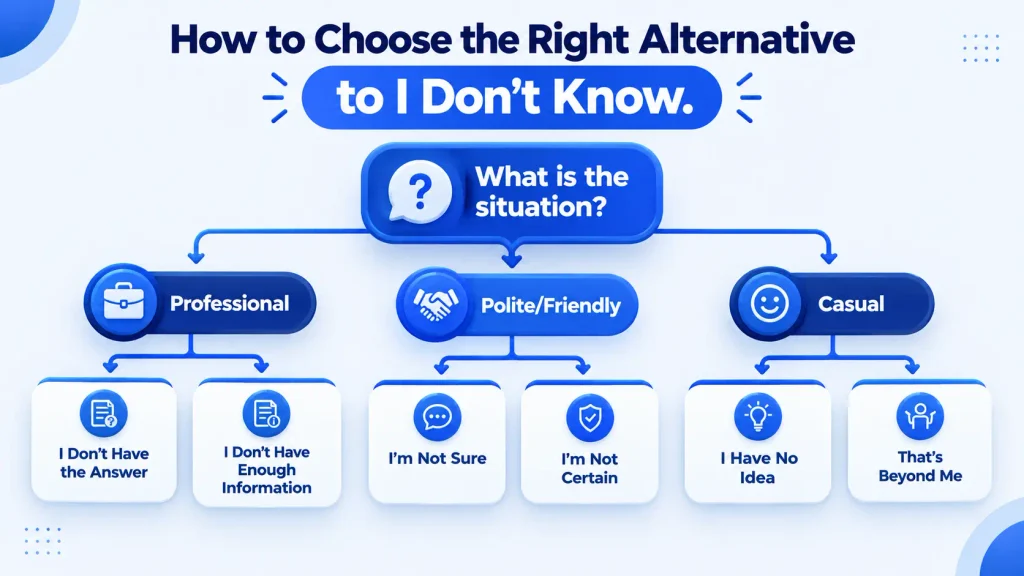
The phrase “another way to say I don’t know” refers to different expressions you can use when you do not have an answer, lack information, or are unsure about something.
“I don’t know” is one of the most common phrases in American English. People use it in everyday conversations when they cannot answer a question or do not have enough information.
People often look for alternatives because “I don’t know” can sometimes sound too blunt, repetitive, or casual. A different expression can make your response sound more polite, professional, thoughtful, or specific to the situation.
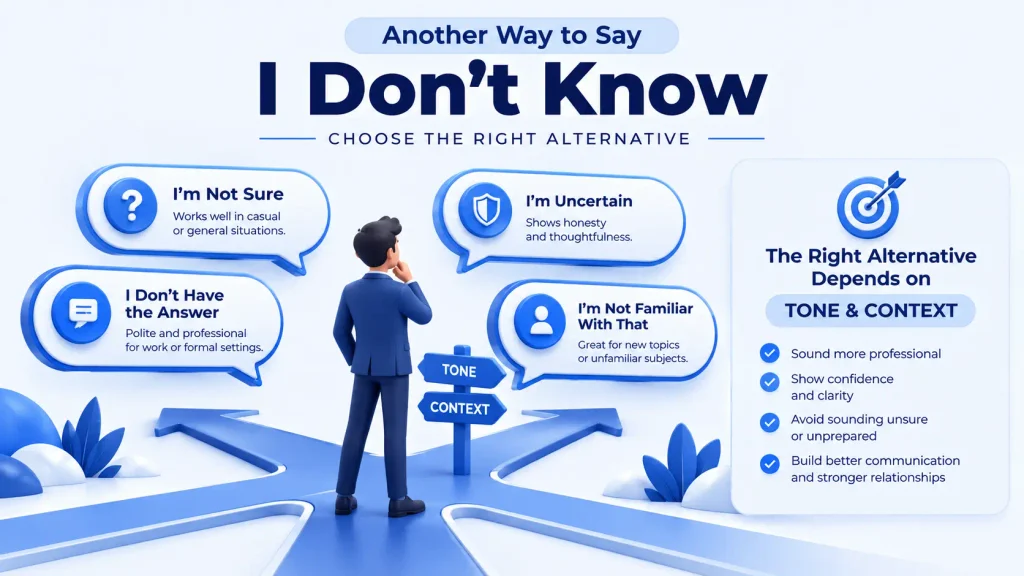
Although “I don’t know” is completely natural, another expression may communicate your meaning more precisely.
Different alternatives can help you:
For example, “I’m not sure” sounds softer than “I don’t know,” while “I don’t have the answer” sounds more direct and professional.
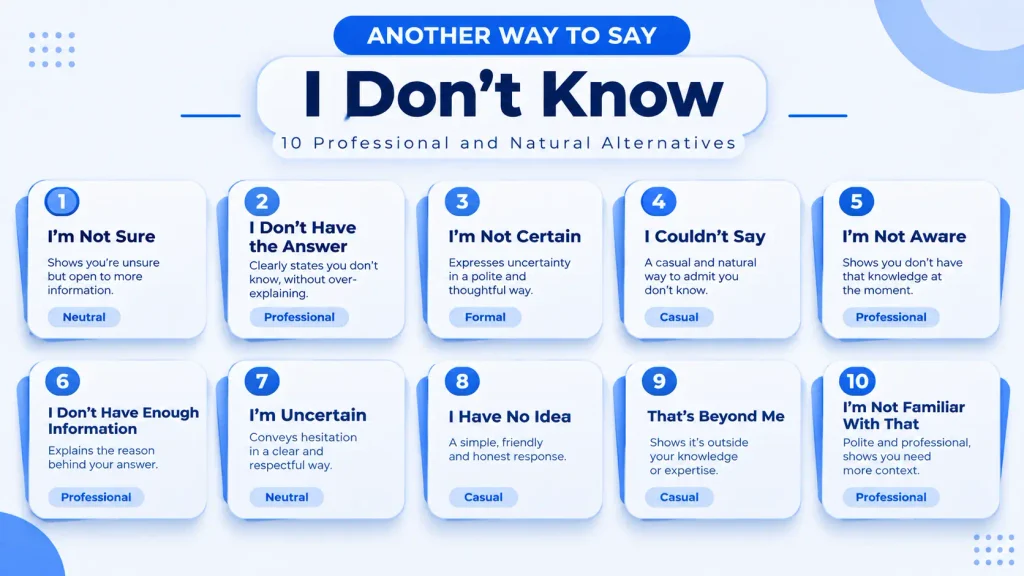
I’m not sure is one of the most natural alternatives to “I don’t know.” It shows that you are uncertain without making your response sound too blunt.
I’m not sure what time the store closes today.
I’m not sure whether Sarah will be joining us for dinner.
Use I’m not sure when you have some uncertainty and want your response to sound natural and polite.
I don’t have the answer is a direct but professional way to explain that you cannot provide the requested information. It works especially well when answering questions at work or in formal discussions.
I don’t have the answer right now, but I’ll check the report.
I don’t have the answer to that question at the moment.
This phrase is useful when you want to acknowledge the question while making it clear that you currently lack the information.
I’m not certain means that you do not have enough confidence to give a definite answer. It sounds slightly more formal than “I’m not sure.”
I’m not certain whether the meeting has been moved to Friday.
I’m not certain which version of the document we should use.
Choose I’m not certain when you want to communicate uncertainty in a polished or professional way.
I couldn’t say is a polite expression used when you cannot confidently provide an answer. It can sound softer and less abrupt than simply saying “I don’t know.”
I couldn’t say which restaurant would be better for the group.
I couldn’t say exactly how long the repairs will take.
Use this phrase when you genuinely cannot make a reliable judgment rather than simply lacking a basic fact.
I’m not aware means that you do not have knowledge of a particular fact, event, change, or situation. It is especially useful in professional communication.
I’m not aware of any changes to the current schedule.
I’m not aware of any issues with the latest version of the software.
Use I’m not aware when you are specifically talking about information or developments rather than answering a general personal question.
I don’t have enough information explains that you cannot answer because you need more details. It sounds more constructive than simply saying “I don’t know.”
I don’t have enough information to determine what caused the delay.
I don’t have enough information to recommend one option over another.
This is a strong choice when you want to explain why you cannot give a definite answer.
I’m uncertain is a concise way to communicate doubt or a lack of confidence. It has a more formal tone than “I don’t know” and can work well in professional or academic writing.
I’m uncertain about the exact date of the next inspection.
I’m uncertain whether this approach will produce the expected results.
Use I’m uncertain when the issue involves doubt rather than a complete lack of knowledge.
I have no idea is a common informal alternative to “I don’t know.” It strongly emphasizes that you have absolutely no information about the subject.
I have no idea where Mark left his keys.
I have no idea what they’re planning for the weekend.
Because this phrase is casual and emphatic, avoid using it in formal emails or professional situations unless the relationship and context clearly allow it.
That’s beyond me means that something is outside your knowledge, experience, or area of expertise. It is informal and can sometimes sound conversational or humorous.
How the new system works is beyond me.
The technical details are beyond me, so I’d ask an engineer.
Use this expression with people you know well. In professional settings, a more neutral phrase such as “I’m not familiar with that” may be better.
I’m not familiar with that is a polite way to say that you do not know about a particular subject, process, product, or situation. It works especially well in professional conversations.
I’m not familiar with that software, so I may need some guidance.
I’m not familiar with that policy, but I can review the documentation.
Choose this phrase when you want to acknowledge a knowledge gap while maintaining a professional and helpful tone.
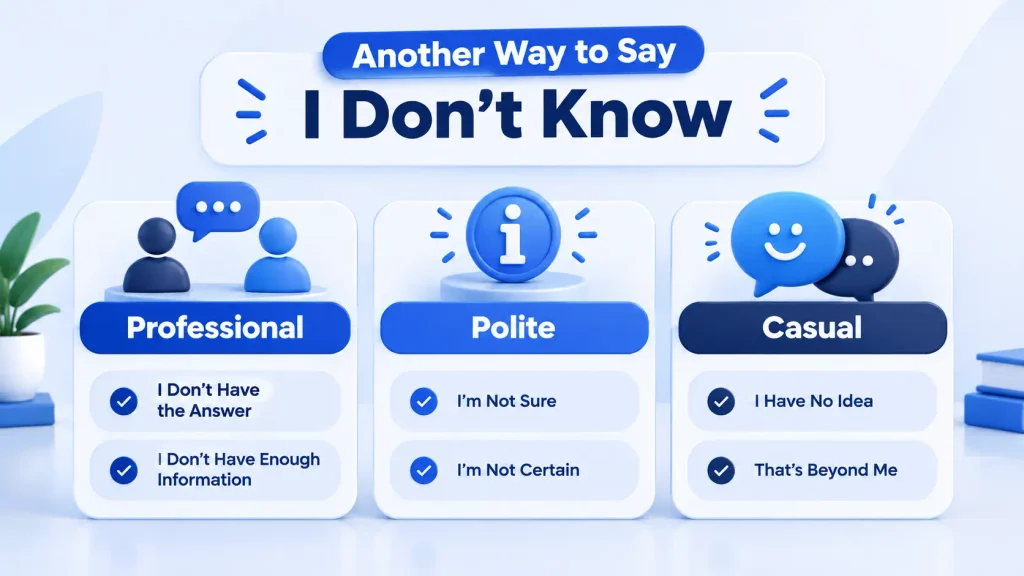
| Alternative | Best Used In | Tone |
| I’m not sure | Everyday conversations, questions | Polite, Natural |
| I don’t have the answer | Work, formal discussions | Professional, Direct |
| I’m not certain | Formal and professional situations | Formal, Polite |
| I couldn’t say | Questions requiring judgment | Polite, Soft |
| I’m not aware | Facts, updates, situations | Professional, Formal |
| I don’t have enough information | Work, research, decision-making | Professional, Clear |
| I’m uncertain | Academic and professional contexts | Formal, Thoughtful |
| I have no idea | Casual conversations | Casual, Direct |
| That’s beyond me | Informal conversations | Casual, Conversational |
| I’m not familiar with that | Work, unfamiliar subjects | Professional, Polite |
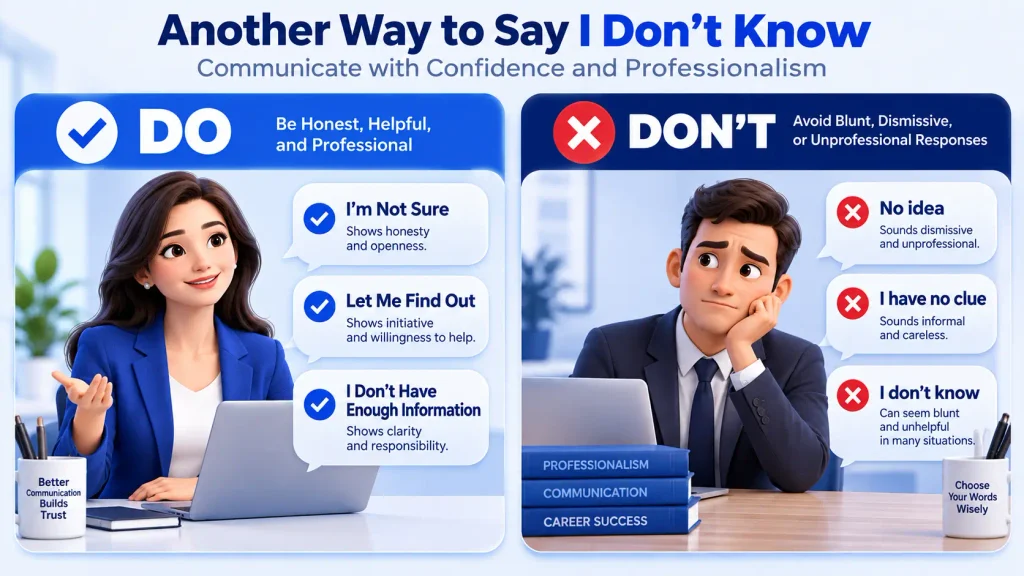
Expressions such as “I have no idea” and “That’s beyond me” can sound too casual in workplace communication. Use alternatives such as “I’m not sure” or “I’m not familiar with that” instead.
Not every conversation requires formal wording. Saying “I’m uncertain” to a close friend may sound unnecessarily stiff when “I’m not sure” would be more natural.
Using the same phrase repeatedly can make conversations sound flat. Vary your wording based on what you actually mean, such as uncertainty, lack of information, or unfamiliarity.
The best alternative depends on why you do not know the answer. “I’m not aware” works well for information you have not received, while “I don’t have enough information” suggests that more details are needed.
A short response like “I don’t know” can sometimes feel abrupt. If you want to sound helpful, add what you can do next, such as “I’m not sure, but I can check.”
A polite way to say “I don’t know” is “I’m not sure,” “I’m not certain,” or “I don’t have enough information.” These phrases communicate uncertainty without sounding dismissive. In everyday conversations, “I’m not sure” is usually the most natural option because it is friendly, simple, and widely understood.
For professional communication, try “I don’t have the answer,” “I’m not aware,” “I’m not familiar with that,” or “I don’t have enough information.” These expressions acknowledge your knowledge gap while maintaining a respectful tone. When possible, offer to check the information or find someone who can provide the answer.
In an email, you can say “I’m not sure,” “I’m not familiar with that,” “I don’t have enough information to confirm,” or “I’m not aware of any updates.” The best choice depends on the situation. If you can investigate the issue, adding a helpful next step can make your response more professional.
“I’m not sure” is one of the most polite and natural alternatives to “I don’t know.” You can also say “I’m not certain,” “I couldn’t say,” or “I don’t have enough information.” These options soften your response while still being honest about your level of knowledge.
For casual conversations, you can say “I’m not sure,” “I have no idea,” or “That’s beyond me.” “I have no idea” is common and natural among friends, while “That’s beyond me” suggests that the subject is outside your knowledge or experience.
Neither phrase is always better. “I don’t know” is direct and completely natural, while “I’m not sure” sounds softer and suggests some uncertainty. If you want to avoid sounding abrupt, “I’m not sure” is often a useful choice in both casual and professional conversations.
To avoid sounding rude, choose a softer expression such as “I’m not sure,” “I couldn’t say,” or “I don’t have enough information.” You can also offer help by saying, “I’m not sure, but I can find out.” This shows that you are willing to help rather than simply dismissing the question.
At work, useful alternatives include “I’m not sure,” “I’m not familiar with that,” “I don’t have enough information,” and “I’m not aware of any updates.” These phrases sound professional while clearly communicating that you do not currently have the requested information.
There are many natural ways to say “I don’t know,” and the best alternative depends on your situation and tone. “I’m not sure” is the most versatile option for everyday conversations, while “I don’t have the answer” and “I don’t have enough information” work well in professional settings.
If you want to explain that you lack knowledge about a specific subject, “I’m not familiar with that” is a polite choice. For casual conversations, “I have no idea” can sound natural, while “I’m uncertain” offers a more formal tone.
The key is to be honest without sounding dismissive. Choose an expression that matches your audience, explain when more information is needed, and offer to help when possible.

Our editorial team brings together decades of expertise in applied linguistics, lexicography, and educational publishing. Dedicated to clarity, precision, and tone, our experts ensure that every resource meets the highest standards of professional and academic excellence.