

Looking for another way to say “one size fits all”? Try “a universal solution,” “a one-size-fits-everyone approach,” “a standard approach,” “a blanket solution,” or “a solution for everyone.” The best alternative depends on whether you mean something broadly applicable, standardized, flexible, or suitable for different needs.
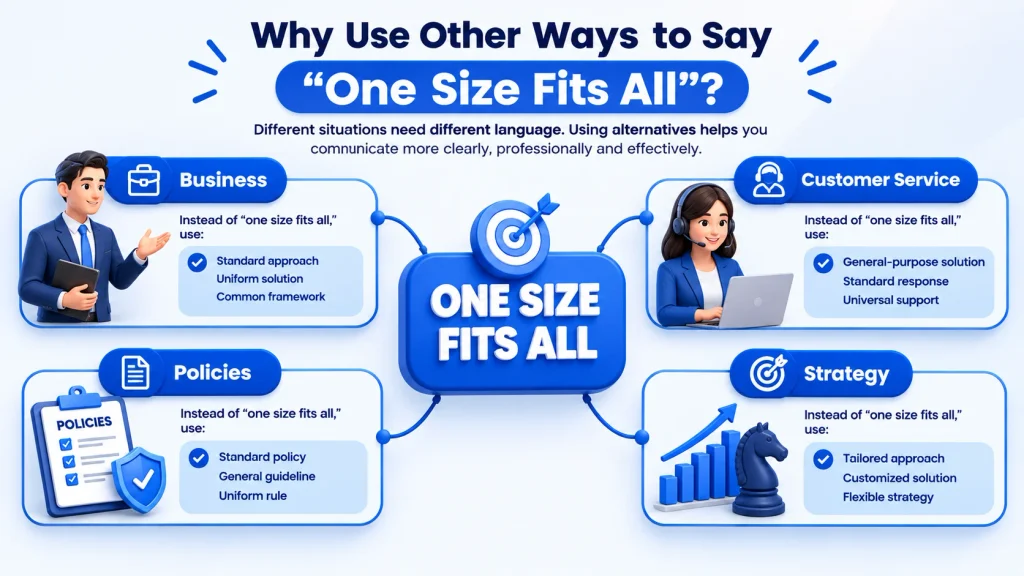
“One size fits all” describes an approach, product, policy, or solution that is intended to work equally well for everyone. The expression comes from products designed in a single size, but it is now commonly used in a broader figurative sense.
For example, a company might say, “There is no one-size-fits-all solution for employee training.” This means different employees may need different types of training rather than one identical program.
The phrase is common in business, education, healthcare discussions, technology, marketing, customer service, and everyday communication. It is often used to point out that individual needs or circumstances can vary.
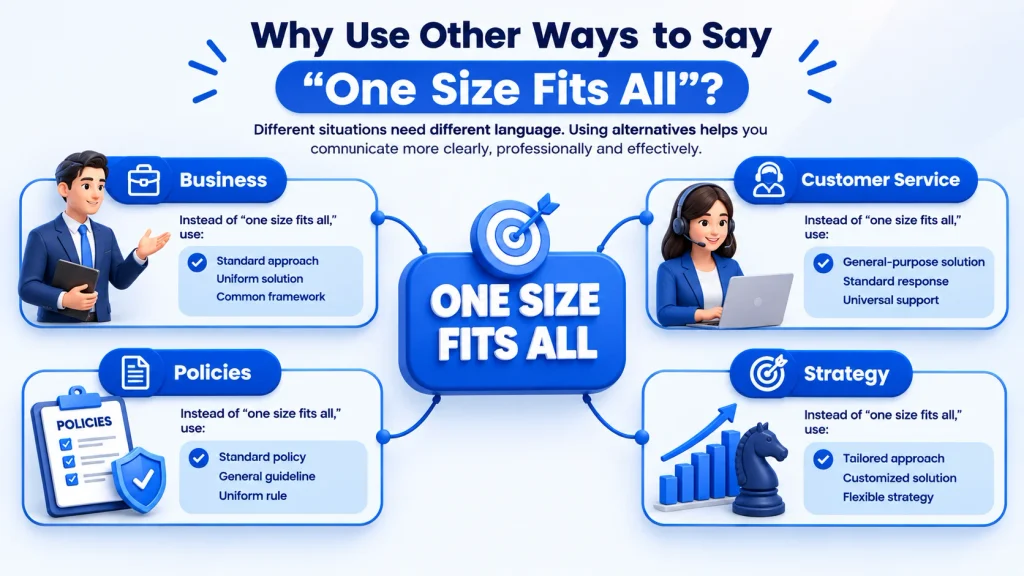
Using alternative expressions can make your writing more precise and professional. Instead of repeating the same phrase, you can choose wording that highlights universality, standardization, flexibility, or the limitations of a general approach.
Other alternatives can help you:
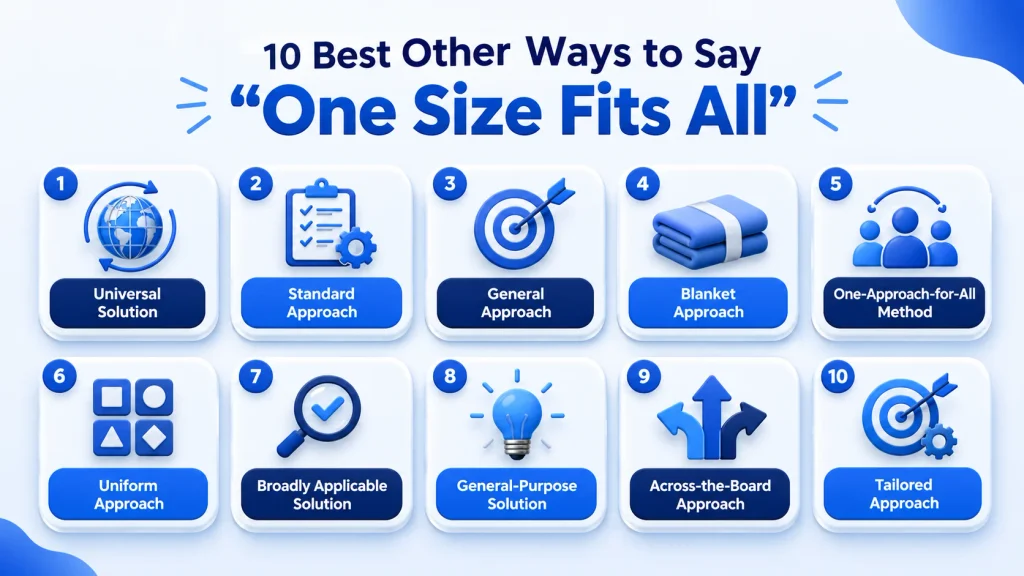
“Universal solution” refers to a solution that can work across many different people, situations, or needs. It emphasizes broad usefulness rather than a specific individual requirement.
“We are looking for a universal solution that can support teams across multiple departments.”
“This software provides a universal solution for managing basic scheduling needs.”
Use “universal solution” when you want a polished alternative that emphasizes broad applicability.
“Standard approach” describes a consistent method that is commonly used for a particular situation. Unlike “one size fits all,” it focuses more on consistency than on serving every person’s unique needs.
“Our company uses a standard approach when onboarding new employees.”
“The standard approach works well for routine requests, but complex cases require additional review.”
Use this phrase when consistency and established procedures are more important than customization.
“General approach” refers to a broad method that can apply to many situations without being designed for one specific case. It is useful when you want neutral and flexible wording.
“We can start with a general approach and adjust the plan based on customer feedback.”
“This general approach gives managers a useful framework for handling common concerns.”
Choose this option when you want to sound balanced without suggesting that the approach works perfectly for everyone.
“Blanket approach” describes applying the same rule, decision, or solution broadly to many people or situations. It can carry a slightly critical tone when individual circumstances are being overlooked.
“A blanket approach to employee scheduling may create problems for workers with different availability.”
“The organization decided against a blanket approach because each department has different requirements.”
Use “blanket approach” when you want to highlight the risk of treating different situations exactly the same way.
“One-approach-for-all method” clearly communicates the idea of using the same method for everyone. It is more explicit than the original idiom and can help readers understand the concept immediately.
“The training program avoids a one-approach-for-all method by offering different learning paths.”
“Our customer service team does not rely on a one-approach-for-all method.”
Use this wording when clarity is more important than using a short idiomatic expression.
“Uniform approach” refers to using the same process, standard, or method across different people or situations. It emphasizes consistency and equal treatment.
“The company adopted a uniform approach to reporting quarterly results.”
“A uniform approach can improve consistency across regional offices.”
This phrase works particularly well in business, operations, policy, and organizational writing.
A “broadly applicable solution” is designed to work across a wide range of circumstances. It suggests flexibility and usefulness without claiming that the solution is perfect for every person.
“We developed a broadly applicable solution for small and midsize businesses.”
“This framework is broadly applicable across several types of customer service teams.”
Use this phrase when you want to emphasize wide usefulness in professional or technical writing.
“General-purpose solution” describes something designed to handle a wide variety of common needs rather than one highly specific requirement. It is especially useful for products, tools, systems, and processes.
“We selected a general-purpose platform that can support several business functions.”
“This general-purpose solution gives smaller teams the flexibility to manage basic projects.”
Use it when discussing products, software, tools, systems, or resources intended for multiple uses.
“Across-the-board approach” means applying the same decision, change, rule, or standard broadly across a group. It often appears in business, finance, management, and policy discussions.
“The company avoided an across-the-board budget reduction because departments had different priorities.”
“An across-the-board policy change may not address the needs of every team.”
Use this phrase when a decision affects an entire group in the same way.
“Tailored approach” is often used as a contrast to “one size fits all.” It means adjusting a solution, strategy, or service to meet specific needs or circumstances.
“Our consultants use a tailored approach based on each client’s goals.”
“A tailored approach can produce better results than applying the same strategy to every customer.”
Choose “tailored approach” when you want to emphasize personalization rather than uniformity.
| Alternative | Best Used In | Tone |
|---|---|---|
| Universal Solution | Business, services, general writing | Professional |
| Standard Approach | Policies, procedures, workplace | Formal |
| General Approach | Plans, strategies, communication | Neutral |
| Blanket Approach | Policies, criticism, analysis | Professional, Critical |
| One-Approach-for-All Method | Explanations, training, business | Formal |
| Uniform Approach | Operations, policies, management | Formal |
| Broadly Applicable Solution | Business, technical writing | Professional |
| General-Purpose Solution | Products, software, tools | Professional |
| Across-the-Board Approach | Business, finance, policy | Formal |
| Tailored Approach | Consulting, customer service, strategy | Professional, Positive |
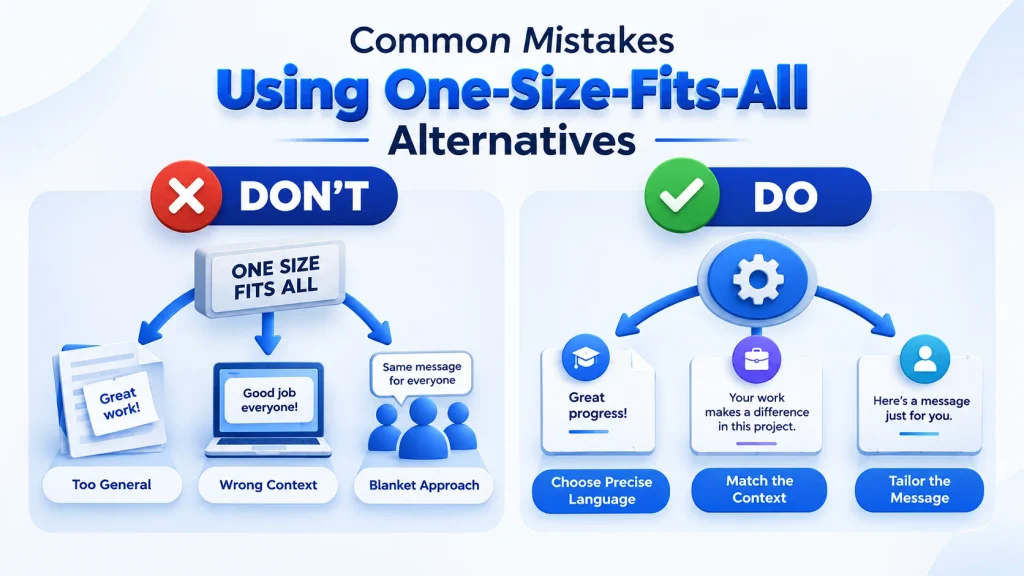
A universal solution may apply broadly without meeting every individual need perfectly. Avoid claiming that something works equally well for everyone unless you can support that statement.
“Blanket approach” can suggest that a solution is too broad or ignores important differences. If you want a positive meaning, “universal solution” or “broadly applicable solution” may be better.
“One size fits all” is widely understood, but formal business writing may benefit from more precise terms such as “standard approach,” “uniform approach,” or “broadly applicable solution.”
A standard approach emphasizes consistency, while a tailored approach emphasizes individual needs. Choosing the wrong term can change the intended meaning.
Not every process needs to be personalized. Routine tasks may benefit from a standard approach, while complex customer or employee needs may require a tailored strategy.
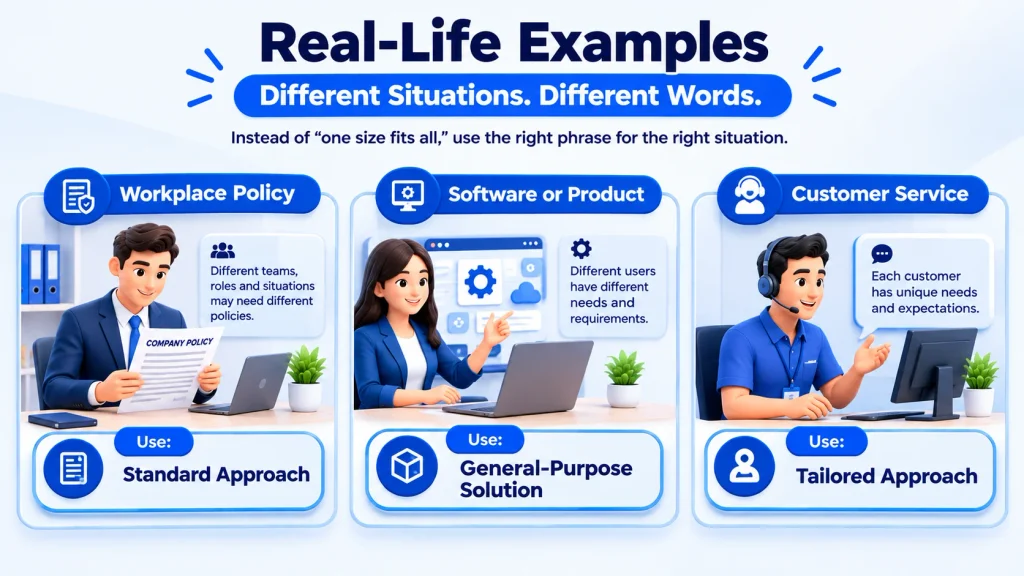
Common alternatives include “universal solution,” “standard approach,” “general approach,” “blanket approach,” and “uniform approach.” If you want to emphasize personalization instead, “tailored approach” is a useful contrast. The best choice depends on whether you are describing broad applicability, consistency, or a solution that does not account for individual differences.
In professional writing, “standard approach,” “universal solution,” “broadly applicable solution,” and “uniform approach” can replace “one size fits all.” If you are criticizing an overly broad strategy, “blanket approach” may be more precise. For business communication, choose the phrase that best describes whether the focus is consistency or flexibility.
The opposite of “one size fits all” is an individualized or tailored approach. Instead of giving everyone the same solution, a tailored approach adjusts a product, service, policy, or strategy according to specific needs. “Customized solution,” “personalized approach,” and “individualized strategy” can also communicate this idea.
“One size fits all” is widely understood and acceptable in many types of English, including professional communication. However, it is somewhat conversational and idiomatic. In highly formal or technical writing, terms such as “universal solution,” “standard approach,” or “uniform method” may communicate the idea more precisely.
A “one size fits all approach” means using the same solution, process, policy, or strategy for everyone or every situation. The expression can be neutral, but it is often used critically when people believe different circumstances require different solutions. For example, employee training may need to vary based on experience and job responsibilities.
Yes, but the meanings are not always identical. A blanket approach specifically suggests applying the same rule or decision broadly, often without considering individual circumstances. It can therefore sound critical. If you simply want to describe something that works across many situations, “universal solution” may be a better choice.
You can say, “There is no universal solution,” “Every situation is different,” or “A tailored approach is often necessary.” In professional writing, “The best solution depends on individual needs” is especially clear. These alternatives communicate that different circumstances may require different strategies or recommendations.
“Standard approach,” “universal solution,” and “broadly applicable solution” are strong choices for business writing. If the context involves customers, employees, or complex projects with different requirements, “tailored approach” can be more effective. The right phrase should reflect whether your goal is consistency, broad application, or personalization.
“One size fits all” is a useful expression for describing a solution, policy, or approach intended to work across different situations. However, the best alternative depends on the exact meaning you want to communicate.
For professional writing, “standard approach” and “uniform approach” emphasize consistency, while “universal solution” and “broadly applicable solution” emphasize wide usefulness. When you want to point out that a strategy is too broad, “blanket approach” is more precise. If you want to highlight personalization, “tailored approach” provides a strong contrast.
The key is to choose words that match your context. A well-selected alternative can make business writing clearer, more precise, and more natural while helping readers understand exactly what you mean.

English Language & Communication Specialist
Dr. Emily Carter is an English language and communication specialist focused on vocabulary, word choice, professional writing, and practical English usage. She helps readers understand the differences between similar words and choose expressions that sound natural, clear, and appropriate for different contexts.













