
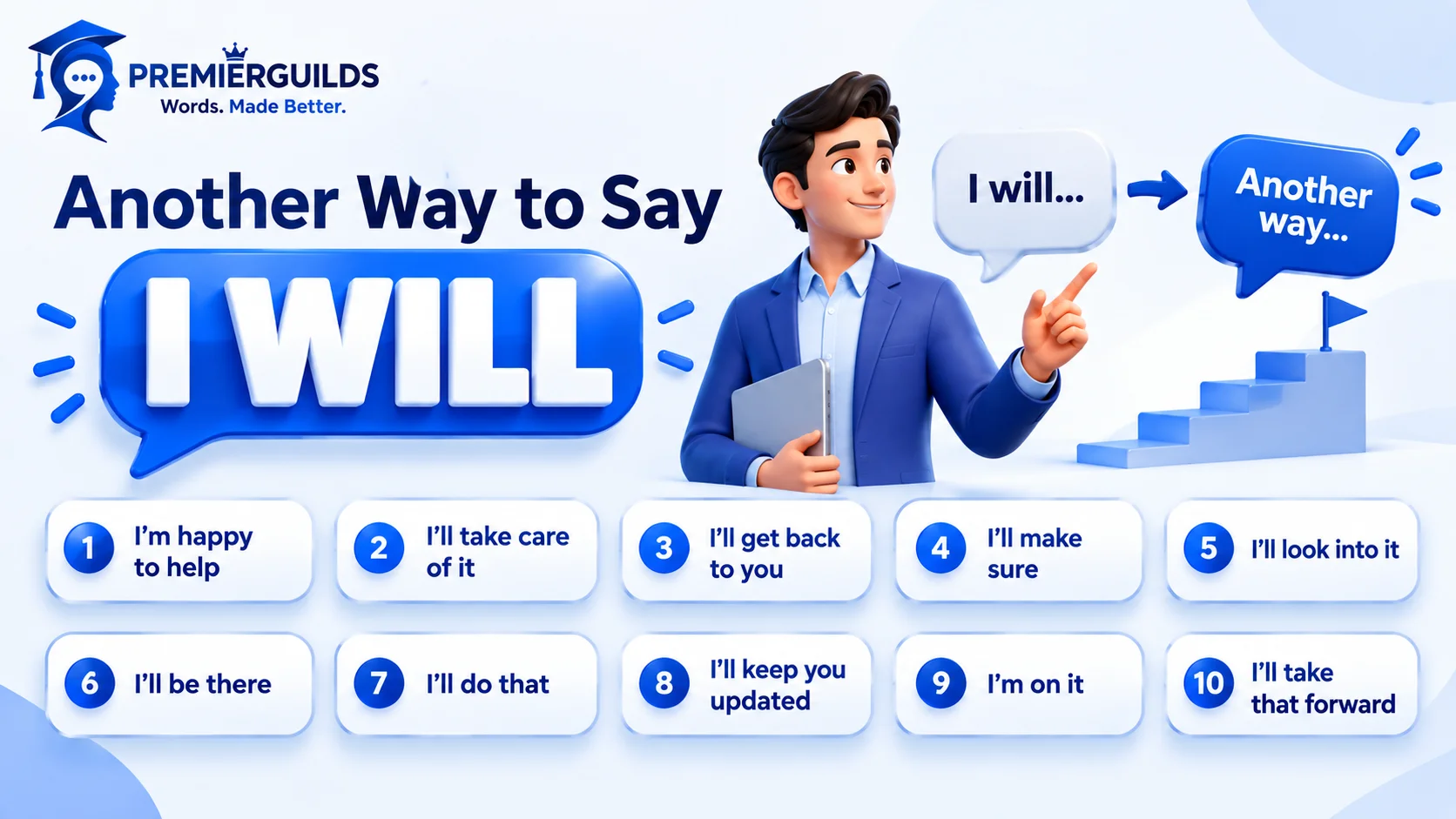
Looking for another way to say I will? Depending on the situation, you can say I’m going to, I plan to, I intend to, I’ll make sure to, I’d be happy to, I expect to, or I’m committed to. The best choice depends on whether you are expressing a plan, promise, willingness, or future action.
“I will” is one of the most common ways to talk about future actions, decisions, promises, and commitments. However, repeating it too often can make your writing sound basic or repetitive.
Fortunately, English offers many natural alternatives. The right phrase can help you show confidence, intention, willingness, responsibility, or formality more clearly.
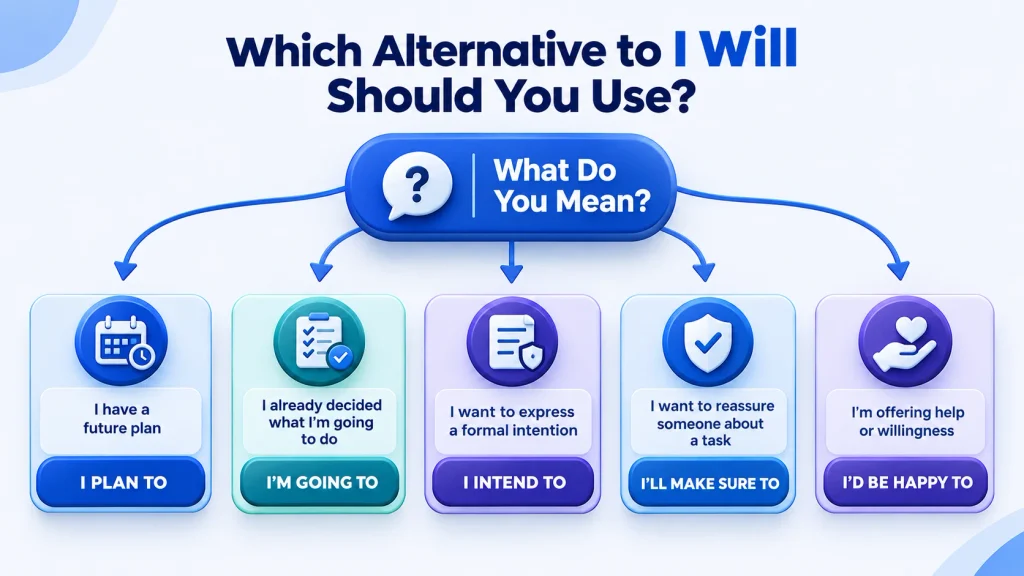
“Another way to say I will” refers to different expressions that communicate a future action or intention without repeatedly using the exact phrase “I will.”
For example, instead of saying, “I will send the report tomorrow,” you could say, “I plan to send the report tomorrow.” Both sentences describe a future action, but the second version emphasizes your plan.
These alternatives are useful in emails, conversations, business communication, academic writing, customer service, and professional settings. Your choice should depend on what you want to communicate and how formal the situation is.
Using different expressions can make your communication more precise and natural. Although “I will” is grammatically correct, another phrase may better express your specific meaning.
Here are a few reasons to use alternatives:
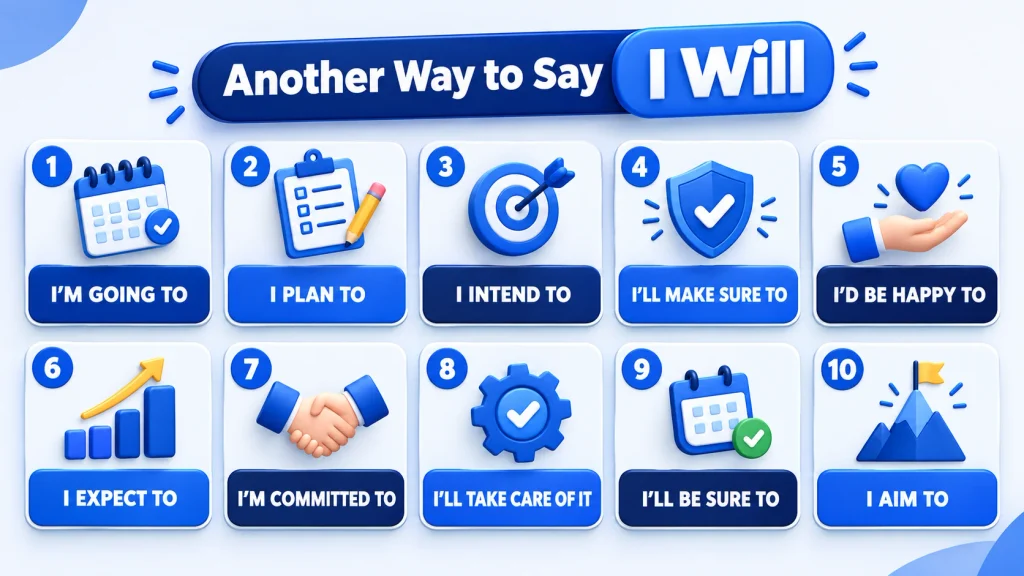
“I’m going to” is a natural way to describe a future action that you have already decided or planned to take. It is common in everyday American English and works well in casual and professional conversations.
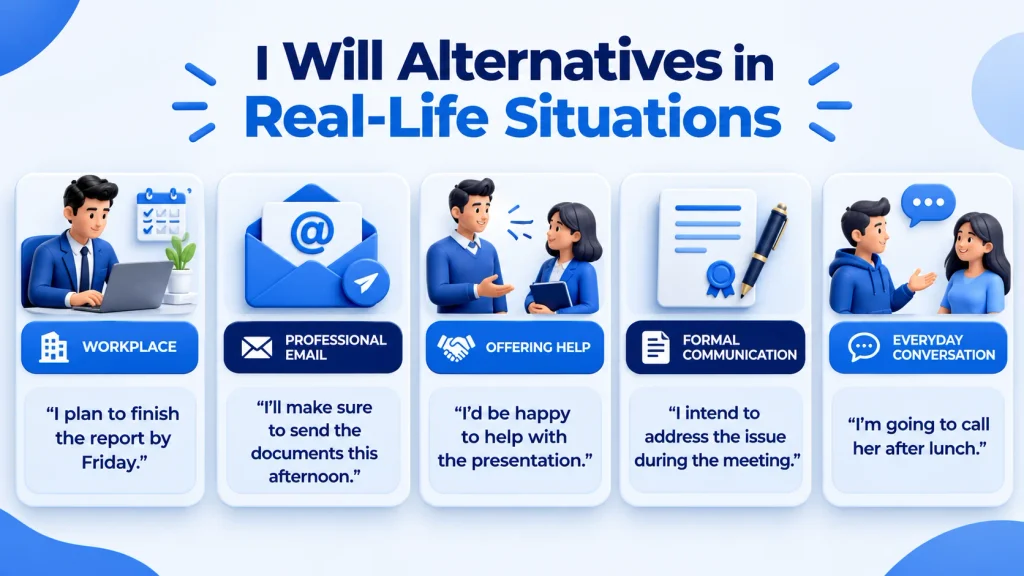
“I’m going to review the proposal before our meeting.”
“I’m going to call the client this afternoon to discuss the changes.”
Use “I’m going to” when the future action feels like an established plan rather than a sudden decision.
“I plan to” clearly communicates an intention or future plan. It sounds natural in both professional and everyday settings without being overly formal.
“I plan to finish the first draft by Friday.”
“We plan to expand the training program next year.”
Choose “I plan to” when you want to emphasize that an action is part of your intended schedule.
“I intend to” expresses a deliberate intention to do something. It has a more formal tone than “I’m going to,” making it useful when your writing needs to sound serious or professional.
“I intend to address each concern during the next meeting.”
“I intend to submit the completed application before the deadline.”
Use “I intend to” when you want your future action to sound deliberate and purposeful.
“I’ll make sure to” communicates a commitment to complete an action. It is especially useful when someone has asked you to remember, handle, or follow up on something.
“I’ll make sure to include the updated figures in the report.”
“I’ll make sure to send you the meeting notes after the call.”
Use this expression when you want to reassure someone that you will take care of a specific responsibility.
“I’d be happy to” expresses willingness to do something and gives the sentence a warm, cooperative tone. It is especially effective when responding to a request or offering assistance.
“I’d be happy to answer any questions about the proposal.”
“I’d be happy to schedule a follow-up call next week.”
Use “I’d be happy to” when you want your response to sound helpful rather than simply stating what you will do.
“I expect to” describes something you believe or anticipate will happen in the future. Unlike “I will,” it can communicate an expectation rather than a firm promise.
“I expect to receive the final numbers by Wednesday.”
“I expect to complete the training program later this month.”
Use this phrase when the future event depends partly on circumstances rather than being entirely under your control.
“I’m committed to” shows a strong level of dedication toward an action, goal, or responsibility. It is particularly useful when discussing professional goals, promises, or long-term efforts.
“I’m committed to providing accurate information to our customers.”
“I’m committed to improving the team’s communication process.”
Remember that “committed to” is followed by a noun or -ing form, such as “committed to improving,” not “committed to improve.”
“I’ll take care of it” tells someone that you will handle a task or problem. It sounds confident and practical, especially when someone has assigned you a responsibility.
“Thanks for pointing out the error. I’ll take care of it today.”
“Don’t worry about the reservation; I’ll take care of it.”
This phrase works best when the listener already understands what task you are referring to.
“I’ll be sure to” communicates that you intend to remember and complete an action. It is polite and reassuring, particularly when responding to instructions or requests.
“I’ll be sure to review the document before sending it.”
“I’ll be sure to let Sarah know about the schedule change.”
Use “I’ll be sure to” when you want to emphasize that you will not forget an important action.
“I aim to” expresses a goal or target that you hope to accomplish. It is useful when the outcome is an objective rather than a guaranteed promise.
“I aim to complete the project ahead of schedule.”
“Our team aims to improve response times throughout the quarter.”
Use “I aim to” when you want to communicate an objective without making an absolute guarantee.
| Alternative | Best Used In | Tone |
|---|---|---|
| I’m Going To | Everyday conversations, plans | Natural, conversational |
| I Plan To | Work, school, everyday communication | Clear, neutral |
| I Intend To | Formal and professional writing | Formal, deliberate |
| I’ll Make Sure To | Workplace requests and responsibilities | Responsible, reassuring |
| I’d Be Happy To | Offers and requests | Warm, polite |
| I Expect To | Professional plans and predictions | Neutral, confident |
| I’m Committed To | Goals and responsibilities | Strong, dedicated |
| I’ll Take Care Of It | Tasks and problems | Confident, practical |
| I’ll Be Sure To | Requests and reminders | Polite, reassuring |
| I Aim To | Goals and objectives | Professional, purposeful |
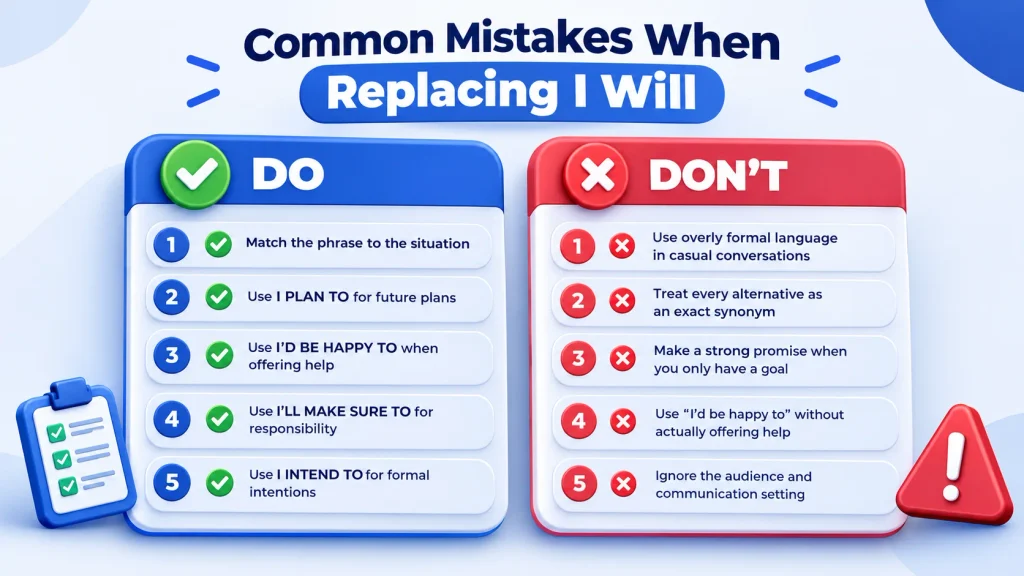
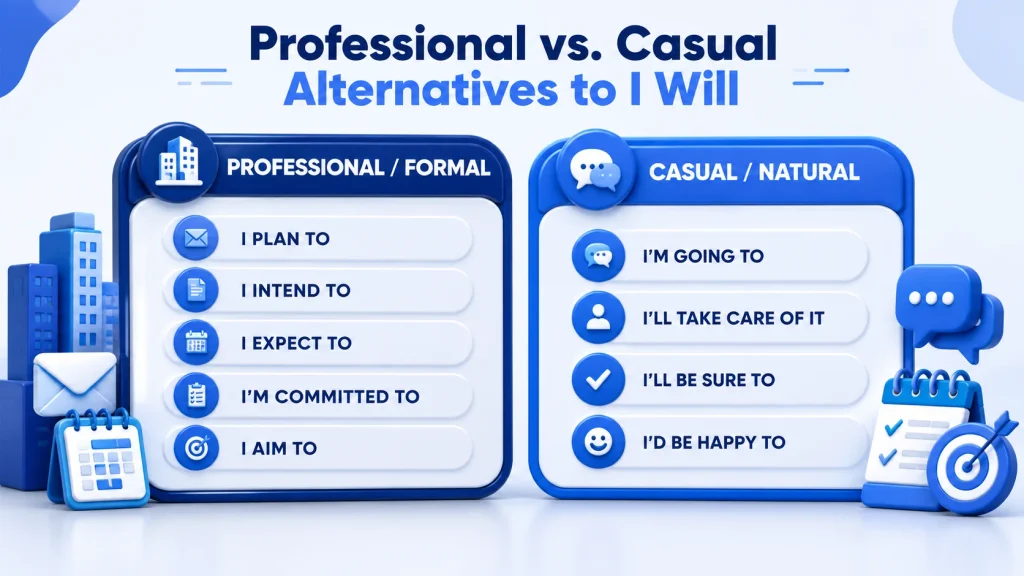
Expressions such as “I intend to” can sound unnecessarily serious in a relaxed conversation. If you are talking with a friend, “I’m going to” or “I’ll” usually sounds more natural.
Not every replacement carries exactly the same meaning. For example, “I aim to” describes a goal, while “I’ll make sure to” communicates a stronger commitment to completing something.
“I will” can sound definite, while “I expect to” or “I aim to” may be more accurate when circumstances could affect the outcome. Choose language that honestly reflects your level of certainty.
A professional email may benefit from “I plan to” or “I intend to,” while a casual conversation may sound more natural with “I’m going to.” Always consider who will read or hear your message.
“I’d be happy to” communicates willingness and a positive attitude. If you are simply announcing a planned action, “I plan to” may communicate your meaning more accurately.
Professional alternatives include “I plan to,” “I intend to,” “I’ll make sure to,” “I expect to,” and “I’m committed to.” The best choice depends on your intended meaning. For example, “I plan to complete the report” states a plan, while “I’m committed to completing the report” emphasizes dedication.
“I’d be happy to” and “I’ll be sure to” are two polite options. For example, “I’d be happy to help with the presentation” sounds warm and cooperative. “I’ll be sure to send the document” reassures the other person that you will remember the requested task.
“I’m going to” and “I will” can both describe future actions, but they can carry slightly different nuances. “I’m going to” often refers to an existing plan, while “I will” can express a decision, promise, willingness, or future action depending on context.
For professional emails, consider phrases such as “I plan to,” “I’ll make sure to,” “I’ll be sure to,” or “I’d be happy to.” For example, instead of “I will send the file shortly,” you could write, “I’ll be sure to send the file shortly.”
“I intend to” is a formal alternative when you want to express a deliberate intention. “I aim to” can also work when describing a professional goal. However, neither phrase should automatically replace “I will”; choose based on whether you are stating an intention, goal, or firm commitment.
Depending on the situation, you can say “I’ll take care of it,” “I’ll make sure to do it,” or “I plan to handle it.” “I’ll take care of it” sounds confident and practical, while “I’ll make sure to do it” places more emphasis on completing the responsibility.
“I’d be happy to help” is a warm and polite alternative. In professional communication, you could also say, “I’d be glad to assist.” If you are describing a planned action rather than offering willingness, “I plan to help” may be more appropriate.
Look at the exact meaning of each sentence before replacing the phrase. Use “I plan to” for intentions, “I’m going to” for established plans, “I’d be happy to” for willingness, and “I’m committed to” for strong dedication. This creates variety without changing your intended message.
There are many natural ways to say “I will,” and the best choice depends on what you want to communicate. “I’m going to” works well for established plans, while “I plan to” clearly states an intention. For formal communication, “I intend to” can sound more deliberate. If you want to reassure someone about a responsibility, “I’ll make sure to” or “I’ll be sure to” works well.
For offers, “I’d be happy to” adds a warm and cooperative tone. Meanwhile, “I’m committed to” emphasizes dedication, and “I aim to” works better for goals than firm promises. The key is not simply to replace “I will” with a different phrase, but to choose wording that accurately matches your meaning, audience, and level of certainty.

Our editorial team brings together decades of expertise in applied linguistics, lexicography, and educational publishing. Dedicated to clarity, precision, and tone, our experts ensure that every resource meets the highest standards of professional and academic excellence.













