
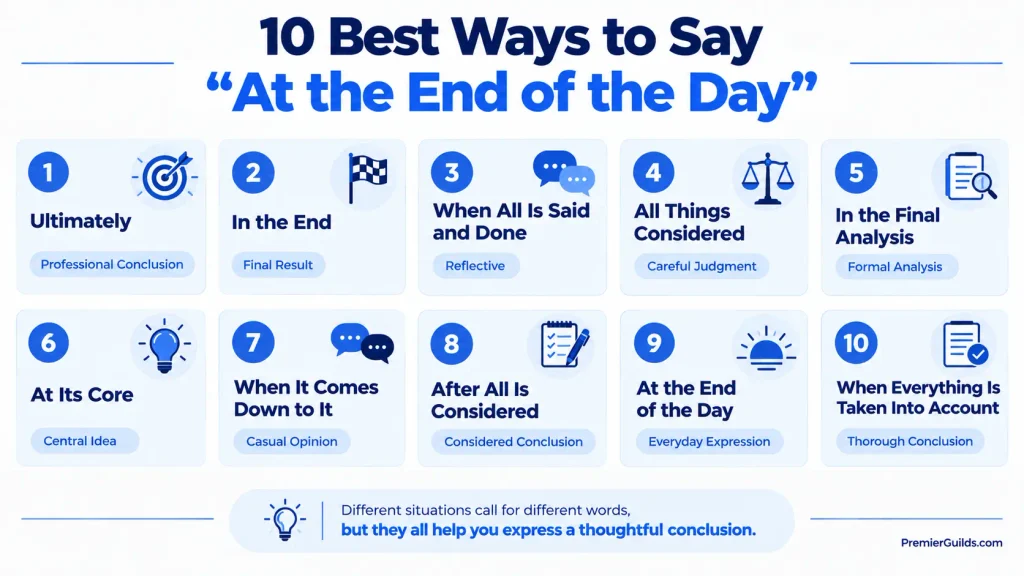
Looking for another way to say “at the end of the day”? Natural alternatives include ultimately, when all is said and done, in the final analysis, in the end, all things considered, and ultimately speaking. The best choice depends on whether you want to sound professional, casual, reflective, or focused on the final result.
The phrase “at the end of the day” often means when everything is considered or when the final result matters. While it is common in American English, repeating it too often can make your writing sound predictable.
Fortunately, you have many natural alternatives. Some work better in professional writing, while others fit casual conversations, opinions, conclusions, and reflective statements.
When someone searches for another way to say “at the end of the day,” they usually want a phrase that expresses a final conclusion, overall judgment, or the most important point after considering everything.
For example, “At the end of the day, customer satisfaction matters most” could become “Ultimately, customer satisfaction matters most.”
The original phrase is common in conversations, workplace discussions, essays, and opinion-based writing. However, alternatives can make your language more precise and help you avoid repetition.
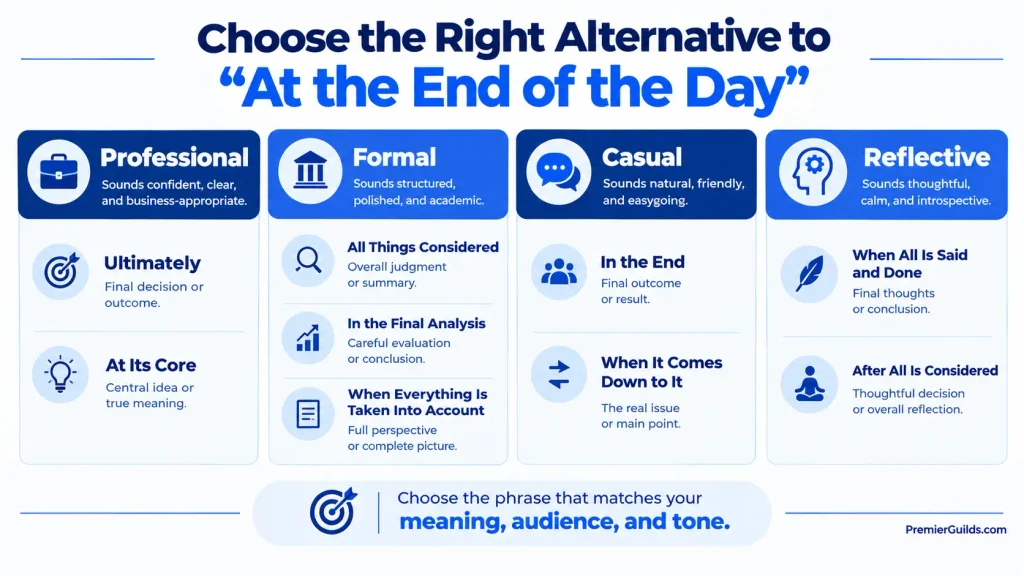
Using alternatives can make your communication clearer and more natural. The best replacement depends on whether you are discussing a final result, giving an opinion, summarizing evidence, or speaking casually.
Benefits include:
“Ultimately” means when everything has been considered or when the final result is what matters most. It is concise and works especially well when making a conclusion.
Ultimately, the success of the project depends on how well the team works together.
Ultimately, we chose the option that offered the best value for our customers.
Use “ultimately” when you want a polished replacement in business writing, reports, essays, or professional discussions.
“In the end” refers to the final outcome or conclusion after events have taken place. It is simple and natural without sounding overly formal.
In the end, we decided to postpone the trip until next month.
In the end, what mattered was that everyone felt heard.
Choose “in the end” when you want a familiar phrase that sounds natural in both conversation and general writing.
“When all is said and done” means after everything has been discussed, considered, or completed. It often introduces a final opinion or lesson.
When all is said and done, spending time with family is what matters most to me.
When all is said and done, the experience taught us more than the result did.
This phrase has a conversational and reflective feel, so it is better suited to speeches, blogs, personal writing, and everyday conversations than highly formal documents.
“All things considered” means after taking all relevant facts, circumstances, or opinions into account. It is useful when you reach a conclusion after weighing different factors.
All things considered, moving the meeting online was the most practical choice.
All things considered, the benefits of the new policy outweigh its disadvantages.
Use this expression when your conclusion comes from comparing several advantages, disadvantages, facts, or circumstances.
“In the final analysis” introduces a conclusion based on careful examination. It has a more formal and analytical tone than everyday alternatives.
In the final analysis, the proposal must provide measurable benefits for employees.
In the final analysis, strong communication was the key factor behind the team’s success.
This phrase works particularly well in essays, reports, analysis, and other formal writing. Avoid it in relaxed conversation if you want to sound casual.
“At its core” focuses on the central idea, essential truth, or most important part of something. It does not always mean a final conclusion, but it can replace “at the end of the day” when the intended meaning is “when you look at what really matters.”
At its core, the program is designed to help students become more confident writers.
At its core, the disagreement was about how the company should serve its customers.
Use “at its core” when you want to emphasize the fundamental issue rather than simply describe the final outcome.
“When it comes down to it” means when the most important issue or practical choice is considered. It is often used before stating a personal opinion or final judgment.
When it comes down to it, I would rather choose quality over convenience.
When it comes down to it, the decision depends on what works best for your team.
This expression sounds conversational, so it is a good choice for discussions, interviews, personal writing, and informal workplace communication.
“After all is considered” emphasizes reaching a conclusion after reviewing the relevant information. It has a thoughtful and measured tone.
After all is considered, the additional investment appears to be worthwhile.
After all is considered, the simpler solution may be the most effective.
Use this phrase when you want to clearly signal that your conclusion follows careful consideration of several factors.
Although the goal is to find an alternative, the original phrase itself remains useful. “At the end of the day” commonly emphasizes what matters most after everything else has been considered.
At the end of the day, everyone wants to feel respected at work.
At the end of the day, the final choice is yours to make.
There is nothing wrong with using the original expression. Simply avoid relying on it repeatedly when a more precise alternative would communicate your meaning better.
“When everything is taken into account” means after all relevant facts, circumstances, and considerations have been included. It clearly signals a carefully reached conclusion.
When everything is taken into account, the revised plan offers the strongest long-term benefits.
When everything is taken into account, the additional cost is reasonable for the extra features.
This longer expression is useful when you want to emphasize thorough consideration rather than simply state a final opinion.
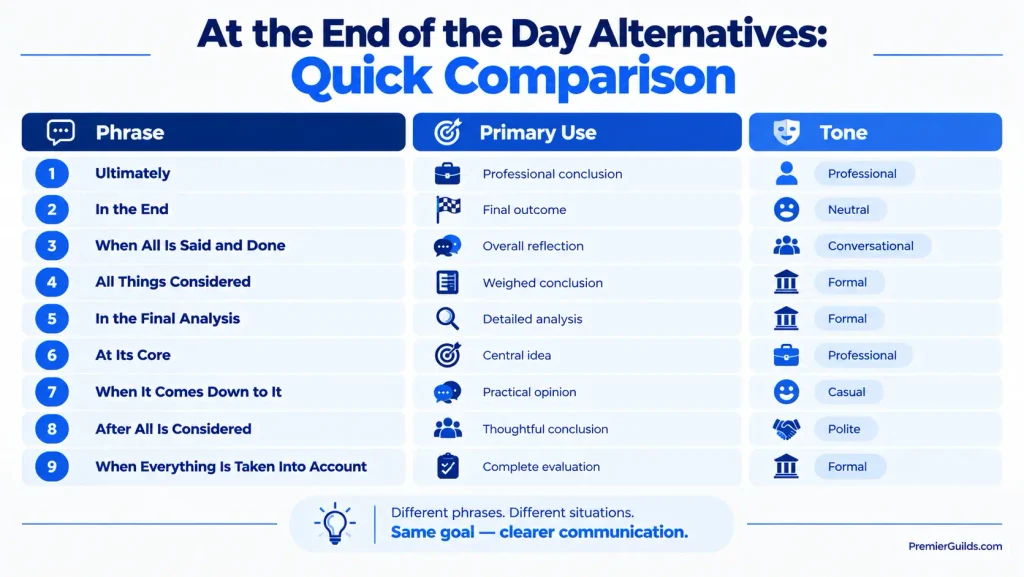
| Alternative | Best Used In | Tone |
| Ultimately | Business, essays, conclusions | Professional |
| In the End | Everyday conversation and writing | Neutral |
| When All Is Said and Done | Personal writing, conversations | Casual |
| All Things Considered | Analysis, decisions, professional writing | Formal |
| In the Final Analysis | Reports, essays, analysis | Formal |
| At Its Core | Explaining central ideas | Professional |
| When It Comes Down to It | Conversations, opinions | Casual |
| After All Is Considered | Careful conclusions | Polite |
| At the End of the Day | Everyday speech and writing | Casual |
| When Everything Is Taken Into Account | Detailed conclusions | Formal |
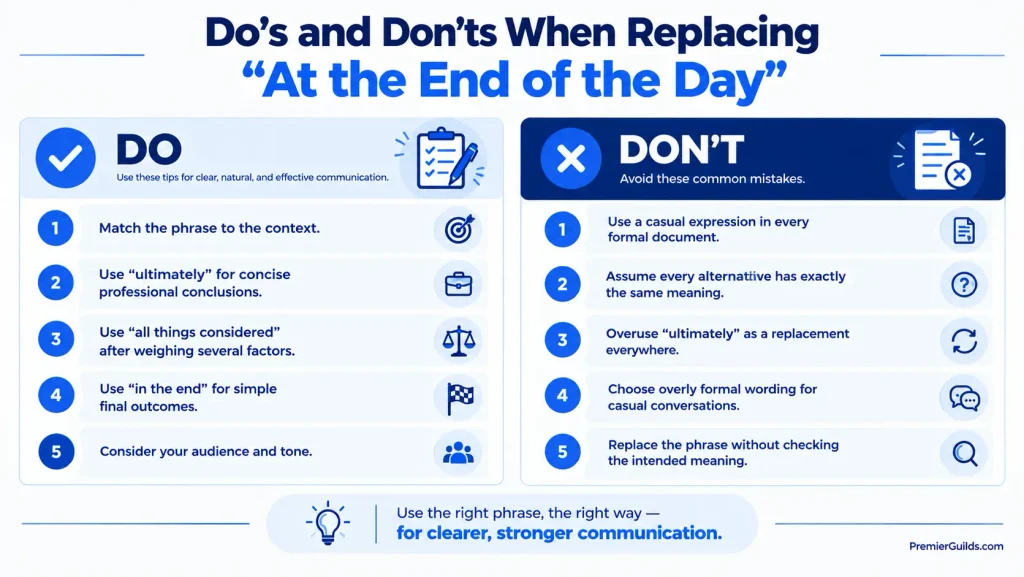
Expressions such as “when it comes down to it” can sound too conversational in an academic paper or formal report. Choose “ultimately” or “all things considered” when appropriate.
These phrases are related but not identical. “At its core” focuses on the central idea, while “in the end” usually focuses on the final outcome.
A phrase such as “in the final analysis” may feel unnatural in a casual conversation. Simple wording is often better when the situation is informal.
Replacing “at the end of the day” with “ultimately” does not solve repetition if you use “ultimately” in every paragraph. Vary your wording based on the exact meaning.
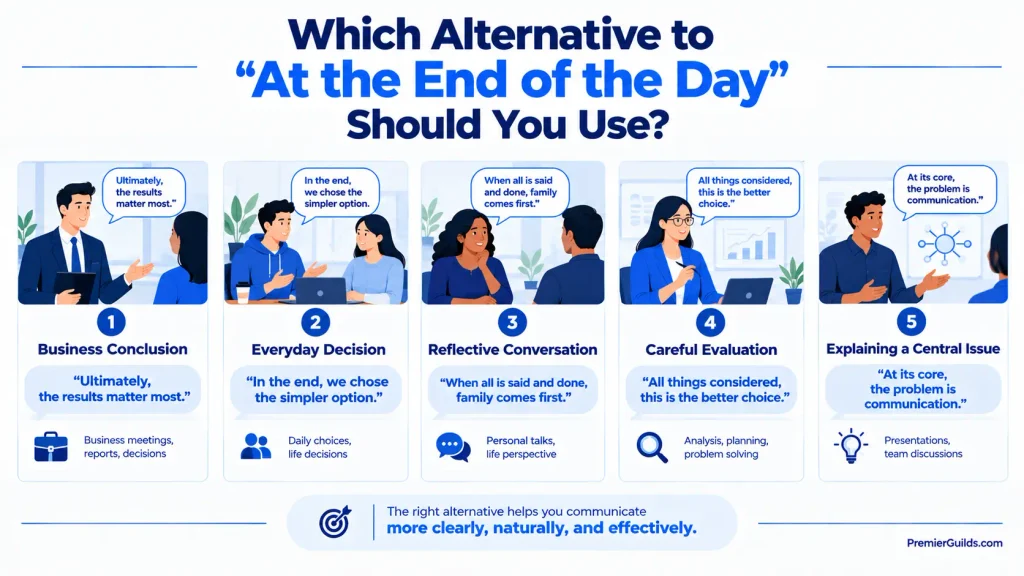
Think about your audience and purpose before choosing an alternative. A business email, college essay, friendly conversation, and personal blog may all require different wording.
“Ultimately” is one of the strongest professional alternatives. It is concise, natural, and works well in emails, reports, presentations, and business discussions. “All things considered” is another good option when you want to show that you reached your conclusion after weighing several factors.
For casual conversation, try “in the end,” “when all is said and done,” or “when it comes down to it.” These expressions sound natural and conversational. The best choice depends on whether you are emphasizing the final result, a personal opinion, or a broader life lesson.
Yes. “Ultimately” is often an excellent replacement when “at the end of the day” means when everything is considered or what matters most. For example, “Ultimately, customer satisfaction matters most” has a concise, professional tone.
They can have similar meanings, but they are not always interchangeable. “In the end” usually focuses on the final outcome of a situation, while “at the end of the day” often emphasizes an overall judgment or the most important point.
Good formal alternatives include “ultimately,” “all things considered,” “in the final analysis,” and “when everything is taken into account.” These phrases work well in professional and academic writing when you need to introduce a conclusion or summarize a reasoned judgment.
It can be used in professional communication, but it has a conversational and reflective tone. It may work well in a presentation, interview, or personal business message. For formal reports or academic writing, “ultimately” or “all things considered” is usually a better choice.
For an essay, consider “ultimately,” “all things considered,” or “in the final analysis.” These alternatives can make your conclusion sound more precise. Choose based on your meaning rather than simply replacing the phrase word for word.
The phrase is common and not grammatically incorrect, but frequent repetition can make writing feel less precise. Using alternatives lets you distinguish between a final outcome, a central idea, a carefully considered judgment, and a personal reflection.
There are many effective ways to say “at the end of the day,” but the best choice depends on your intended meaning and tone. Use “ultimately” for concise professional writing, “in the end” for simple everyday language, and “all things considered” when your conclusion follows a review of several factors. For more context, see the meaning and usage of “at the end of the day.”
For a reflective or conversational style, “when all is said and done” and “when it comes down to it” sound natural. If you are discussing the central idea rather than a final result, “at its core” may be more accurate.
The key is to choose an expression that matches the situation instead of replacing the original phrase automatically. The right alternative should make your meaning clearer, your tone more natural, and your writing more precise.

Our editorial team brings together decades of expertise in applied linguistics, lexicography, and educational publishing. Dedicated to clarity, precision, and tone, our experts ensure that every resource meets the highest standards of professional and academic excellence.