

Looking for another way to say thanks for your patience? Try I appreciate your patience, thank you for waiting, I appreciate your understanding, thank you for bearing with me, or I’m grateful for your patience. The best choice depends on whether you are writing a professional email, apologizing for a delay, or speaking casually.

Looking for another way to say “thanks for your patience” means finding a different expression to show appreciation when someone has waited, tolerated a delay, or remained understanding during a difficult or time-consuming situation.
The phrase commonly appears in customer service messages, business emails, workplace communication, support responses, and everyday conversations. You might use it after a delayed reply, extended wait, technical issue, scheduling problem, or lengthy process.
Different alternatives can emphasize different things. Some focus directly on the person’s patience, while others highlight their understanding, flexibility, cooperation, or willingness to wait.
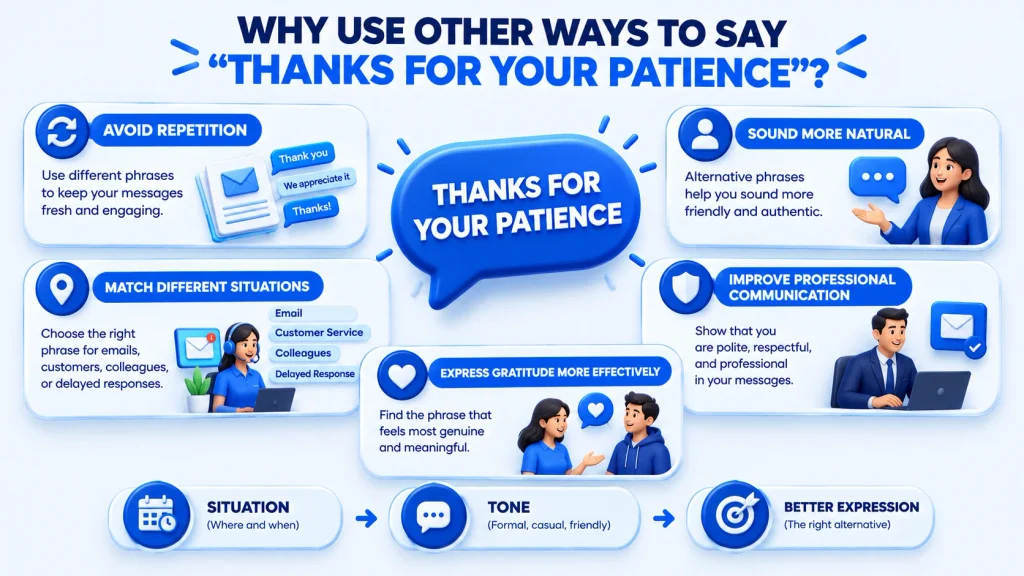
Using different expressions can help you make your gratitude sound more natural and appropriate for the situation. A customer service email may need polished wording, while a message to a coworker can be warmer and more conversational.
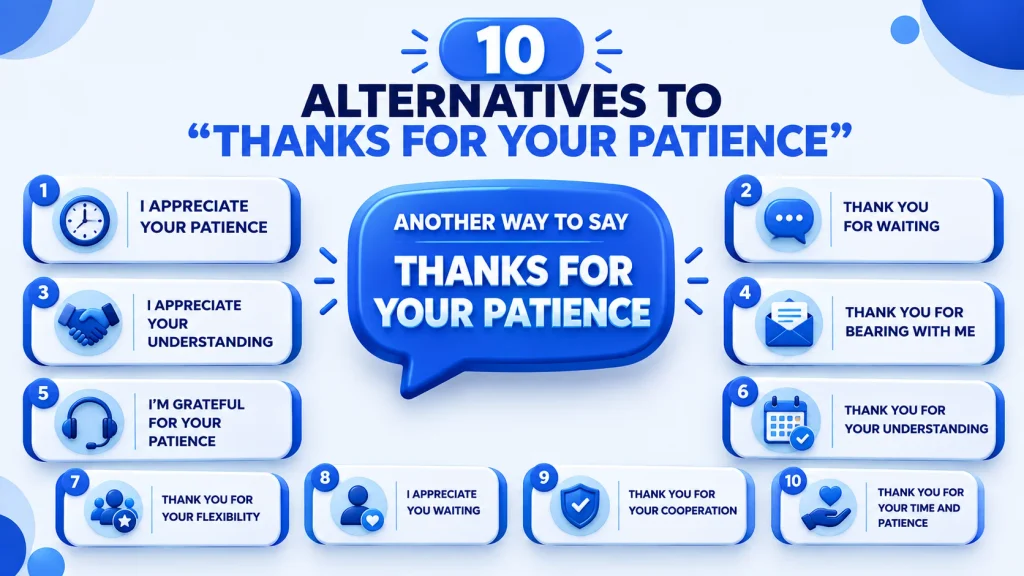
“I appreciate your patience” is a polished and widely useful alternative to “thanks for your patience.” It directly acknowledges the person’s willingness to wait and works especially well when you want your message to sound professional and sincere.
I appreciate your patience while our team reviews your application.
I appreciate your patience as we work through the remaining issues with your account.
Use this as a dependable choice for professional emails, customer service replies, and workplace communication.
“Thank you for waiting” directly recognizes the time someone spent waiting for a response, service, decision, or update. It is simple, clear, and less formal than some business-oriented alternatives.
Thank you for waiting while I gathered the information you requested.
Thank you for waiting while we prepared your order for pickup.
Choose this phrase when the person has literally been waiting for something and you want to acknowledge that specific action.
“I appreciate your understanding” shifts the focus from waiting to accepting a situation or delay. It works well when you have explained a problem, change, limitation, or inconvenience and want to acknowledge the other person’s cooperation.
I appreciate your understanding as we adjust the meeting schedule.
I appreciate your understanding while we resolve this unexpected issue.
Use this when the person’s patience involves accepting circumstances rather than simply waiting.
“Thank you for bearing with me” is a warm and conversational way to appreciate someone’s patience during a delay, mistake, explanation, or complicated process. It feels more personal than standard business wording.
Thank you for bearing with me while I walk through the new process.
Thank you for bearing with me while I sort out the details.
This phrase is especially natural when you are speaking directly to someone who has been patient with you.
“I’m grateful for your patience” expresses a stronger sense of appreciation than a basic thank-you. It can make your message feel sincere and personal while still remaining appropriate in many professional situations.
I’m grateful for your patience during this unexpected transition.
I’m grateful for your patience while we complete the final review.
Use this when you want your gratitude to sound especially sincere without becoming overly emotional.
“Thank you for your understanding” is a common professional expression used when someone has accepted an explanation, delay, change, or inconvenience. It emphasizes mutual understanding rather than the amount of time the person waited.
Thank you for your understanding regarding the revised delivery schedule.
Thank you for your understanding while we make these necessary changes.
This is a strong choice when you have already explained why a delay or change occurred.
“Thank you for your flexibility” recognizes someone’s willingness to adapt when plans, schedules, or expectations change. It is particularly useful when patience involves adjusting to circumstances rather than simply waiting.
Thank you for your flexibility as we move the training session to next Thursday.
Thank you for your flexibility with the revised project timeline.
Use this when someone has adjusted their plans or expectations to accommodate a change.
“I appreciate you waiting” is a direct and friendly expression that acknowledges someone’s time and patience. It sounds personal and conversational while still being suitable for many workplace interactions.
I appreciate you waiting while I checked those figures for you.
I appreciate you waiting for me after the meeting ran longer than expected.
This option works naturally in direct conversations and informal professional messages.
“Thank you for your cooperation” focuses on the person’s willingness to work with you during a process or situation. It is more formal than “thanks for your patience” and often fits instructions, procedures, requests, or business notices.
Thank you for your cooperation while we complete the required security checks.
Thank you for your cooperation as we transition to the new scheduling system.
Choose this phrase when the person’s helpful participation matters as much as their patience.
“Thank you for your time and patience” recognizes two things at once: the time someone has given and their willingness to remain patient. It is a useful choice when a process has taken longer than expected.
Thank you for your time and patience while we reviewed your request.
Thank you for your time and patience throughout the interview process.
Use this when the person has invested both time and patience in a longer interaction or process.
| Alternative | Best Used In | Tone |
|---|---|---|
| I Appreciate Your Patience | Professional emails and customer service | Professional |
| Thank You for Waiting | Direct conversations and delays | Friendly |
| I Appreciate Your Understanding | Explanations and difficult situations | Polite |
| Thank You for Bearing With Me | Personal and conversational messages | Warm |
| I’m Grateful for Your Patience | Meaningful or sincere appreciation | Warm |
| Thank You for Your Understanding | Business communication and notices | Formal |
| Thank You for Your Flexibility | Schedule or plan changes | Professional |
| I Appreciate You Waiting | Direct workplace conversations | Friendly |
| Thank You for Your Cooperation | Procedures and formal requests | Formal |
| Thank You for Your Time and Patience | Longer processes and interactions | Professional |
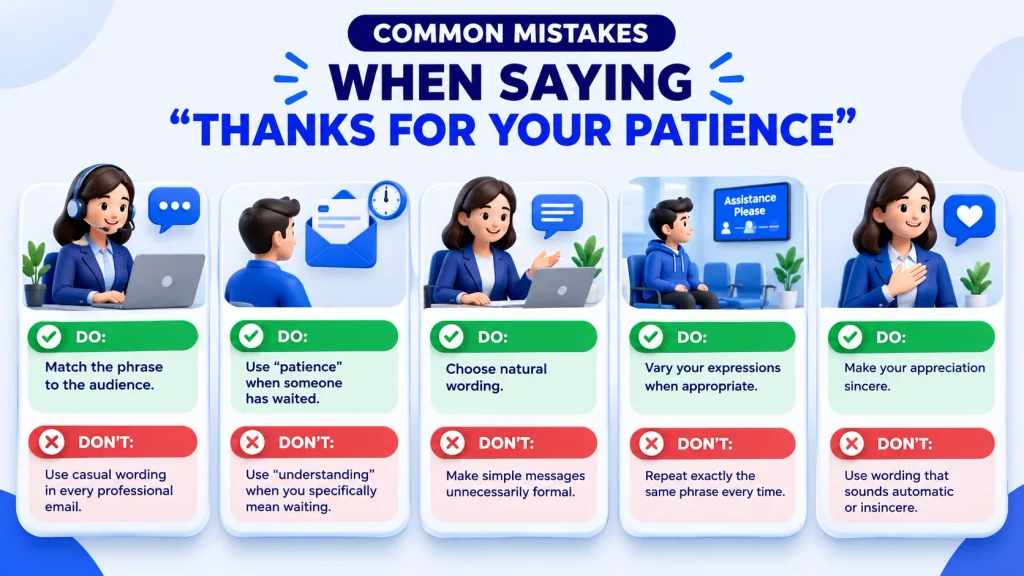
Some alternatives sound more conversational than others. For a customer, manager, or formal business contact, “I appreciate your patience” may fit better than a highly casual expression.
“Patience” and “understanding” are related but not identical. If someone has simply waited for a response, “thank you for waiting” may be more precise.
“Thank you for your cooperation” can sound appropriate in formal notices, but it may feel stiff in a friendly conversation. Match the phrase to the relationship and context.
Using “thanks for your patience” in every delayed-response message can make your communication feel repetitive. Rotate between natural alternatives when the context supports it.
A thank-you should fit the situation and acknowledge what the other person actually did. Avoid adding overly emotional wording when a simple, specific expression would communicate your appreciation more naturally.
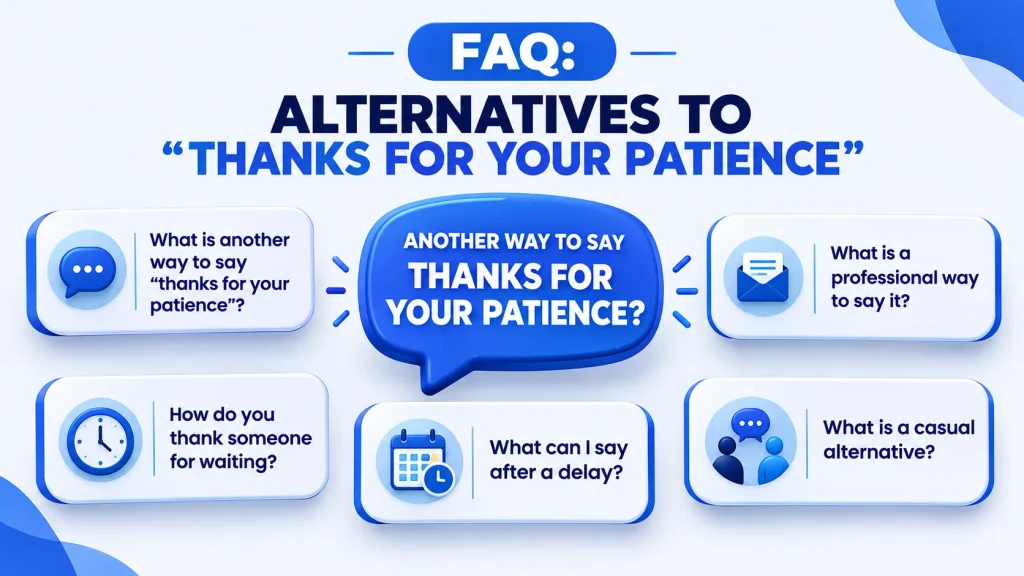
Common alternatives include “I appreciate your patience,” “thank you for waiting,” “I appreciate your understanding,” “thank you for bearing with me,” and “I’m grateful for your patience.” The best option depends on whether you are thanking someone for waiting, accepting a delay, adapting to a change, or cooperating with a process.
For professional communication, “I appreciate your patience” is a clear and polished choice. You can also use “thank you for your understanding” or “thank you for your time and patience.” These expressions work well in business emails, customer service responses, workplace updates, and messages about delays.
Start with a direct expression such as “I appreciate your patience” or “Thank you for your understanding.” Then, if useful, briefly explain the delay or provide an update. Keeping the message specific helps your appreciation sound genuine instead of like a routine closing phrase.
You can say “Thank you for waiting,” “I appreciate you waiting,” or “I appreciate your patience.” All three acknowledge the person’s time without sounding overly formal. For a customer or professional contact, “I appreciate your patience” usually provides a more polished tone.
These phrases communicate essentially the same idea, but their tone can differ slightly. “I appreciate your patience” often sounds more polished and professional, while “thanks for your patience” feels shorter and more conversational. Choose based on the audience, relationship, and overall tone of your message.
After a delay, you can say “thank you for waiting,” “I appreciate your understanding,” “I’m grateful for your patience,” or “thank you for your time and patience.” If you caused the delay, adding a brief acknowledgment of the inconvenience can make the message clearer and more considerate.
For casual communication, try “Thanks for waiting,” “I appreciate you waiting,” or “Thanks for bearing with me.” These options sound natural in texts, chats, friendly conversations, and informal workplace messages. Choose the one that best reflects how directly you want to address the delay.
“Patience” focuses on someone’s willingness to wait or tolerate a delay. “Understanding” focuses more on accepting the reason behind a situation, decision, or inconvenience. For example, thank someone for their patience when they waited for a response, but thank them for their understanding when you explain why something changed.
There are several natural ways to say “thanks for your patience,” and the best choice depends on what you want to acknowledge. “I appreciate your patience” is a reliable option for professional emails and customer communication. “Thank you for waiting” works well when someone has experienced a specific delay, while “I appreciate your understanding” is useful when circumstances require acceptance or flexibility.
For warmer communication, “thank you for bearing with me” or “I’m grateful for your patience” can feel more personal. If someone has adapted to a schedule or process change, “thank you for your flexibility” may be more precise. The key is to match your wording to the situation, audience, and tone. A specific, sincere thank-you will always sound more natural than a phrase chosen simply out of habit.

Senior English Editor & Stylistics Director
Michael Bennett is a veteran editor, lexicographer, and publishing consultant with more than two decades of experience in academic and educational publishing. Formerly a senior editorial director at major university presses, he specializes in structural editing, register refinement, and vocabulary development. Michael oversees tone, precision, and stylistic consistency across all publication channels, ensuring content meets rigorous editorial and pedagogical standards.













