
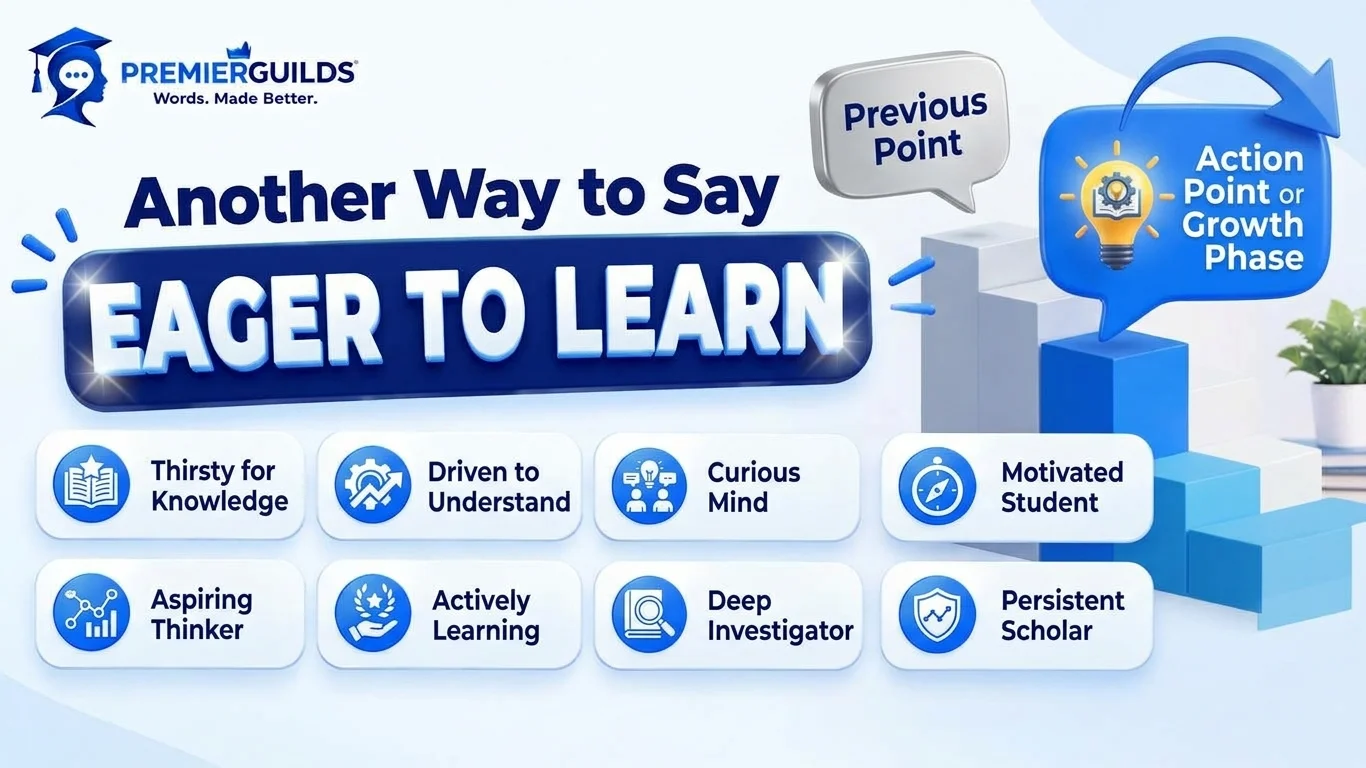
Looking for another way to say eager to learn? Try phrases such as willing to learn, enthusiastic about learning, keen to learn, open to learning, or ready to grow. The best choice depends on whether you are writing a resume, preparing for an interview, communicating at work, or describing someone’s attitude toward personal growth.
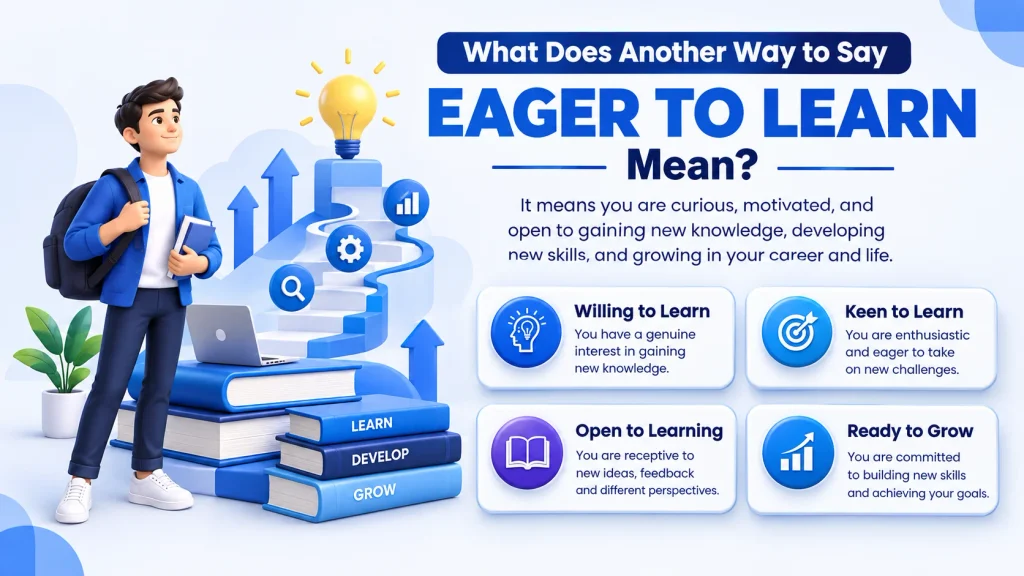
The phrase “another way to say eager to learn” means looking for different expressions that communicate someone’s enthusiasm, willingness, or readiness to gain new knowledge and skills.
“Eager to learn” is commonly used when describing students, job candidates, employees, or people starting a new role. It often appears in resumes, cover letters, interviews, professional profiles, and workplace conversations.
For example, a candidate might say, “I am eager to learn new software and contribute to the team.” The statement shows motivation and a positive attitude toward professional development.
However, using the same phrase repeatedly can make your writing sound generic. Choosing a more specific alternative can help you communicate curiosity, adaptability, motivation, or a desire for growth.
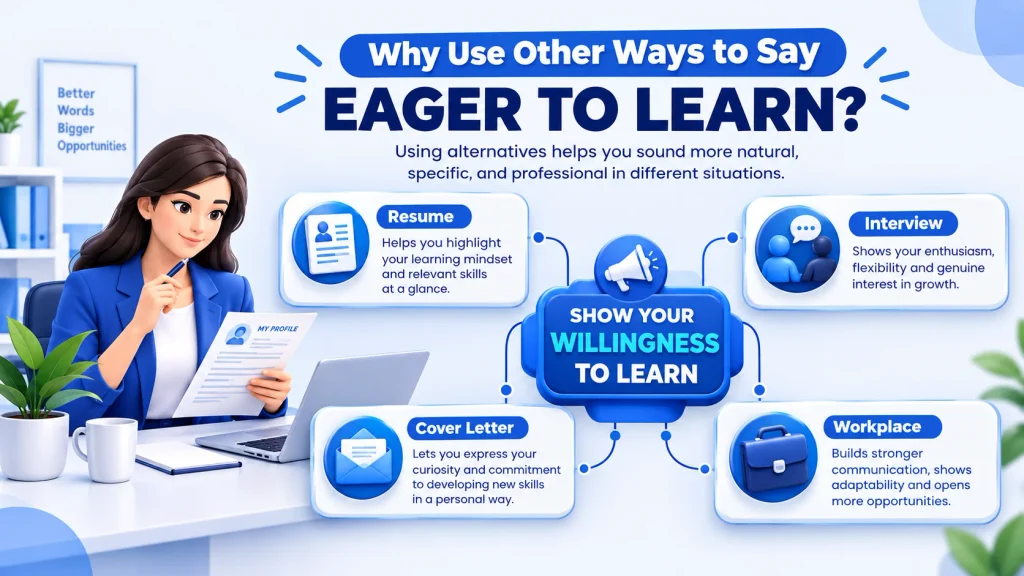
Although “eager to learn” is positive and professional, alternatives can make your communication more natural and specific.
You might choose another expression to:
The strongest alternative is usually the one that explains how you approach learning, rather than simply stating that you want to learn.
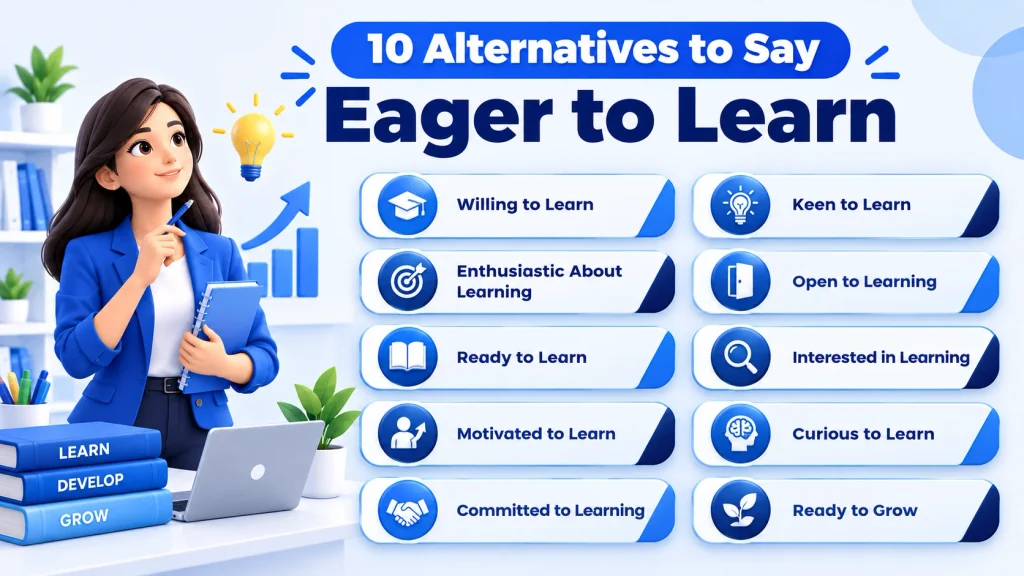
“Willing to learn” communicates that someone is ready to gain new knowledge or skills. It has a practical and professional tone without sounding overly enthusiastic.
It is especially useful when describing an employee or candidate who is prepared to accept training and develop new abilities.
I am willing to learn new systems and adapt to the team’s workflow.
She is willing to learn from experienced colleagues and take on new responsibilities.
Use this phrase when you want to emphasize a positive attitude toward training and development.
“Keen to learn” expresses strong interest in gaining knowledge or developing skills. It sounds polished and confident while remaining natural in professional communication.
The phrase can work well when you want to communicate enthusiasm without sounding overly excited.
I am keen to learn more about data analysis and apply those skills to future projects.
Our new team member is keen to learn and quickly understand the company’s processes.
Use “keen to learn” when you want a concise alternative that sounds motivated and professional.
“Enthusiastic about learning” directly highlights excitement and positive energy toward gaining knowledge. It is stronger than simply saying someone is willing to learn.
This phrase works particularly well when discussing professional development, education, or a new area of expertise.
I am enthusiastic about learning new techniques that can improve my design work.
He is enthusiastic about learning from the senior members of the department.
Choose this expression when genuine excitement about learning is important to your message.
“Open to learning” emphasizes receptiveness to new information, ideas, feedback, and experiences. It suggests that a person is flexible and willing to consider different approaches.
It is especially useful when discussing teamwork, career development, or adapting to change.
I am open to learning new approaches that could improve our customer service process.
A strong team member should remain open to learning from feedback.
Use this phrase when you want to highlight adaptability rather than excitement alone.
“Ready to learn” suggests that someone is prepared to begin learning or take advantage of a new opportunity. It is simple, direct, and easy to understand.
The expression works well when someone is starting a job, course, project, or unfamiliar task.
I am ready to learn the tools required for this position.
The interns arrived ready to learn and contribute to the project.
Use “ready to learn” when you want your statement to sound confident and action-oriented.
“Interested in learning” communicates curiosity about gaining knowledge or developing a particular skill. It is slightly less intense than “eager to learn,” making it useful when you want a measured tone.
The phrase is particularly suitable when discussing a specific subject or area of development.
I am interested in learning more about user experience research.
She is interested in learning how the sales team manages client relationships.
Use this phrase when you want to sound curious without making your enthusiasm seem excessive.
“Motivated to learn” emphasizes internal drive. It suggests that a person has a clear reason or determination to develop new knowledge and skills.
This phrase can be especially effective in professional settings because it connects learning with personal initiative.
I am motivated to learn new skills that will help me take on greater responsibility.
The candidate appears highly motivated to learn and improve throughout the training program.
Use this alternative when you want to emphasize initiative and determination rather than simple curiosity.
“Curious to learn” highlights a desire to discover, understand, and explore something new. It gives your writing a more personal and intellectually engaged tone.
It is a good choice when learning involves asking questions, exploring ideas, or understanding how something works.
I am curious to learn how the new platform will affect our workflow.
She is naturally curious to learn more about emerging technologies.
Use “curious to learn” when you want to emphasize interest and exploration.
“Committed to learning” communicates a long-term dedication to personal or professional development. It suggests consistency rather than temporary enthusiasm.
This phrase is particularly strong when discussing career growth, continuing education, or ongoing skill development.
I am committed to learning and improving my leadership skills throughout my career.
Our company values employees who are committed to learning and continuous improvement.
Use this phrase when you want to show that your interest in learning is ongoing and serious.
“Ready to grow” expresses a willingness to develop personally or professionally. It can include learning new skills, accepting feedback, taking on responsibilities, and improving performance.
The phrase sounds positive and modern without focusing only on academic learning.
I am ready to grow within the company and take on new challenges.
She joined the team ready to grow, contribute, and learn from others.
Use “ready to grow” when you want to connect learning with broader career or personal development.
| Alternative | Best Used In | Tone |
|---|---|---|
| Willing to Learn | Resumes, applications, workplace communication | Professional, Practical |
| Keen to Learn | Resumes, interviews, emails | Polished, Professional |
| Enthusiastic About Learning | Interviews, profiles, professional conversations | Positive, Warm |
| Open to Learning | Workplace communication, interviews | Flexible, Professional |
| Ready to Learn | New roles, training, conversations | Direct, Confident |
| Interested in Learning | Education, workplace, conversations | Curious, Natural |
| Motivated to Learn | Resumes, interviews, performance reviews | Driven, Professional |
| Curious to Learn | Conversations, profiles, interviews | Curious, Engaged |
| Committed to Learning | Resumes, career discussions, professional profiles | Dedicated, Formal |
| Ready to Grow | Interviews, resumes, workplace communication | Positive, Growth-focused |
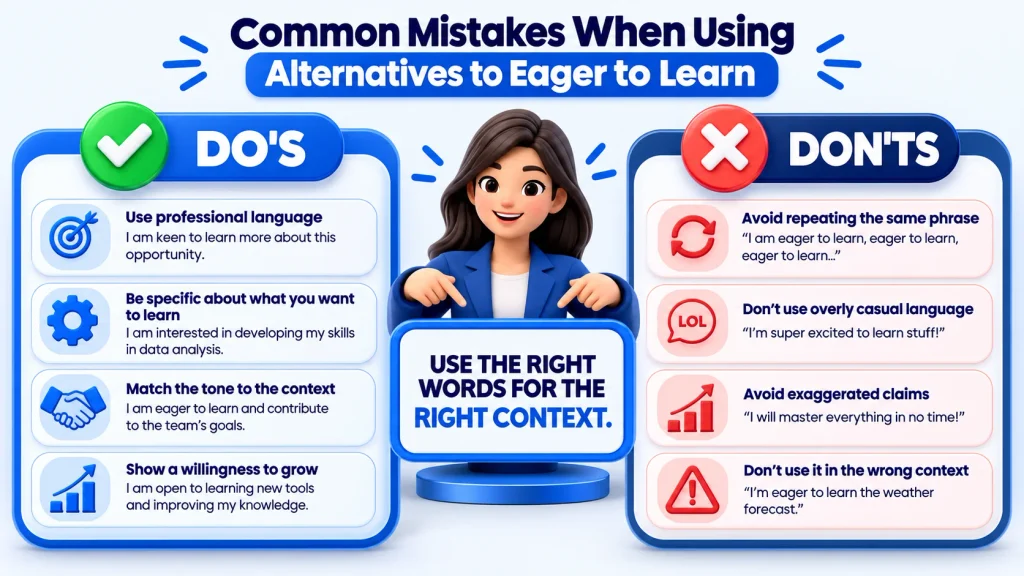
Simply saying “I am eager to learn” does not tell the reader what you want to learn. Whenever possible, mention a specific skill, subject, tool, or responsibility.
Recruiters see many similar phrases in applications. Repeating “eager to learn” can make your resume sound generic. Use a more specific statement that connects learning to the position.
Expressions such as “I’m excited to learn everything” may sound natural in conversation but can feel unprofessional in a formal application. Match your wording to the audience.
Being willing to learn does not mean you already have the skill. Avoid wording that makes your current experience sound greater than it is.
Strong words such as “extremely passionate” or “incredibly excited” can sound exaggerated if the rest of the message does not support them. Keep your language confident, specific, and believable.

Professional alternatives include “motivated to learn,” “committed to learning,” “keen to learn,” and “open to learning.” Each has a slightly different emphasis. “Motivated to learn” highlights initiative, while “committed to learning” suggests long-term development. For a resume or interview, choose the phrase that best connects your willingness to learn with the role.
For a resume, consider phrases such as “motivated to learn,” “committed to learning,” “keen to learn,” or “open to learning.” Even better, connect the phrase to a specific skill or responsibility. For example, explaining that you are motivated to learn a company’s software is more informative than simply saying you are eager to learn.
The two phrases are similar, but their strength differs. “Willing to learn” mainly communicates readiness and openness, while “eager to learn” suggests stronger enthusiasm. If you want to sound practical and professional, “willing to learn” works well. If you want to emphasize excitement or strong interest, “eager to learn” is more expressive.
In a cover letter, use a specific statement such as “I am motivated to learn new tools and contribute to your team.” This approach is stronger than simply saying you are eager to learn because it connects your willingness to develop with the position. Whenever possible, mention the skills or responsibilities you hope to take on.
There is no single best replacement because the ideal phrase depends on context. “Motivated to learn” is strong for professional applications, “open to learning” highlights flexibility, and “committed to learning” emphasizes long-term development. For everyday communication, “ready to learn” is simple and natural.
You can describe such a person as curious, enthusiastic about learning, committed to learning, or naturally curious. If you are writing professionally, “committed to continuous learning” can communicate a strong interest in ongoing development. For a casual conversation, “naturally curious” sounds more personal and relaxed.
A confident approach is to connect your interest in learning with action. Instead of simply saying “I am eager to learn,” you might say that you are “motivated to develop new skills” or “ready to take on new responsibilities.” This shows both enthusiasm and a willingness to put that enthusiasm into practice.
Yes. “Open to learning” is a useful professional expression because it communicates flexibility, receptiveness to feedback, and willingness to develop new skills. It works well in interviews, performance discussions, workplace profiles, and applications. If you want to emphasize stronger motivation, “motivated to learn” may be a better choice.
There are many effective ways to say “eager to learn,” and the best option depends on the message you want to send. “Willing to learn” is practical and straightforward, while “keen to learn” sounds polished and professional. “Motivated to learn” highlights initiative, and “committed to learning” communicates long-term dedication to development.
For resumes and cover letters, avoid relying on generic enthusiasm alone. Instead, connect your willingness to learn with a specific skill, responsibility, or career goal. In conversations, phrases such as “ready to learn” or “interested in learning” may sound more natural.
The strongest wording shows both interest and action. Choose an alternative that reflects your actual attitude and fits the situation, and your communication will sound more genuine, confident, and professional.

Our editorial team brings together decades of expertise in applied linguistics, lexicography, and educational publishing. Dedicated to clarity, precision, and tone, our experts ensure that every resource meets the highest standards of professional and academic excellence.













