

If you’re looking for another way to say first of all, you can use phrases such as to begin with, first and foremost, initially, to start with, or above all. The right alternative depends on whether you’re introducing a point, organizing ideas, emphasizing importance, or writing in a professional or academic setting.
“First of all” is used to introduce the first point in a list, explanation, argument, or series of actions. It signals to the reader or listener that the information that follows is the starting point.
For example, someone might say, “First of all, we need to review the budget.” The phrase helps organize the conversation and tells the audience what should be considered first.
You will often see “first of all” in essays, presentations, workplace discussions, emails, speeches, instructions, and everyday conversations. While it is natural and correct, using alternatives can make your writing more varied and precise.
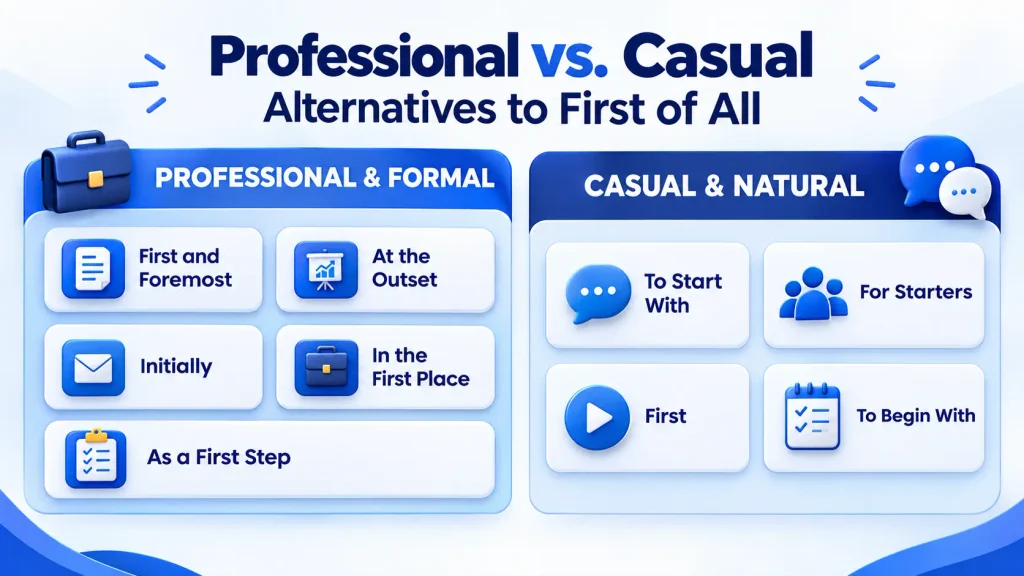
Replacing “first of all” can help you choose wording that better matches your purpose and audience.
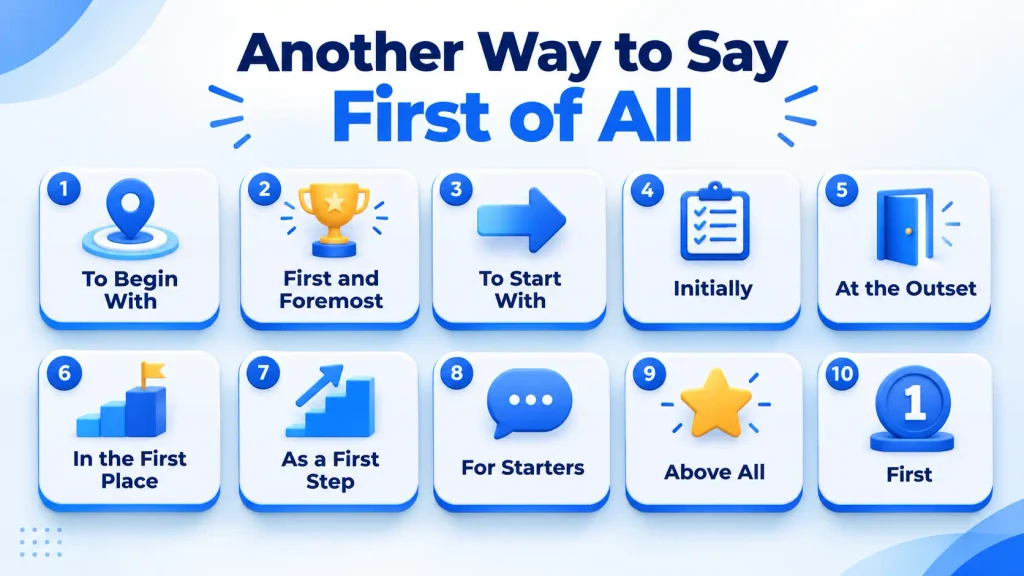
“To begin with” introduces the first point in a discussion or explanation. It is one of the most natural replacements for “first of all” because it clearly signals where the discussion starts.
To begin with, let’s review the goals we agreed on last week.
To begin with, the proposal needs a clearer explanation of the project timeline.
Use “to begin with” when you are introducing the first of several related points.
“First and foremost” means that something is the most important consideration or priority. Unlike “first of all,” it can emphasize importance rather than simply indicate order.
First and foremost, customer safety must remain our highest priority.
First and foremost, I want to thank everyone who contributed to the project.
Choose this phrase when you want to communicate importance, not just sequence.
“To start with” introduces the first idea, task, or reason in a natural and conversational way. It is especially common in spoken American English and informal professional communication.
To start with, let’s look at the main concerns raised by the team.
To start with, you’ll need to create an account before submitting your application.
Use this phrase when you want a simple, conversational alternative that does not sound overly formal.
“Initially” refers to something that happened at the beginning of a process, period, or situation. It is different from “first of all” because it often describes timing rather than introducing a list of ideas.
Initially, the team expected the project to take six weeks.
Initially, we planned to launch the service in three cities.
Use “initially” when discussing what happened at the beginning, especially when circumstances later changed.
“At the outset” means at the very beginning of an activity, project, or situation. It has a more formal tone and works particularly well in reports and professional writing.
At the outset, the project team established clear communication guidelines.
At the outset of the partnership, both companies agreed on shared goals.
Use this phrase for formal descriptions of how a project, relationship, or process began.
“In the first place” can introduce an initial reason or explain why something was considered or done originally. It can also emphasize the original basis for a decision.
We need to understand why the issue occurred in the first place.
The policy was created in the first place to protect customer information.
“In the first place” does not always mean “first” in a list, so use it when referring to an original reason or circumstance.
“As a first step” clearly identifies the first action in a process. It is useful when giving instructions, explaining procedures, or describing a plan.
As a first step, please gather the documents listed in the application guide.
As a first step, the manager reviewed the team’s current workflow.
Use this alternative when your sentence introduces an action rather than a general idea.
“For starters” introduces an initial point, example, or reason. It is more conversational than “first of all” and often appears when someone wants to begin explaining a situation.
For starters, the new schedule gives everyone more flexibility.
For starters, let’s make sure everyone has access to the shared document.
This phrase is best for conversational writing, informal emails, discussions, and everyday speech.
“Above all” means more importantly than anything else. It does not simply identify the first item in a sequence; instead, it highlights the most important principle, goal, or consideration.
Above all, we want every customer to feel respected and supported.
Above all, remember that clear communication can prevent unnecessary confusion.
Use “above all” when you want to emphasize priority or importance, not chronological order.
“First” is a short and direct alternative to “first of all.” It works well when organizing instructions, arguments, lists, or presentations and avoids unnecessary wording.
First, review the instructions before completing the form.
First, let’s discuss the main issue before considering other options.
When your writing already has a clear sequence, simply using “first” can make the sentence more concise.
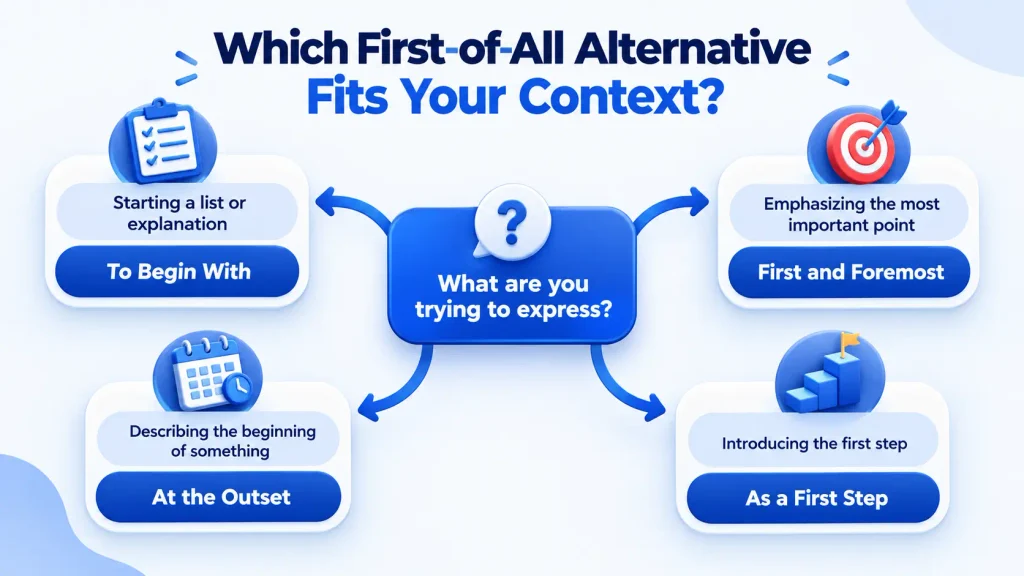
| Alternative | Best Used In | Tone |
| To Begin With | Essays, emails, discussions | Neutral |
| First and Foremost | Priorities, speeches, professional writing | Emphatic |
| To Start With | Conversations, emails, explanations | Conversational |
| Initially | Reports, timelines, formal writing | Formal |
| At the Outset | Business reports, projects | Formal |
| In the First Place | Reasons, explanations | Neutral |
| As a First Step | Instructions, procedures | Professional |
| For Starters | Conversations, casual writing | Casual |
| Above All | Priorities, advice, statements | Emphatic |
| First | Lists, instructions, presentations | Direct |
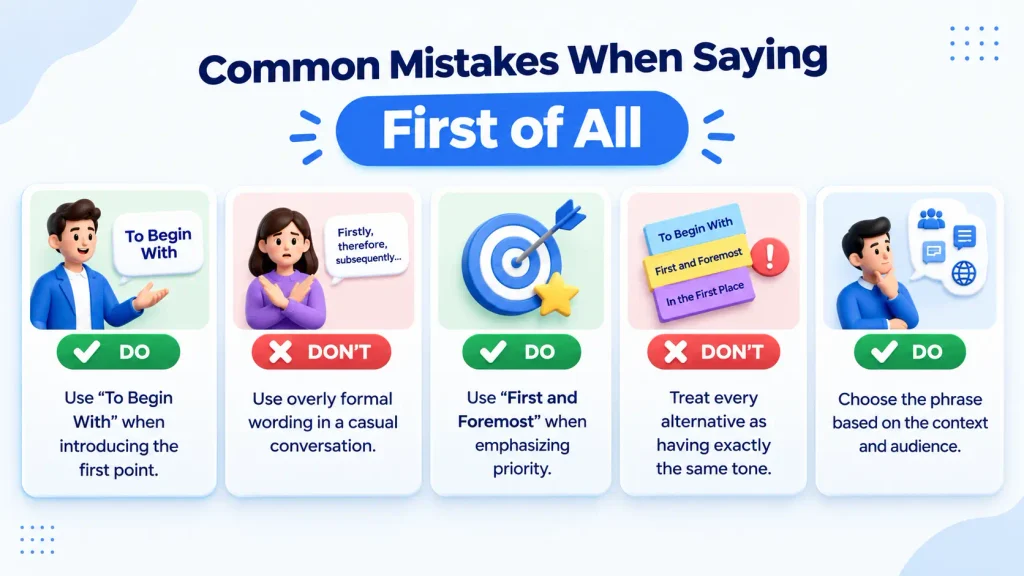
“First and foremost” emphasizes importance. If you are simply introducing the first item in a list, “to begin with” or “first” may communicate your meaning more accurately.
“Initially” focuses on the beginning of a situation or process. It is not always appropriate when you are simply introducing the first point in an argument.
Expressions such as “for starters” can sound relaxed. They may work well in a blog or conversation but may not fit a formal academic report.
Before choosing an alternative, ask whether you mean first in order, most important, or first in time. These meanings require different expressions.
Using “first of all,” “to begin with,” and “first” repeatedly in the same paragraph can make your writing feel mechanical. Use transitions only when they genuinely help readers follow your ideas.
Professional alternatives include to begin with, first and foremost, initially, at the outset, and as a first step. The best choice depends on your intended meaning. “To begin with” introduces a first point, while “first and foremost” highlights importance. “At the outset” works particularly well in formal business or project-related writing.
For an essay, you can use to begin with, first, initially, or first and foremost, depending on your meaning. “To begin with” works well when introducing your first argument. If you are emphasizing the most important point, “first and foremost” may be more precise.
“First of all” is a neutral expression that works in both everyday and professional communication. However, academic or formal writing may sometimes benefit from a more precise transition, such as “to begin with,” “initially,” or “at the outset,” depending on the sentence.
More formal alternatives include at the outset, initially, and first and foremost. However, each has a slightly different meaning. “At the outset” refers to the beginning of something, “initially” focuses on an early stage, and “first and foremost” emphasizes priority.
Yes. “To begin with” is one of the closest natural alternatives to “first of all.” Both can introduce the first point in a discussion or explanation. However, “to begin with” can sound slightly smoother in some written contexts, particularly when transitioning into an explanation.
“First of all” usually introduces the first point in a sequence, while “first and foremost” emphasizes the highest priority or greatest importance. For example, “First, we need to review the report” describes order, whereas “First and foremost, safety matters” highlights importance.
Casual alternatives include to start with and for starters. Both are common in everyday American English. “To start with” can introduce the first point or action, while “for starters” often introduces an initial reason, example, or observation in a conversational way.
Not exactly. “First of all” usually indicates the first item in a sequence, while “above all” means more important than anything else. Because their meanings differ, “above all” should be used when you want to emphasize priority rather than simply introduce your first point.
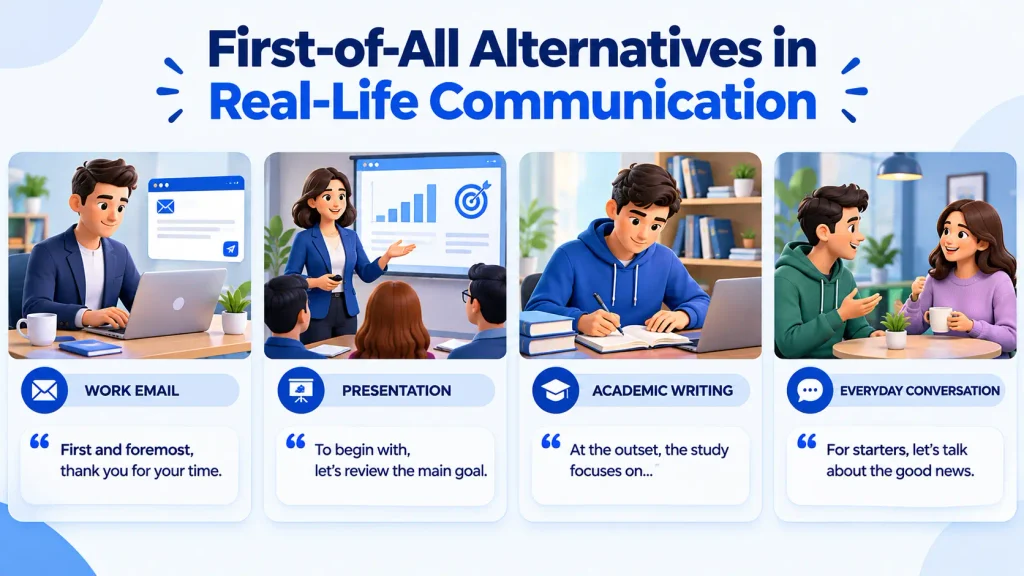
“First of all” is a useful transition for introducing the first point, action, or idea, but you do not always need to repeat it. Alternatives such as to begin with, to start with, and first work well when you are organizing information.
When you want to emphasize importance, first and foremost or above all may be more appropriate. For formal descriptions of a beginning, initially and at the outset provide a more precise option. Meanwhile, for starters is better suited to casual conversations.
The key is to choose an expression based on meaning, not just vocabulary variety. If you mean “the first point,” choose a sequencing phrase; if you mean “the most important point,” choose an emphasis phrase. That small distinction can make your writing clearer and more natural.

English Language & Communication Specialist
Dr. Emily Carter is an English language and communication specialist focused on vocabulary, word choice, professional writing, and practical English usage. She helps readers understand the differences between similar words and choose expressions that sound natural, clear, and appropriate for different contexts.













