
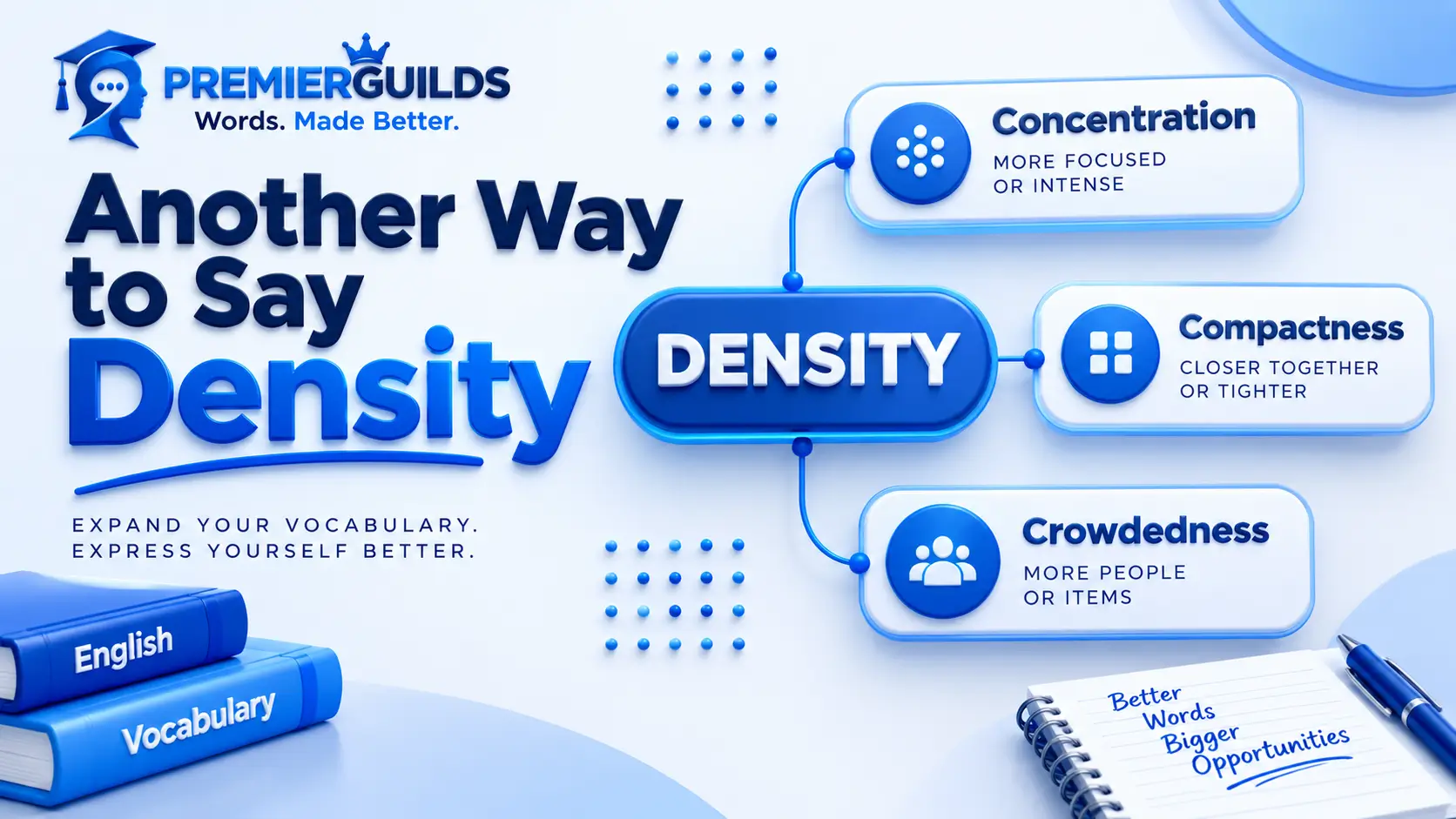
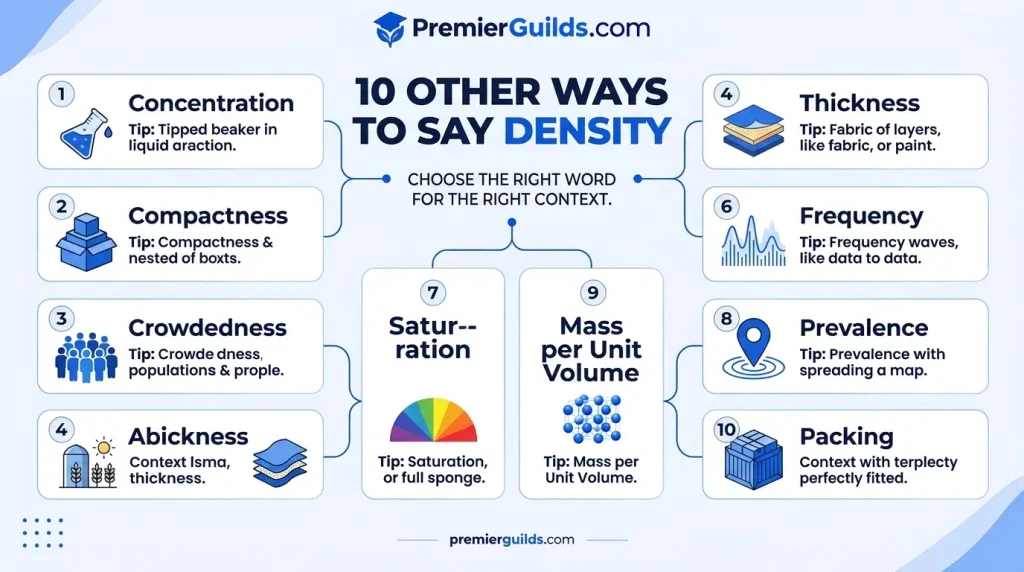
If you need another way to say density, the best choice depends on context. Useful alternatives include concentration, compactness, thickness, crowdedness, abundance, frequency, saturation, prevalence, mass per unit volume, and packing. For scientific writing, “mass per unit volume” is the most precise alternative, while “concentration” works well for people, data, or substances.
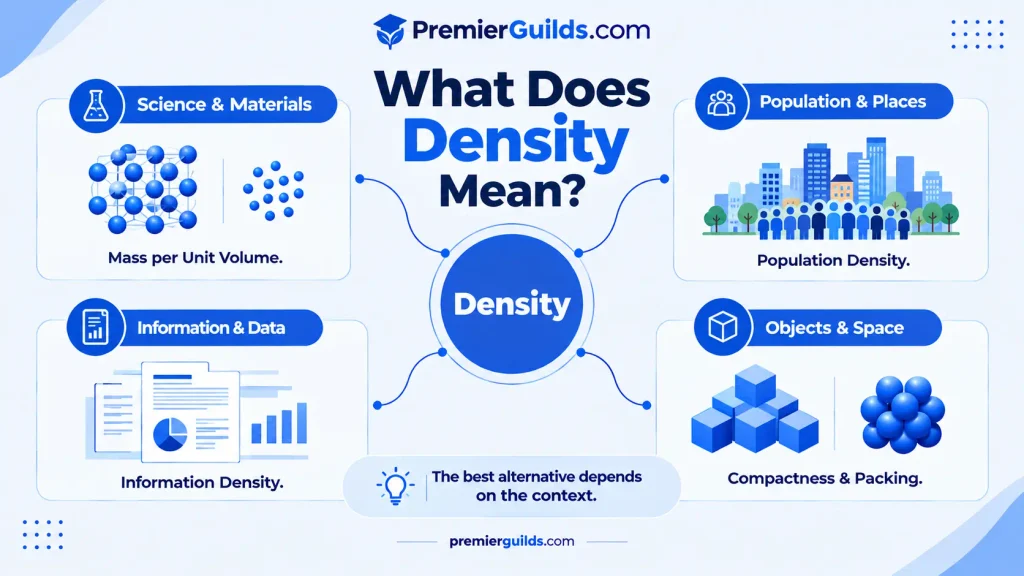
The word density has several meanings, so the best alternative depends on what you are describing. You might use it to discuss the amount of matter in a specific volume, the number of people in an area, the concentration of information, or how closely objects are arranged.
Finding another way to say density can make your writing more precise and prevent repetition. The right replacement can also make technical ideas easier for general readers to understand.
“Another way to say density” means looking for a different word or phrase that expresses the same or a closely related idea as density.
In science, density usually refers to the amount of mass contained in a given volume. In everyday or descriptive writing, however, it can refer to how crowded, concentrated, thick, or closely packed something is.
For example, you might describe a city as having a high population density, while a technical report might discuss the mass per unit volume of a material. Because the meaning changes with context, there is no single replacement that works everywhere.
Using alternatives to density can make your writing clearer and more natural. It also helps you choose language that fits your audience.
Concentration describes how much of something exists within a particular space, area, or amount. It is especially useful when discussing substances, information, populations, or activity rather than physical mass alone.
The high concentration of businesses makes downtown a popular commercial district.
The solution contains a high concentration of salt.
Use concentration when the focus is on the amount of something within a defined space or mixture.
Compactness describes how closely something is arranged or how little space it occupies. It works especially well when discussing objects, structures, designs, or physical arrangements.
The compactness of the equipment makes it ideal for a small laboratory.
Engineers improved the compactness of the device without reducing its performance.
Choose compactness when you want to emphasize how closely or efficiently something is arranged.
Crowdedness refers to the condition of having many people or things in a limited space. Unlike the more technical word “density,” it sounds natural in everyday conversation.
The crowdedness of the subway made the morning commute uncomfortable.
We avoided the beach because of its extreme crowdedness during the holiday weekend.
Use crowdedness mainly for places or situations where too many people or objects are packed together.
Thickness describes the distance between two opposite surfaces or how thick a material is. It can sometimes replace “density” when someone is describing a material’s substantial or closely formed appearance.
The thickness of the insulation helps keep the building warm.
We measured the thickness of each sheet before installing the panels.
Do not use thickness as a direct scientific synonym for density. Use it only when the context is specifically about how thick something is.
Abundance means having a large amount of something. It can work as an alternative when density refers to the large presence or quantity of something in a particular environment.
The forest is known for its abundance of native plant species.
An abundance of fresh food is available at the local market.
Use abundance when the main idea is “a lot of something,” rather than how tightly it occupies a specific space.
Frequency refers to how often something occurs within a particular period or area. It can be useful when “density” refers to how frequently events, signals, or occurrences appear.
Researchers recorded the frequency of traffic accidents along the highway.
The report examines the frequency of service interruptions throughout the year.
Use frequency when the important factor is how often something happens, not how much physical space it occupies.
Saturation describes a condition in which something is filled, absorbed, or present to a very high degree. It can replace density in contexts involving markets, colors, solutions, or systems that have reached a high level.
The market is approaching saturation after years of rapid growth.
The photographer reduced color saturation to create a softer appearance.
Use saturation when something has reached or is approaching a maximum or very high level.
Prevalence describes how common or widespread something is within a particular population or setting. It is especially useful in research, healthcare, social science, and statistics.
The study measured the prevalence of the condition among adults.
Researchers found a high prevalence of remote work in the region.
Choose prevalence when density refers to how common something is rather than how tightly it is physically arranged.
Mass per unit volume is the most precise plain-language description of scientific density. It explains exactly what density measures: how much mass is contained within a specific amount of space.
Scientists calculated the material’s mass per unit volume before comparing the samples.
The experiment showed that the metal had a greater mass per unit volume than the plastic.
Use this phrase when accuracy matters, especially in science or educational writing.
Packing describes how closely objects or particles are arranged within a particular space. It is useful when discussing storage, materials, particles, or physical arrangements.
Efficient packing allows more products to fit inside the shipping container.
The crystal structure depends partly on the packing of its particles.
Use packing when you want to emphasize the arrangement of individual objects or particles within a space.
| Alternative | Best Used In | Tone |
| Concentration | Science, business, general writing | Professional |
| Compactness | Design, engineering, technical writing | Formal |
| Crowdedness | Places and everyday situations | Casual |
| Thickness | Materials and physical objects | Neutral |
| Abundance | Nature, resources, general descriptions | Formal |
| Frequency | Statistics, events, research | Academic |
| Saturation | Markets, colors, systems | Technical |
| Prevalence | Research, health, statistics | Formal |
| Mass per unit volume | Physics, chemistry, education | Scientific |
| Packing | Materials, storage, structures | Technical |
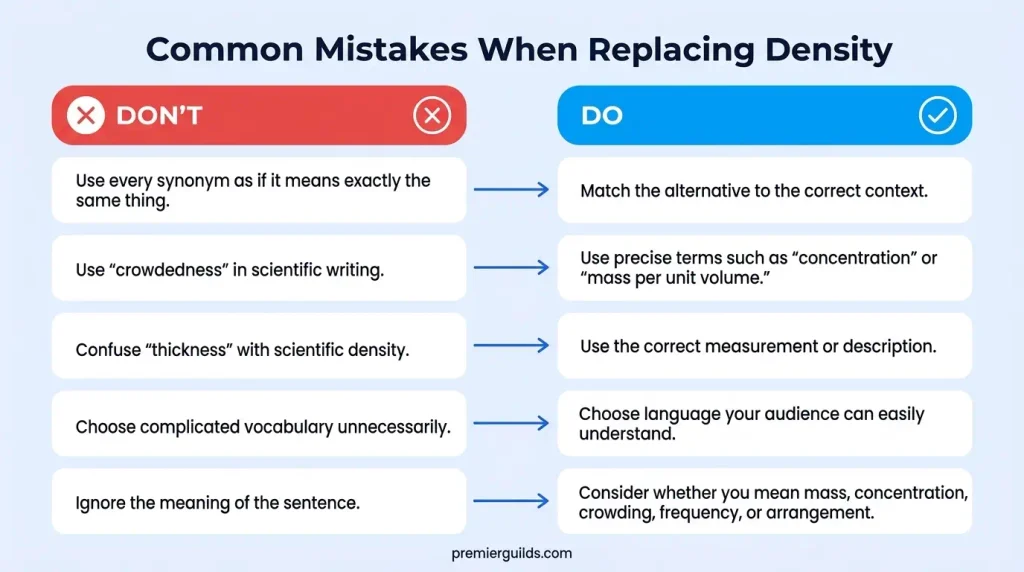
Words such as density, thickness, and concentration have different meanings. Replacing one with another without checking the context can change the meaning of a sentence.
“Crowdedness” sounds conversational and usually describes people or busy spaces. A scientific paper will normally need a more precise term such as concentration or mass per unit volume.
Thickness measures the distance between surfaces, while density measures mass relative to volume. They can relate to each other, but they are not the same measurement.
Terms such as prevalence and saturation can sound technical. If your readers simply need to understand that something is common or present in large amounts, a simpler expression may be clearer.
Before choosing an alternative, ask what “density” means in your sentence. Is it about mass, people, information, frequency, or physical arrangement? That answer should guide your word choice.
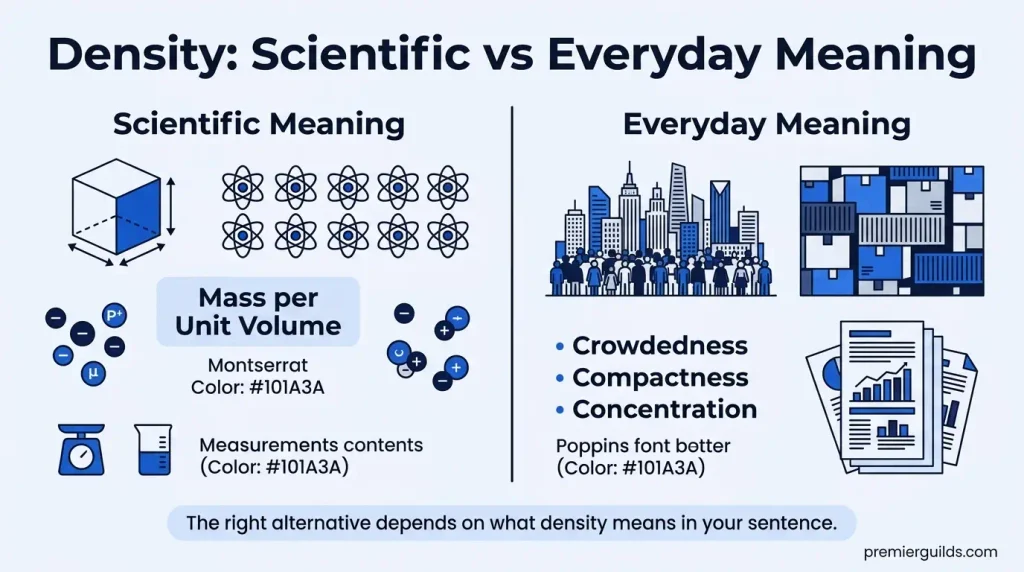
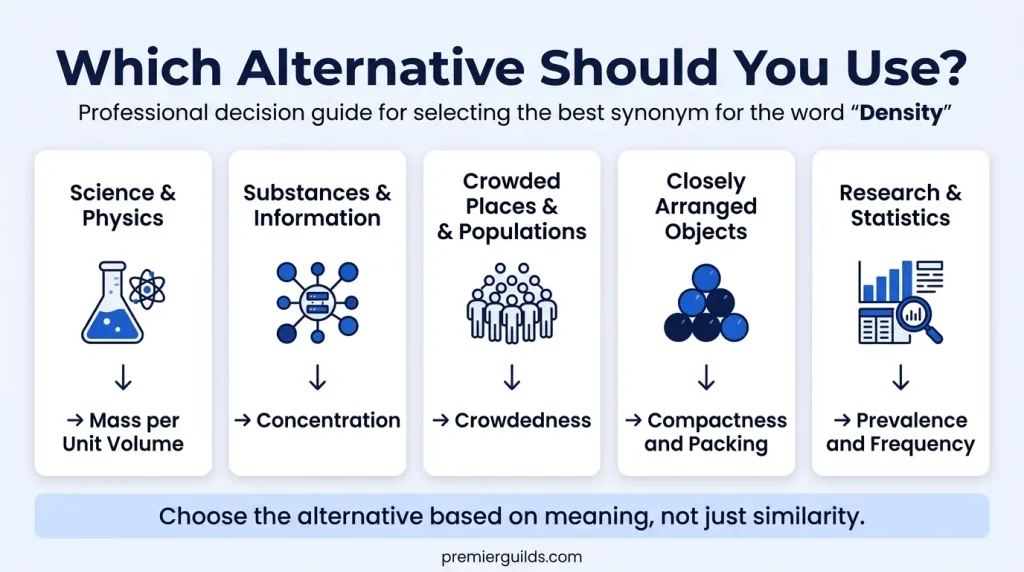
The best synonym depends on context. Concentration is useful for substances, populations, and information, while compactness works for closely arranged objects. For scientific writing, mass per unit volume is the most precise descriptive alternative.
Depending on the context, you can say high concentration, closely packed, heavily populated, crowded, highly concentrated, or greater mass per unit volume. For example, “a high population density” could become “a heavily populated area,” while a scientific context may require more precise terminology.
Useful alternatives include population concentration, population distribution, crowding, and number of people per unit area. The best choice depends on whether you are discussing how many people live in an area, how they are distributed, or how crowded the area feels.
Possible alternatives include compact, crowded, concentrated, closely packed, thick, or highly populated. The correct option depends on what “dense” describes. A dense forest may be described as thick or heavily wooded, while a dense material may require scientific terminology.
The opposite depends on the meaning of density. In a physical context, you might use low density or sparsity. For people or objects in an area, spaciousness, openness, or scattered distribution may communicate the opposite idea more naturally.
Sometimes, but not always. Concentration usually describes the amount of a substance or something present within a particular space or mixture, while physical density specifically relates mass to volume. Always check what measurement or idea your sentence intends to communicate.
No. Thickness describes the distance between two surfaces, while density describes how much mass exists within a given volume. A thick object can have low density, and a thin object can have high density, depending on the material.
In science, density is commonly expressed as mass per unit volume. It is calculated by dividing an object’s mass by its volume. Common units include kilograms per cubic meter and grams per cubic centimeter.
There are many ways to express the idea of density, but the right choice depends on your meaning and audience. Concentration is a versatile option for substances, populations, and information, while compactness and packing are better for closely arranged objects. For busy locations, crowdedness sounds more natural in everyday English.
In scientific writing, avoid replacing density with a loose synonym when precision matters. Mass per unit volume clearly communicates the scientific definition of density. For the scientific definition of density, NIST provides a reliable technical reference.
The key is to match the alternative to your context rather than simply choosing the closest-looking synonym. That small distinction can make your writing clearer, more accurate, and more natural.

English Language & Communication Specialist
Dr. Emily Carter is an English language and communication specialist focused on vocabulary, word choice, professional writing, and practical English usage. She helps readers understand the differences between similar words and choose expressions that sound natural, clear, and appropriate for different contexts.